Wishing you a Blessed Feast tomorrow!
(July 12/June 29)
Previous 2023 Post:
Happy Sts. Peter & Paul Day!
Various beautiful sermons and homilies about The Apostles Peter and Paul! An edifying resource!
Happy Feast Day!
Wishing you a Blessed Feast tomorrow!
(July 12/June 29)
Previous 2023 Post:
Happy Sts. Peter & Paul Day!
Various beautiful sermons and homilies about The Apostles Peter and Paul! An edifying resource!
Happy Feast Day!
Photo by Andriy Tod on Unsplash
Let my prayer be set forth as incense before thee. ~ Psalm 141:2
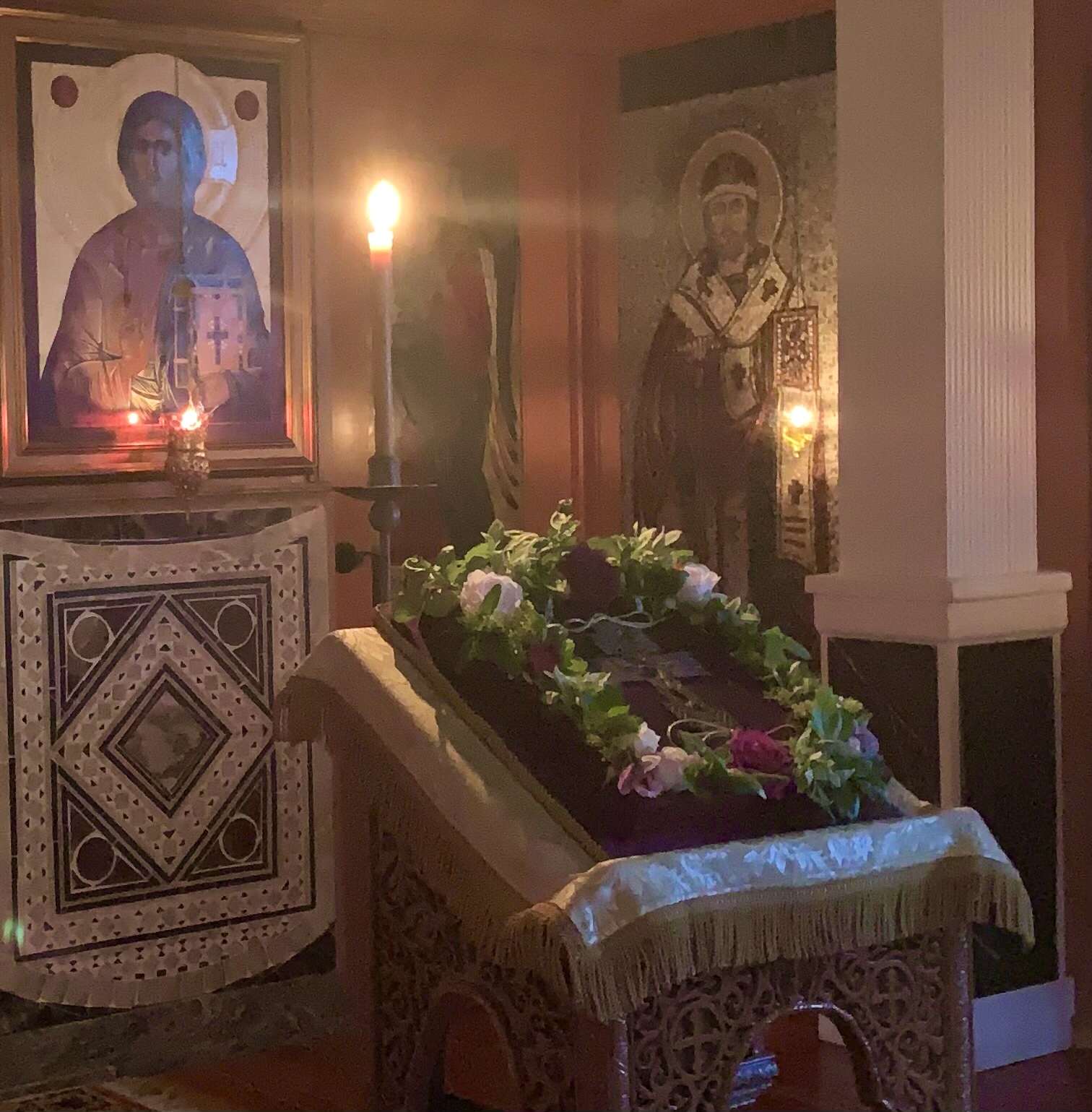
Recently, at an evening service, and through the golden glow of candlelight… smokey tendrils of incense swirled as wreaths of living halos about the holy icons, before wafting upwards as billowing clouds – the noetic breath of our prayers… and the setting sun’s beams pierced through the church windows to ignite the mosaics’ gold tessera like fiery embers. Immersed in all this spiritual beauty, my cup overflowed. It took my breath away.
I’d love to share these beautiful reminders listed from St. Vasilios Greek Orthodox Church – of the rich symbolism and significance of Church incense and the Censer.
What is the Censer?
The censer is a covered dish suspended on four chains. It is used to convey the fragrant smoke of the incense to holy objects. It’s parts represent all of God’s creation.
What does it represent?
May we continually blow breath to spark our own noetic charcoal – keeping it afire with the Love, Zeal, and the Fragrance of Christ.
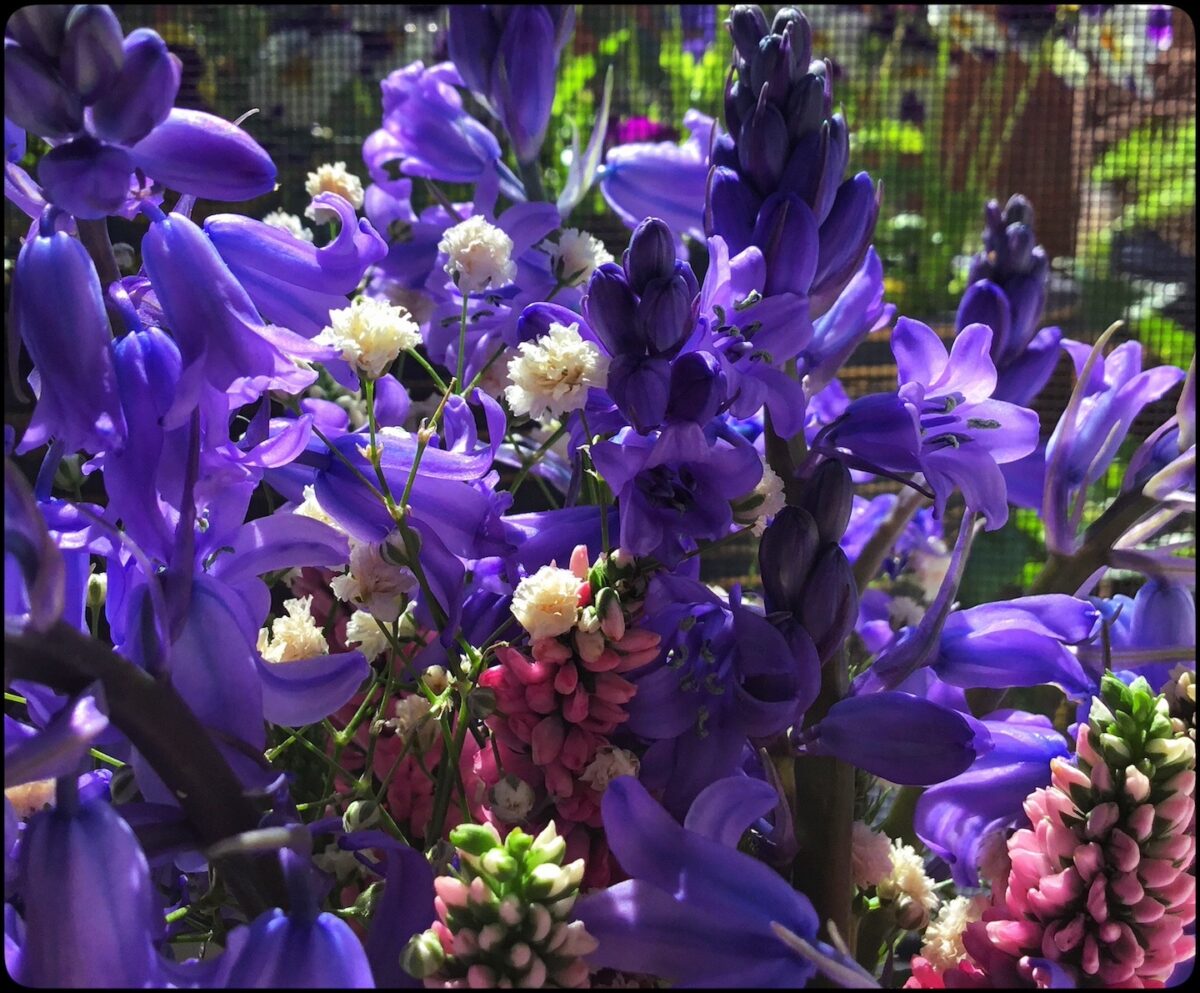
A fistful of garden bluebells and bonnie heather adorn my sunny windowsill.
Orthodoxy is really very simple, although some theologians try to make a complicated system of it. ~ Father George Cheremetieff (Embassy, Emigrants and Englishmen)
If you would be simple-hearted like the Apostles, would not conceal your human shortcomings, would not pretend to be especially pious, if you would walk free from hypocrisy, then that is the path. While it is easy, not everyone can find it or understand it. This path is the shortest way to salvation and attracts the grace of God. Unpretentiousness, guilelessness, frankness of soul – this is what is pleasing to the Lord, Who is lowly of heart. Except ye become like children, ye shall not enter into the Kingdom of God (Mt. 18:13). ~ Elder Leonid of Optina quoted in Living God’s Word by Fr. Silouan Benedict, Bangalore, India
Orthodoxy is life. One must not talk about it; one must live it. ~ Elder Nektary of Optina
Introduction to the Orthodox Church (short, simple, edifying videos) ~ Frederica Mathewes-Green
Image by Bianca from Pixabay
The heart is but a small vessel; and yet dragons and lions are there, and there likewise are poisonous creatures and all treasures of wickedness; rough, uneven paths are there, and gaping chasms. There also is God, there also are the angels, there – life and the Kingdom, there-light and the apostles, the heavenly cities and the treasures of grace: all things are there. ~ St. Macarius the Great
We may ignore, but we can nowhere evade the presence of God. The world is crowded with Him. He walks everywhere Incognito. ~ C.S. Lewis
Christ’s Descent into Hades Icon
This icon is frequently referred to as the Anastasis or Resurrection Icon. It is an icon of Pascha (Easter).
The golden bars by Christ’s feet are the gates of Hades, which He has broken and torn apart. At Pascha, a tradition includes the cracking of our blessed Pascha eggs together. This represents how Christ shattered the gates of Hades.
There are keys floating in the abyss below, which symbolizes that he has entered and conquered both death and Hades. Some icons have a skeletal figure who is chained up: that’s Death. He has been bound and killed by Christ. All throughout Pascha-tide until the Ascension, we greet each other with, “Christ is Risen, Truly He is Risen!”
The two figures whom Christ has grasped and is pulling out of Hades are Adam and Eve, symbolizing that His Victory redeems all mankind, even back to the beginning.
This Resurrection scene is taking place in the past, present, and future.
To His left, we see three Old Testament saints: Kings David and Solomon, two of His ancestors according to his fleshly nature. We also see, closest to him St. John the Baptist, who was his Forerunner in both life and death. On the right, we have the New Testament, including the apostles who are alive. The purpose is to show that Christ’s redemption transcends time and space. This is an act that happened in the past, is happening right now, and will happen in the future. Christ is always in the state of redeeming and setting us free.
The blue shape around Christ is called the Mandorla (which is Italian for almond, which describes its shape). The Mandorla is the Uncreated, Eternal Light of Christ. In the writings of the Eastern Orthodox mystics, God is often prayerfully experienced as Light. This is not simply a beautiful bright light. It is the same Light which filled the apostles with wonder when they witnessed His Transfiguration. It is the Light which Christ Himself described as the power of the Kingdom of God (Mark 9:1, Matt. 16:28, Luke 9:27). It is also the Light that is seen when one purifies their heart and mind (Blessed are the pure in heart, for they shall see God).
Those who seek God will find that the more they know Him, the less they comprehend Him.
To know God, to experience Him, is to walk from the darkness of sin, into His Light, to enter into the mystery of His Presence. ~ The Ark Youth Quarterly – St. Sophia Orthodox Church
May you have a glorious, and joyous, Bright Week!

Image by Dimitris Vetsikas from Pixabay
Truly He is Risen!
Accept the troubles that come to you as good, knowing that nothing happens without God. ~ The Didache (Teachings of the Twelve Apostles)
The Cross is our Hope and Strength. We are in God’s Merciful Hands.
May your day bring Peace and Joy.
Image by Manfred Richter from Pixabay
One should not seek among others the truth that can be easily gotten from the Church. For in her, as in a rich treasury, the apostles have placed all that pertains to truth, so that everyone can drink this beverage of life. She is the door of life. ~ St. Irenaeus of Lyon
For the Lord is good; his mercy is everlasting; and his truth endureth to all generations. ~ Psalm 100:5
And the Word was made flesh, and dwelt among us, (and we beheld his glory, the glory as of the only begotten of the Father,) full of grace and truth. ~ St. John 1:14
God is a Spirit: and they that worship him must worship him in spirit and in truth. ~ St. John 4:24
And ye shall know the truth, and the truth shall make you free. ~ St. John 8:32
For the fruit of the Spirit is in all goodness and righteousness and truth…~ Ephesians 5:9
My little children, let us not love in word, neither in tongue; but in deed and in truth. ~ 1 John 3:18
Christ is Born!
Today we celebrate Righteous Joseph the Betrothed, protector of the Virgin Mary, as well as the Feast of St. Stephen the Archdeacon and Protomartyr.
St. Stephen was one of the seven original deacons of the Church, ordained by the Apostles to care for widows and the poor.
The eastern church observes St. Stephen’s Day on the third day of Nativity, and not on the second day, as western churches do. Since times of antiquity, on this day the Church Collection Boxes, of cash, food and clothing hampers were opened and given to the poor and needy... the Original meaning of Boxing Day!
Of course, it’s spiritually beneficial to distribute alms in the memory of a loved one, not only at Christmas, but on any day of the year. …Ye who now will bless the poor, shall yourselves find blessing! Many have heard about the “Feast of St. Stephen” from “Good King Wenceslas” (Prince of Czechs), a carol set to a 13th century melody. (St. Wenceslas’s grandmother was St. Ludmilla)
An Everyday Carol below – by 9th century St. Joseph the Hymnographer… can be sung to the 13th century melody we know as Good King Wenceslas!
Christian friends, your voices raise, wake the day with gladness.
God Himself to joy and praise, turns our human sadness:
Joy that martyrs won their crown, opened heaven’s portal,
When they laid the mortal down, for the Life Immortal.
Christ is Born! Glorify Him!
Icon of the Holy Trinity – St. Sophia Orthodox Church, Canada
Greetings on Great and Holy Pentecost!
Fifty days after Great and Holy Pascha, we celebrate the wonderful, joyful Great Feast of Pentecost. This important day commemorates the fulfillment of Christ’s promise to his disciples and the descent of the Holy Spirit upon them, and later…. on us. This day is often called the birthday of the Church. The disciples were gathered in prayer at Jerusalem, waiting as Christ had commanded… when a mighty wind was heard, and tongues of fire appeared over their heads. A multilingual crowd heard the disciples preaching about Christ… miraculously speaking to the multitudes in their various native languages.
Preparing for Pentecost, people clean and decorate their homes and icon corners with herbs and green tree branches, that symbolize rebirth of all life through the Holy Spirit.
Today Churches are decorated with flowers, and greenery. Fresh grasses and herbs are strewn on the floors. Everything is vibrant. Small floral bouquets are often held by the faithful at the Liturgy. Sometimes people take the flowers they held at church and afterwards place them in their home’s icon corner, or to the grave of a loved one, or give them to someone who is sick, or elderly.
The Holy Spirit is is the Giver of Life, and clergy wear green vestments in honour of the Holy Spirit. Parishioners also wear green or white in celebration.
It is also said to be traditionally (with a small “t”) windy at Pentecost, to remind us of Holy Spirit.
Today is the first of the Three Days of the Holy Spirit.
May you find and enjoy a delightful, refreshing breeze today!
The Holy Spirit is life and life, the noetic Source of life – the Spirit of wisdom, the Spirit of understanding, good upright, noetic, possessing dominion, cleansing transgressions: God and deifying, Fire and transcending fire, speaking, acting, distributing gifts, by Whom all the prophets and divine apostles and martyrs have been crowned. Strange is the report, strange is the sight – fire distributed in the bestowal of gifts. The Holy Spirit has always been, is now and ever shall be, having neither beginning nor end, but one with the Father and the Son: life and life giving; goodness itself and source of goodness, through Whom the Father is made known and the Son is glorified, and is known by all: one power, one unity, one worship, of the Holy Trinity. ~ Matins at Pentecost Vigil
…The closer we approach God, the closer we approach each other, just as the closer rays of light are to each other, the closer they are to the Sun. In the coming Kingdom of God there will be unity, mutual love and concord. The Holy Trinity remains eternally unchanging, all-perfect, united in essence and indivisible... The One, Indivisible Trinity ever remains the Trinity. The Father always remains the Father, the Son remains the Son, the Holy Spirit remains the Holy Spirit. Besides Their personal Properties, They all share all in common and in Unity. That is why the Holy Trinity is One God. ~ St. John Maximovitch of Shanghai and San Francisco