This Nativity night [Christ] bestowed peace on the whole world; So let no one threaten; This is the night of the Most Gentle One – Let no one be cruel; This is the night of the Humble One – Let no one be proud. Now is the day of joy – Let us not revenge; Now is the day of Good Will – Let us not be mean. In this Day of Peace – Let us not be conquered by anger. Today the Bountiful One impoverished Himself for our sake; So, rich one, invite the poor to your table. Today we receive a Gift for which we did not ask; So let us give alms to those who implore and beg us. This Day opens the heavenly doors to our prayers; Let us open our door to those who ask our forgiveness. Today the Divine One took upon Himself the seal of our humanity, In order for humanity to be adorned by the Seal of Divinity. ~ by St. Isaac the Syrian, 7th century
Parish Youth Choir sang this short Nativity piece (virtually), back in 2020. Their merry voices rang out like silver trumpets, with the lyrics from St. Isaac the Syrian’s poem above, and put to my music.
Below, our Parish Choir (recorded in 2014) sings the ancient Nativity Kontakion (a short hymn of a feast or a saint) composed by 6th century St. Romanos the Melodist:
…Wishing you a blessed Nativity Feast tomorrow, and a joyous Twelve Days of Christmas!
Sharing our parish choir’s women’s (a cappella) recording of this beautiful carol – Star of the East. ⭐️
Parish Recording 2014
Hail the blest morn, see the great Mediator, Down from the regions of glory descend. Shepherds, go worship the Babe in the manger, Lo, for His guard the bright angels attend.
Refrain: Brightest and best, of the stars of the morning, Dawn on our darkness and lend us thine aid. Star in the East, the horizon adorning, Guide where our Infant Redeemer was laid.
Cold on His cradle the dewdrops are shining, Low lies His bed, with the beasts of the stall. Angels adore Him, in slumbers reclining, Wise men and shepherds before Him do fall.
Say, shall we yield Him in costly devotion Odours of Eden and offerings divine, Gems from the mountain and pearls from the ocean, Myrrh from the forest and gold from the mine.
Vainly we offer each ample oblation, Vainly with gold, we His favour secure, Richer by far is the heart’s adoration, Nearer to God are the prayers of the poor.
Text by Reginald Heber (1783-1826) Musical Arrangement by John H. Hickok (1832)
Today we commemorate the 14,000 Infants slain by Herod at Bethlehem, and its surroundings. The relics of these little saints rest in the Grotto of the 4th Century Church of the Nativity, in Bethlehem.
It was shocking to hear and understand the “Christmas” Coventry Carol for first time, when I was but a child.
Why on earth would people want to sing this, when all the other Christmas carols were warm, cozy, pockets of peace and joy? “Why? It’s ugly! Terrible!”
Mom agreed. “It is. But, they’re in heaven now, and we sing to remember this waspart of what happened at Jesus’ birth.”
Even as an older youth it was painful to ponder, and still is… especially hearing the Carol now, with a grandmother’s ear. It’s a lullaby of lament… a dissonant dirge of restrained anguish. How could it not be?
Although there is great beauty in the world, this is also a world with warts and all. Earth isn’t heaven, and that’s why Christ is born… to reunite the created with the Creator.
The Coventry Carol was also my godmother’s favourite Christmas piece. She was an exceptional, amazing woman, Memory Eternal Eve! Through her, I learned to embrace the deep significance and bright sadness of this carol.
Below is a recording from a public Nativity Concert in 2014, at St. Sophia Orthodox Church, Canada.
St. Matthew 2: 16 – 18 Then Herod, when he saw that he was mocked of the wise men, was exceeding wroth, and sent forth, and slew all the children that were in Bethlehem, and in all the coasts thereof, from two years old and under, according to the time which he had diligently inquired of the wise men. Then was fulfilled that which was spoken by Jeremiah the prophet, saying, In Rama was there a voice heard, lamentation, and weeping, and great mourning, Rachel weeping for her children, and would not be comforted, because they are not.
St. Matthew 2: 13-14 …describes how St. Joseph was warned in a dream by an angel to flee Bethlehem and go to Egypt.
I came across this moving YouTube Video Tour: Grotto of the Holy Innocents at the Church of the Nativity in Bethlehem.
The doves in Bethlehem murmured since the serpent destroyed their offspring. The eagle fled to Egypt to go down to receive the promises. ~ St. Ephraim the Syrian
The eastern church observes St. Stephen’s Day on the third day of Nativity, and not on the second day, as western churches do. Since times of antiquity, on this day the Church CollectionBoxes, of cash, food and clothing hampers were opened and given to the poor and needy... the Original meaning of Boxing Day!
Of course, it’s spiritually beneficial to distribute alms in the memory of a loved one, not only at Christmas, but on any day of the year. …Ye who now will bless the poor, shall yourselves find blessing! Many have heard about the “Feast of St. Stephen” from “Good King Wenceslas” (Prince of Czechs), a carolset to a 13th century melody. (St. Wenceslas’s grandmother was St. Ludmilla)
An Everyday Carol below –by 9th centurySt. Joseph the Hymnographer… can be sung to the 13th century melody we know as Good King Wenceslas!
Christian friends, your voices raise,wake the day with gladness.
God Himself to joy and praise, turns our human sadness:
Joy that martyrs won their crown, opened heaven’s portal,
When they laid the mortal down, for the Life Immortal.
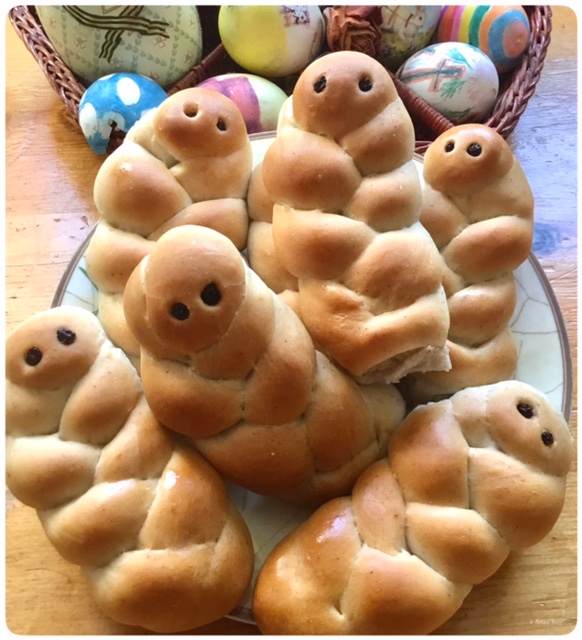
This special Greek bread is traditionally baked to serve on Lazarus Saturday, the day before Palm Sunday… to celebrate the miracle of Jesus raising Lazarus from the dead. Shaped like a man wrapped in a shroud, they are vegan, and contain several sweet spices. Lazarus Saturday ends at sundown, and Palm Sunday marks the beginning of Holy Week.
Lazarus Saturday is a special day in the Orthodox Church, and celebrates the final, great miracle of Jesus Christ before His Resurrection. Today prefigures His own death, and demonstrates His Authority over death. Seeing His friend is already four days dead, Jesus sheds tears and cries out: “Lazarus, come forth!”
In Orthodox countries, on Lazarus Saturday, children go house to house with decorated hand baskets, singing Lazarus Carols, and sharing Lazarakia. Sometimes coins are popped into the children’s baskets by parishioners, as a donation for the church. Some folks slip lenten treats to the children, which they take home and share with their families. It is also customary to collect wildflowers, palms, and branches on this day to adorn homes, as the next day is the feast of Palm Sunday.
There are many ways to make Lazarakia. Although fresh is best, you may certainly bake them ahead of time, and they freeze well.
Here is our own family recipe. It’s a bit different from the recipe on YouTube (seen near bottom of page), but it makes approximately the same quantity of Lazarakia buns as described in the video – depending of course… on the forms’ shapes and sizes. We basically do the same dough preparation as in the video. We make it a 3 braid and use peppercorns for the eyes (which are easier and safer to chew), instead of using whole clove sticks.
Ingredients
1 and 1/2 cups lukewarm water
2 tsp. yeast
4 – 5 cups flour
Zest of half an orange
1/3 cup white sugar
1/4 cup liquid honey
1/4 cup olive oil
1 tsp. salt
1 tsp. cinnamon
1 tsp. nutmeg
1 tsp. ground cloves
1/2 tsp. ground cardamom
1/8 tsp. ground anise (optional)
peppercorns for the eyes
Knead. Let rise as usual.
Round dough into approximately 3.5 ounce balls. Each ball will be enough to form a smaller circle ball for a head and 3 strips to braid. If you’d like to add a thin forehead headband strip, pull an extra minuscule amount from main ball, roll that out thinly too, and place across forehead. Push in the peppercorn eyes.
Bake in 370 degree oven for about 14 – 17 minutes, or until golden brown. (Baking time depends on the size of the Lazarakia.)
For “Bun-Shine” – a glossy vegan finish, use an extra couple of Tbsp. of olive oil for brushing onto the hot, baked, Lazarakia, after they come out of the oven. Extra yummy with a honey or syrup dip when nibbling.
Here is an excellent YouTube video. It’s easy to follow, with well explained how to’s… Step by step instructions show different ways to form the Lazarakia.
Lazarus Saturday will soon be here! I hope you enjoy the sweet venture of making and/or sharing traditional Lazarakia.