Happy Eve of Nativity!

Past Orthodox Christmas Postings Resource ⭐️

On the Night of Nativity ~ 7th Century Homily

This Nativity night [Christ] bestowed peace on the whole world;
So let no one threaten;
This is the night of the Most Gentle One –
Let no one be cruel;
This is the night of the Humble One –
Let no one be proud.
Now is the day of joy –
Let us not revenge;
Now is the day of Good Will –
Let us not be mean.
In this Day of Peace –
Let us not be conquered by anger.
Today the Bountiful One impoverished Himself for our sake;
So, rich one, invite the poor to your table.
Today we receive a Gift for which we did not ask;
So let us give alms to those who implore and beg us.
This Day opens the heavenly doors to our prayers;
Let us open our door to those who ask our forgiveness.
Today the Divine One took upon Himself the seal of our humanity,
In order for humanity to be adorned by the Seal of Divinity.

~ by St. Isaac the Syrian, 7th century

Parish Youth Choir sang this short Nativity piece (virtually), back in 2020. Their merry voices rang out like silver trumpets, with the lyrics from St. Isaac the Syrian’s poem above, and put to my music.

Below, our Parish Choir (2014 recording) sing the ancient Nativity Kontakion composed by 6th century St. Romanos the Melodist:

2014 Parish Recording of Megalynarion, Ode 9, & Nativity Canon

Snowflakes are Dancing Little Pine Tree My Nativity Carol

Wishing you a Blessed Nativity Feast tomorrow, and a Joyous Twelve Days of Christmas… bursting with Light and Love!

Eve of Nativity Greetings

Past Orthodox Christmas Postings Resource ⭐️

On the Night of Nativity ~ 7th Century Homily

This Nativity night [Christ] bestowed peace on the whole world;
So let no one threaten;
This is the night of the Most Gentle One –
Let no one be cruel;
This is the night of the Humble One –
Let no one be proud.
Now is the day of joy –
Let us not revenge;
Now is the day of Good Will –
Let us not be mean.
In this Day of Peace –
Let us not be conquered by anger.
Today the Bountiful One impoverished Himself for our sake;
So, rich one, invite the poor to your table.
Today we receive a Gift for which we did not ask;
So let us give alms to those who implore and beg us.
This Day opens the heavenly doors to our prayers;
Let us open our door to those who ask our forgiveness.
Today the Divine One took upon Himself the seal of our humanity,
In order for humanity to be adorned by the Seal of Divinity.

~ by St. Isaac the Syrian, 7th century

Parish Youth Choir sang this short Nativity piece (virtually), back in 2020. Their merry voices rang out like silver trumpets, with the lyrics from St. Isaac the Syrian’s poem above, and put to my music.

Below, our Parish Choir (recorded in 2014) sings the ancient Nativity Kontakion (a short hymn of a feast or a saint) composed by 6th century St. Romanos the Melodist:


…Wishing you a blessed Nativity Feast tomorrow, and a joyous Twelve Days of Christmas!

To the Supersubstantial

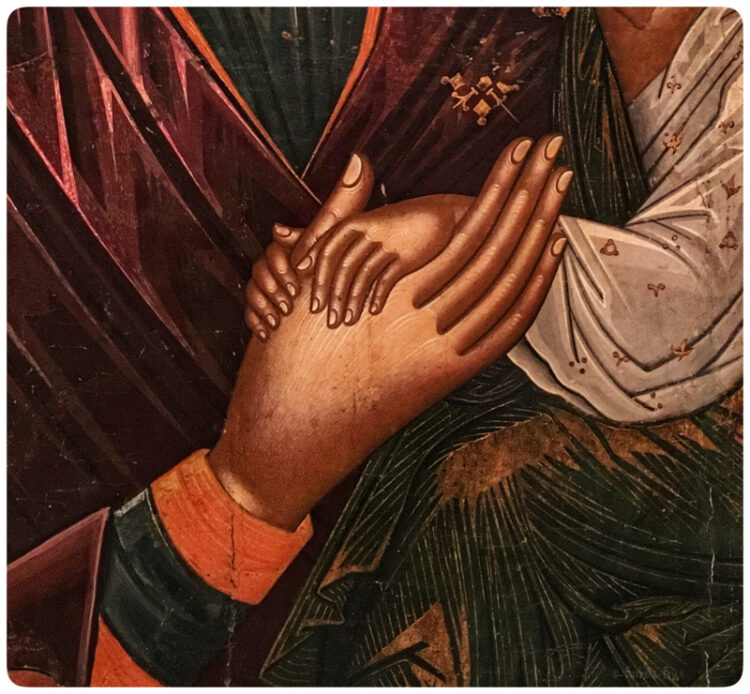
Detail of Icon with the Theotokos Virgin Mary holding our Lord Jesus Christ – Greece 2017

Christ is Born!

Happy 4th Day of Nativity today!

I love this short, sweet, and sublime 5th century Nativity Kontakion (Hymn) by St. Romanus the Melodist. This a cappella recording was sung by our parish in 2014.

Our parish a cappella recording 2014

The Kontakion of the Nativity bursts with the Numinous Essence of the Feast!

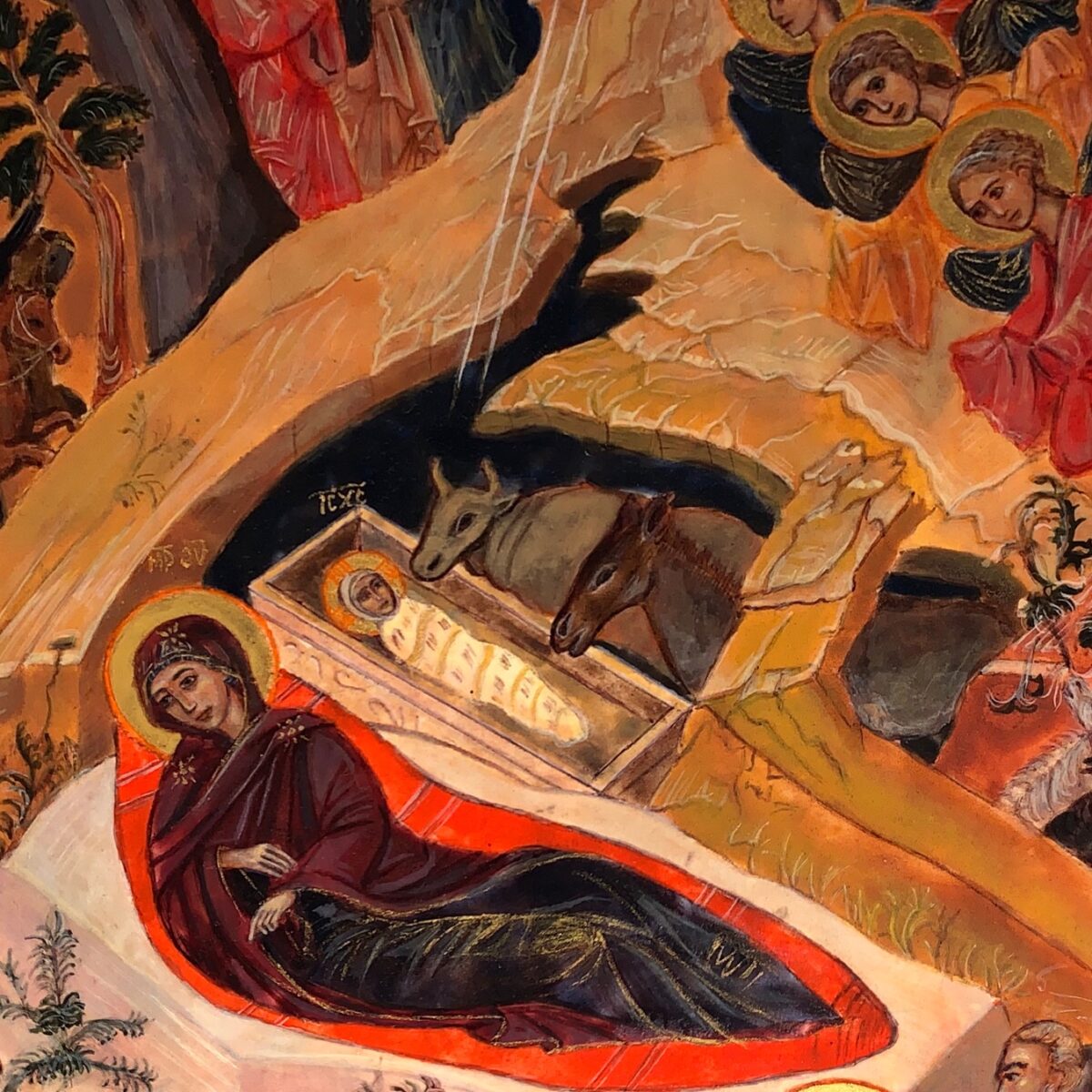
Today a Virgin bringeth forth the Supersubstantial, and earth offereth a cavern to the Unapproachable. Angels together with shepherds sing praises, the Wise Men journey on with the Star. For, for our sakes, God, Who is before all the ages, is born a little Child. ~ Nativity Kontakion by St. Romanus the Melodist (5th century)

A Tour Inside the Ancient Church of the Nativity, in Bethlehem, built over where Jesus Christ was born.

Inside the Church of the Nativity


Lastly, here is an early pre-greeting, for tomorrow’s
5th Day of Nativity commemorating the Holy Innocents.

Happy Birthday Baby Jesus! ~ Ekaterina (memory eternal)

Glorify Him!

A Blessed Christmas! Meriġe Crīstesmæsse!

Detail of the Nativity Icon brings to mind the Nativity Kontakion (Short Hymn of a Feast): Today a Virgin giveth birth unto the Supersubstantial, and earth offereth a cavern to the Unapproachable, angels together with shepherds sing praises, the Wise Men journey on with the Star. For, for our sakes, God Who is before all the ages, is born a little Child. ~ 5th Century St. Romanus the Melodist

Christ is Born! Happy First Day of the Nativity!

Meriġe Crīstesmæsse is an ancient salutation from pre-12th century Old English, which meant a Blessed Christ’s Mass.” Today Meriġe Crīstesmæsse has morphed into the joyful Seasonal Greeting of Merry Christmas, or Happy Christmas!

Thy Nativity O Christ our God, hath arisen upon the world as the Light of Wisdom. For at it, those who worshipped the stars, were, by a Star, taught to adore Thee. The Sun of Righteousness and to know Thee, the Orient from on high. O Lord, glory to Thee! ~ Nativity Tropar (Longer Hymn of the Feast) Composed by 5th century St. Romanus the Melodist

Christ is Born! Give ye glory! Christ comes from heaven meet ye Him! Christ is on earth be ye exalted, O all the earth sing unto the Lord, and sing praises in gladness O ye people, for He hath been glorified. ~ Ode 1 of the Nativity Canon

In keeping with the situation… Here is a beautiful, a cappella Nativity Folk Carol, “Heaven and Earth” as recorded by our parish in 2014.

Heaven & Earth

More Beautiful Than the Stars

Happy Saint’s Day to my goddaughter Cecilia.

Cecilia-strong in faith, rich in faith – Her faith more beautiful than the stars, more precious than gold… ~ St. Nikolai Velimirovich

Greetings on St. Cecilia’s Feast Day! (December 5/November 22)

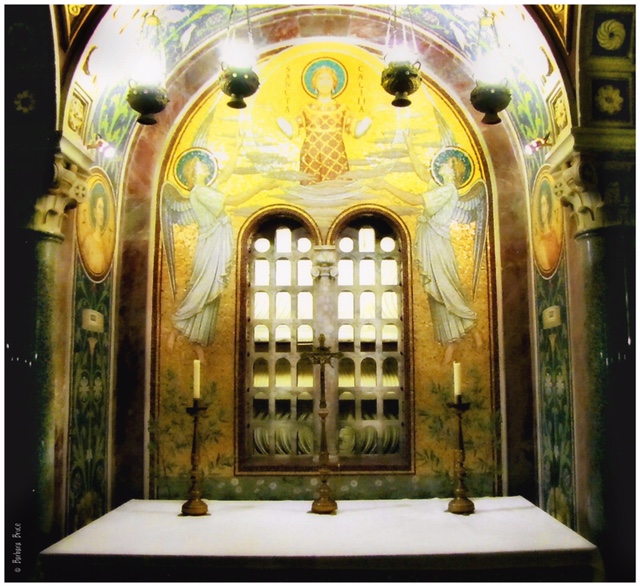
The two featured photos are from a visit to Rome in 2009. Below the main floor is the Church’s Chapel of Relics. The altar with the candlesticks is situated in front of the crypt. Behind the altar’s screened gate is the repository of the second century martyrs, St. Cecilia and her husband St. Valerian.

The Church of St. Cecilia in Trastevere (a Roman neighbourhood), was originally established in the 3rd century, and built on the site of her home after her martyrdom. At the time of her death, St. Cecilia’s body was interred for five centuries in the Catacomb Cemetery of St. Callixtus. However, in the early 800’s, the Pope returned her “home” again, to her own Basilica.

On the upper floor of the main church and in front of the main altar, is the later addition (commissioned in the 16th century), of a glass case enclosing the white marble statue of St. Cecilia. A marble slab on the floor in front of it, quotes the Italian sculptor Stefano Maderno’s sworn statement, recording her miraculously incorrupt body was positioned as seen, and seemingly asleep when the tomb was reopened during the renovations in 1599.

St. Cecilia is considered a patron saint of music in the west. During her undesired earthly wedding; she heard heavenly music, and sang hymns in her heart to Christ. (In the east, St. Romanos the Melodist is a patron saint of music.)

Here is a beautiful, short, 2 minute YouTube video, with detail of St. Cecilia’s Chapel Crypt.

Yet the Lord will command his lovingkindness in the day time, and in the night his song shall be with me, and my prayer unto the God of my life. ~ Psalm 42:8

Kontakion in the 4th Tone

Let us in Godly wise, the hosts of the faithful, / sing hymns to her wedded to Christ of her own will, Cecilia, / whose pure heart with virtues was adorned; / for she wholly put to shame the conceit of Almachius, / and she shone bright as the sun amidst them that pursued her / and then appeared to those upon the earth as a divine staff // that strengthened the holy Faith.

St. Cecilia’s radiant prayers continue to God for us, and are as ever-shining as stars in the heavens.

Protection of the Theotokos

Church of Blachernae in Constantinople, Turkey – 2006 Visit

Greetings on The Protection of the Mother of God a beloved Orthodox feast day, commemorated October 14/1.

The Church of Blachernae was originally built beside a miraculous holy well, by the Emperor Justinian in the latter years of his reign (559-560 AD), and enclosed with remaining construction material from the Cathedral Hagia Sophia in Constantinople.

Damaged later by fires and rebuilt twice (in the 11th and 15th century), the present church still contains the holy well. Additional exterior construction seen today was added in 1867.

Blachernae Church’s Holy Well in 2006 Visit

Several of the Theotokos’ relics were kept in this church; her robe, veil, and part of her belt were transferred from Palestine, during the fifth century. 

This feast day celebrates the appearance of the Mother of God at Blachernae (Constantinople, Turkey). In the year 911, the city was threatened by a barbarian invasion. St. Andrew, with his disciple St. Epiphanius, and a group of people in the church, saw the Mother of God, St. John the Baptist, and several other saints and angels during a vigil service in the Church of Blachernae. In tears, the Theotokos approached the centre of the church, knelt down and remained in prayer for a long time. As a sign of her protection, she rose, took her omophorion (scarf-like veil), and held it aloft, thereby covering all the people present in the church. By her miraculous intervention, danger was averted and the city spared from violence and suffering.

Each human soul is precious to the Mother of God!

May the joy, comfort and glory of the Most Holy Theotokos’ Protection, encompass all and shine within our hearts.

Below is an English version of the original 6th century Akathist Hymn to the Theotokos, attributed to St. Roman the Melodist . (Today is also his day too!)

Greetings and Congratulations to the dear Nuns at Holy Protection Convent on this, their Special Day!

O Most Holy Theotokos, pray to God for us!

error: Content is protected !!