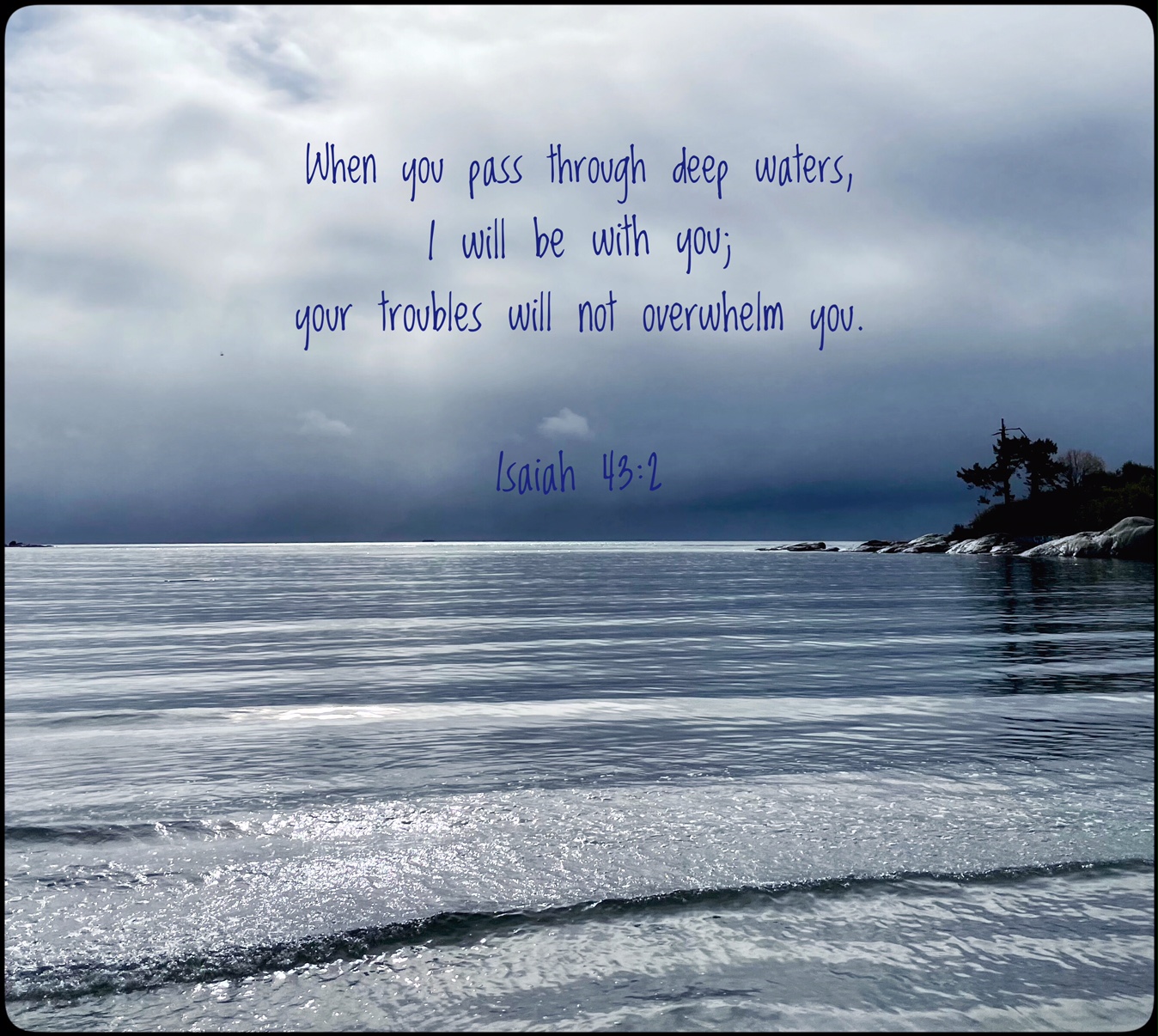
Feature Image background photo shared by Melania (Divine Florals Cards), who today (along with a daring river otter), braved high winds and darted across the road to escape the dramatic waves! ~ Storm Season, Victoria BC, Canada
Behold the sea of life, surging high with the tempest of temptations, I have fled to Thy tranquil haven and cry aloud unto Thee: Lead Thou my life forth from corruption, O most Merciful One. ~ Resurrectional Ode 6, Tone 6
Today (Feb. 14/1) is also the Feast Day of St. Brigit of Ireland and St. Valentine of Rome. St. Brigit is one of my favourite saints, and St. Valentine is the first western saint I heard of, as a child. I delight in how instrumental St. Brigit was implementing educational and artistic centres… How she founded the spiritual community that bettered their county and country – through charity, hospitality, and medical support. I love how St. Brigit perceived Christ in everyone she met, and through the strength of her great faith and pure heart, performed – and continues to this very day… working miracles!
Parish Youth Choir sing Hymn to St. Brigit of Ireland (Feb. 2025)
We work, pray and hope every day to experience God’s mercy. Every day we experience a continuous miracle. Others begin to feel this and come to our church in order to give their souls a rest. ~ St. Elizabeth, Grand Duchess
She was a rare combination of exalted Christian spirit, moral nobility, enlightened mind, gentle heart, and refined taste. She possessed an extremely delicate and multifaceted spiritual composition and her outward appearance reflected the beauty and greatness of her spirit. Upon her brow lay the seal of an inborn, elevated dignity which set her apart from those around her. Under the cover of modesty, she often strove – though in vain, to conceal herself from the gaze of others, but one could not mistake her for another. Wherever she appeared, one would always ask: “Who is she who looketh forth as the morning, clear as the sun” (Song of Solomon 6:10)? Wherever she would go she emanated the pure fragrance of the lily. Perhaps it was for this reason that she loved the colour white – it was the reflection of her heart. All of her spiritual qualities were strictly balanced, one against another, never giving an impression of one-sidedness. Femininity was joined in her to a courageous character; her goodness never led to weakness and blind, unconditional trust of people. Even in her finest heartfelt inspirations she exhibited that gift of discernment which has always been so highly esteemed by Christian ascetics… ~ Metropolitan Anastassy + (1965)
St. Elizabeth the Grand Duchess was the granddaughter of England’s Queen Victoria, (so was St. Elizabeth’s sister, the Tsarina Empress and Royal Martyr St. Alexandra). As Canadians, these are warm connections to our own country’s history.
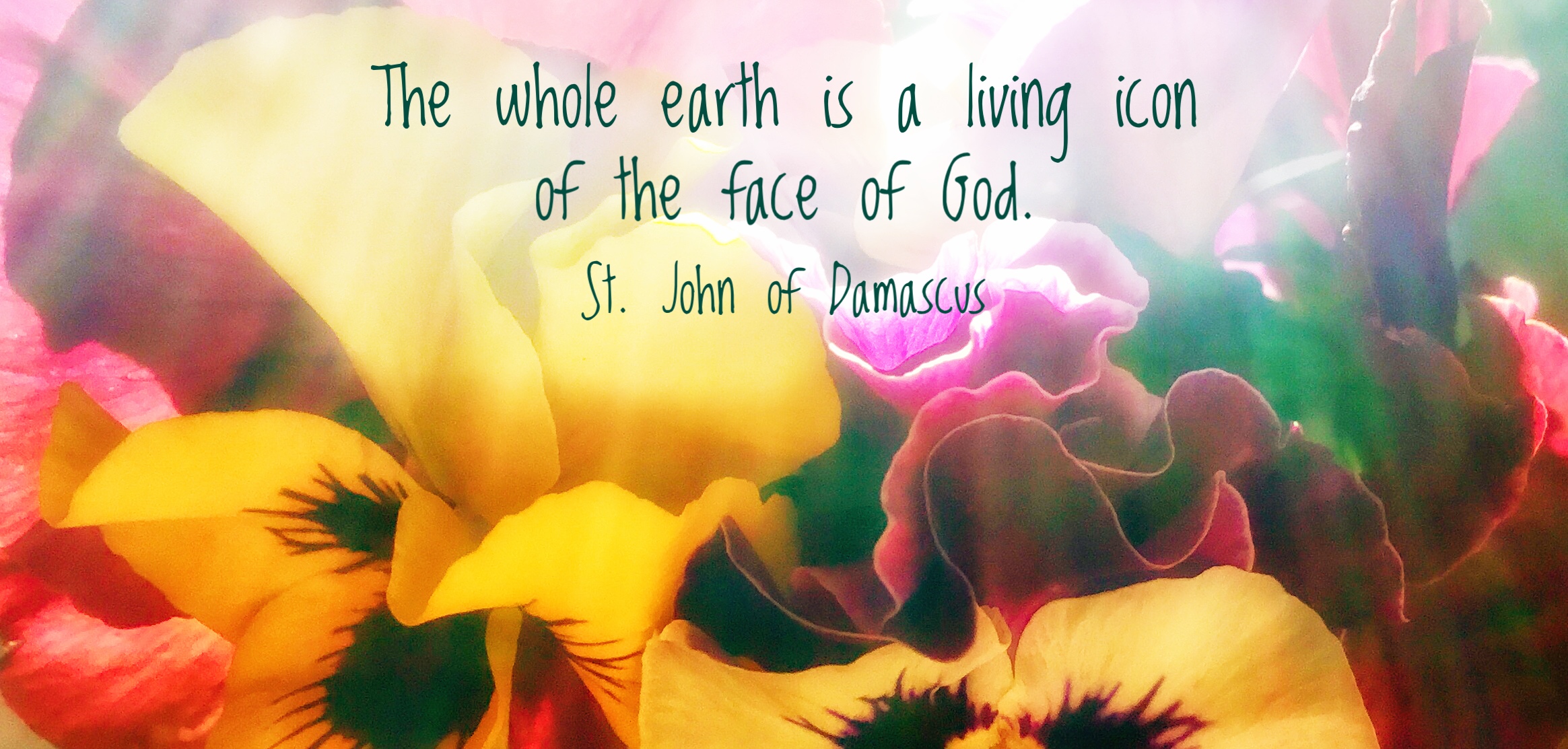
The holy relics were carried to the church entrance over a welcoming walkway (see above feature image), strewn with hundreds of petals and herbs from parishioners’ gardens. The brisk afternoon breeze continuously swept the flowers in vibrant kaleidoscopes of colour.
The Saints’ Reliquary was veneratedby the faithful and visitors to our parish… where many detected the relics emitting a gentle, heavenly fragrance of roses.
Before and during the Hierarchical Divine Liturgy a new Reader was tonsured (Axios!), and our priest was awarded the right to wear the kamilavka (Axios!). The kamilavka is a special hat which reminds us of our Saviour’s Crown of Thorns.
After Divine Liturgy, a Molieben to St. Elizabeth was served, culminating with a joyful Procession around the church… where both the building and the congregation were blessed with refreshing and copious showers of Holy Water!
Holy New-Martyr Grand Duchess Elizabeth and Nun Barbara, pray to God for us!
Beautiful 6 minute Folk Hymn/Ballad about the life of St. Elizabeth, by Katina, (Memory Eternal)
Lazarus Saturday is a special day in the Orthodox Church, and celebrates the final, great miracle of Jesus Christ before His Resurrection. Today prefigures His own death and demonstrates His Authority over death.
Seeing that His good friend is already four days dead, Jesus sheds tears at the tomb where is friend is buried, and cries out: “Lazarus, come forth!” St. Lazarus(the Four Days Dead of Bethany) – was 30 years old when he first reposed and was raised again by Christ (St. John 11:1-45).
Tour of St. Lazarus’ Tomb in Bethany
After the Resurrection of Christ, St. Lazarus lived for another 30 years and became the first Bishop of Kition in Cyprus. An ancient tradition records that because of what St. Lazarus had seen in Hades before Christ raised him, St. Lazarus never smiled again – except once… when he saw someone stealing a clay pot. With an amused expression, he observed, “The clay steals the clay.”
In Orthodox countries, on Lazarus Saturday, children go house to house with decorated hand baskets, singing Lazarus Carols, and sharing Lazarakia. Sometimes coins are popped into the children’s baskets by parishioners, as a donation for the church. Some folks slip lenten treats to the children, which they take home and share with their families. It is also customary to collect wildflowers, palms, and branches on this day to adorn homes, as tomorrow is the feast of Palm Sunday, the Day commemorating the Entrance of our Lord into Jerusalem.
Following His glorious miracle of raising Lazarus from the dead, the people went out to meet the Lord with palms and branches. They welcomed Him with honour and shouts of praise.
It is with bittersweet joy that we anticipate the events to come, during Holy Week as we near the end of our own Journeys to Pascha.
Lazarus was raised from the dead. Christ is risen from the dead. The difference is everything. Our hope is not in being resuscitated to our present form, but a true transformation into the Life of Resurrection. ~ Father Stephen Freeman
Troparion (Hymn) in Tone 1 for Lazarus Saturday
🎵O Christ God, when You raised Lazarus from the dead before the time of your Passion, you confirmed the future resurrection of all. We too, like the children of old, carry before You the symbols of victory, and cry out to You, O Conqueror of Death: Hosanna in the highest! Blessed is He who comes in the name of the Lord! 🎵
Here are some fascinating historical documents about St. Patrick, written by the 7th century monk Muirchú from the Royal Irish Academy.
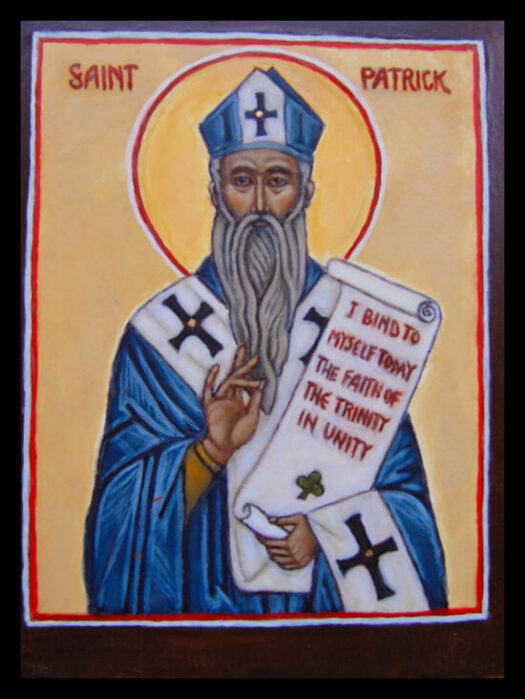
Icons of St. Patrick often show him holding a three-leafed shamrock growing on a single stem, he used this to illustrate the Holy Trinity – our One God in Three Persons.
St. Patrick wrote many hymns. Here is an excerpt from a beautiful, longer hymn, the Lorica (Breastplate) of St. Patrick.“I bind unto myself today, the Strong Name of the Trinity! By Invocation of the same, the Three in One, and One in Three!” ~ St. Patrick
Abbreviated Lorica Hymn of St. Patrick’s Prayer, recorded and sung below, by our Youth Choir in 2019.
One of his many miracles: During a perilous journey to share the Christian faith in King Loegaire’s territory, the saint discovered they were in mortal danger of an ambush. He prayed the Lorica Prayer, and to those lying in ambush, the saint and his company of monks appeared to them as if they were wild deer, and not humans. Because of this miracle, the Lorica Prayer is also known as The Deer’s Cry.
The early fifth century Enlightenment of Ireland by St. Patrick and his brethren, has been called the most successful single missionary venture in the history of the church.
A short recording by my GG’s
Today is also the 4th anniversary of my first Blisswood posting (A Shamrock Day) which fell upon St. Patrick’s Day in 2020! Thank you for visiting!
Below are two easy, tasty, recipes to celebrate St. Patrick’s day – or any day!
An online Plant Based Colcannon (Potato/Cabbage) Side Dish Recipe, and…
This Morning’s Sonshine Broke Through Storm Clouds
Today we commemorate the heavenly birthday of sainted Good King Wenceslas! Many westerners have been introduced to him through an ancient Christmas Carol, retelling one of his miracles.
In this carol, St. Wenceslashelps distribute alms to the needy on the Eve of the Feast of St. Stephen the Apostle, Deacon, and Protomartyr (celebrated on the third day of Christmas); when the churches were opened and yearly collections from the Poor Alms Boxes were dispersed among the needy of the community. This was the original purpose and meaning of Boxing Day!
St. Wenceslas was martyred on today’s date (September 28/October 11) in the year 935. He is buried in Prague.
A beautiful hymn was penned in the 9th century by St. Joseph the Hymnographer – a Greek monk, and one of the many liturgical poets and hymnographers of the Orthodox Church. The hymn was later translated into English, and woven into the ancient 13th century carol melodyused for Good King Wenceslas.
This ancient hymn was also later sung on St. Stephen’s feast day and many other special days of the martyrs. Some churches add on St. Joseph the Hymnographer’s hymn to carol of Good King Wenceslas, as an extra and final verse:
Christian friends, your voices raise. Wake the day with gladness. God Himself to joy and praise turns our human sadness: Joy that martyrs won their crown, opened heav’ns bright portal, when they laid the mortal down for the life immortal.
Whatever we do, let us always try to do our very best to please God our Creator… that we may wake each day with gladness, and rejoice to see heaven’s bright portal break through the clouds… to illumine the way ahead!
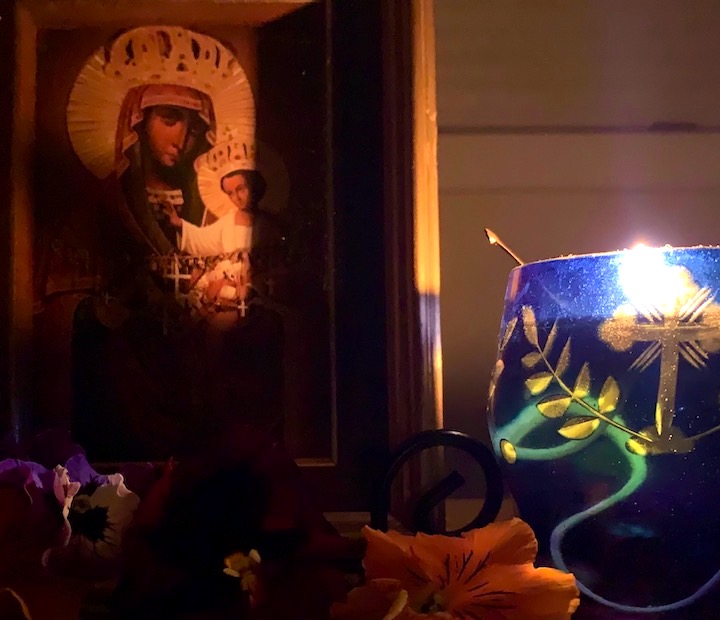
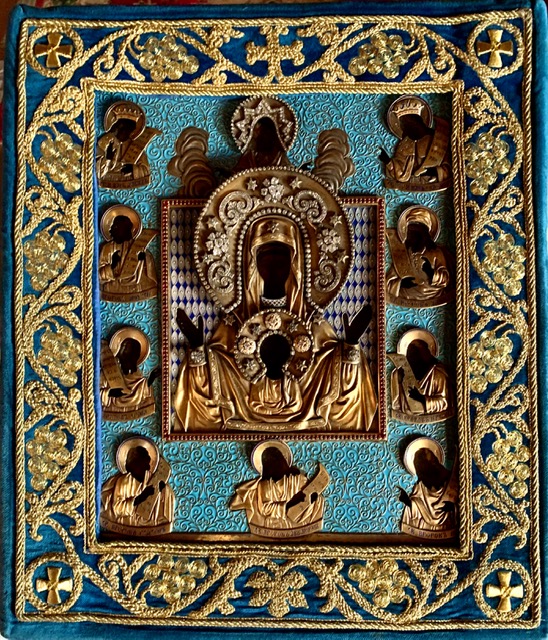
For the health of a dear friend, family prayers were recently said in front of this special Icon, She Who is Quick to Hear.
The original wonderworking icon resides on Holy Mount Athos at the Dokhiareia monastery. There are many copies of it throughout the world. Tradition states the icon was written in the tenth century when the head of this monastery was St. Neophytes – who is also commemorated on theIcon’s Feast DayNovember 22/9. At its first miracle in 1664 AD, our Most Holy Lady Theotokos and Ever Virgin Mary promised, “From this time on, my icon shalt be named Quick-Hearing, and for all hastening to it, shalt there quickly appear, mercy and fulfillment of entreaties.”
To this day, the Most Holy Mother of God continues to fulfill Her promise and quickly offers help and consolation for all, who with faith, hasten to her. She hears every prayer!
This icon, a copy of She Who is Quick to Hear, belonged to my grandmother and given upon her baptism at 89 years of age, by a venerable matushka (the same age as she), who became her godmother, by proxy.
I’ll always remember my grandmother’s first visit to the church after her baptism. It was an arduous journey, for at that time we had no Orthodox church in our city and had to travel by car and ferry, a trip (3-4 hours each way) to church.
Her godmother – an aged matushka, could only speak Russian, and my grandmother could only speak English. However,upon greeting each other joyfully for the first time (before the church service began – and what would be their last time to ever see one another upon this earth), they embraced and chatted non-stop with each other… Matushka Eudocia in Russian, and my grandmother in English! I stood perplexed at this exchange. Then one of them apparently said something amusing to the other, and they both glanced over at me, giggled simultaneously over the anecdote… and happily continued their conversation until the service began.
Journeying home after church, I was bursting to know what my grandma and matushka Eudocia were chatting about? She responded matter-of-factly, “Surely you heard, my dear? You were standing there right beside us… and now Eudocia and I know each other better – before one of us heads off to Glory!”
I asked my grandma howcould she understand matushka Eudocia, because matushka was speaking Russian?!
My grandmother smiled serenely, looked out the car window at the passing scenery and said, “We understood each other perfectly, my dear”.
And that was that!
Little Miracles occur everyday!
Memory Eternal dear Faith, and matushka Eudocia, who through the Power and Mystery of the Holy Spirit… transcended the barrier of language! Amen!
In the radiance of His light the world is not commonplace. The very floor we stand on is a miracle of atoms whizzing in space… In a world where everything that seems to be present is immediately past, everything in Christ is able to participate in the eternal present of God. ~ Fr. Alexander Schmemann
The sky is beautiful, but it is so in order that you may bow down before Him who made it; the sun is bright, but it is so in order that you may worship its Author; if you stop at the wonder of creation and get stuck at the beauty of these works, the light will become dark for you, or rather you will have used the light to change it to darkness. ~ St. John Chrysostom
Beauty is never ‘necessary,’ ‘functional’ or ‘useful.’ And when, expecting someone we love, we put a beautiful tablecloth on the table and decorate it with candles and flowers, we do all this not our of necessity, but out of love. And the Church is love, expectation and joy. ~ Fr. Alexander Schmemann
…God, Who fashioned us and brought us out of non-existence into being, has placed us in this life as in a schoolroom to learn the Gospel of His Kingdom. ~ St. Theodore the Studite
With God placing us in this life as in a schoolroom, may we all graduate in heaven!
The Icon depicts the Theotokos of the Sign with the Christ Child before her. Her arms are outstretched. Above her is theLord of Hostsand on either side and below are 9 prophets who wrote about the birth of Christ (clockwise, starting in the top right): King Solomon, Prophets Daniel, Jeremiah, Elijah, Habakkuk, Judge Gideon, Prophets Isaiah, Moses, and King David. The wooden Icon is covered with an intricately worked [protective] cover of blue and gold. ~ OrthodoxWiki
Even if you just lean your head on an Icon, you will find consolation. ~ St. Paisios the Athonite
Shared by a dear friend:“I came to venerate this Holy Icon with certain petitions already in mind for both physical and spiritual healing. But when I approached the Icon, overwhelming thoughts of the heartbreaking Russian war in Ukraine (and resulting divisions in the Orthodox world) engulfed me instead. All I could pray was one single word ‘Help.’ I laid my head on the Icon, much as a grieving child would upon their own mother’s bosom… and although it seemed I was there for quite some time (in reality – only several seconds), a Warm Wave of Consolation washed over me… a Spiritual Embrace. The next one-word prayer I offered was ‘Thank you’… And I know that She’s sad too.”
Epilogue: I was also told a few days later, that a long-standing family issue my friend was going to especially pray for in front of the Icon (she had also been praying separately for), has miraculously been resolved!
Help and Thank You are two very simple, powerful, prayer words.
Our Most Holy Theotokos knows what we need even when words won’t suffice. When we turn to her with hope and faith, she always hears the wordless groaning of hearts.
O Most Holy Theotokos, thank you for your blessings – both known and unknown!
like cells of an enormous, incomprehensible fabric
our eyes are slowly opened
to the miracle which binds us together
May the Lord continue to bless us
~ by an Anonymous Friend
I initially posted this with my friend’s permission and name, but he has since requested that “anon would do nicely” and gave me this humble reason…
The words that I write Are rarely my own But are more seeds of light That some Angel has sown They take root and flower And raising their heads By some mystical power They rise in their beds And sing the praise of their Sower.