A Virtue and Prize

Forest in Ireland
by Josip Rmc from Pixabay


In your patience possess ye your souls. ~ St. Luke 21:19

It is a virtue and a prize to listen patiently to and put up with insults for the sake of God ~ St. Brigit of Kildare

Greater love hath no man than this, that a man lay down his life for his friends. ~ St. John 15:13

And now abideth faith, hope, charity, these three; but the greatest of these is charity. ~ 1 Corinthians 1:13

Greetings on the Forefeast of the Meeting of our Lord!

Today (Feb. 14/1) is also the Feast Day of St. Brigit of Ireland and St. Valentine of Rome. St. Brigit is one of my favourite saints, and St. Valentine is the first western saint I heard of, as a child. I delight in how instrumental St. Brigit was implementing educational and artistic centres… How she founded the spiritual community that bettered their county and country – through charity, hospitality, and medical support. I love how St. Brigit perceived Christ in everyone she met, and through the strength of her great faith and pure heart, performed – and continues to this very day… working miracles!

Parish Youth Choir sing Hymn to St. Brigit of Ireland (Feb. 2025)


St. Brigit of Ireland Past Posts

St. Brigid of Ireland ~ Feb. 13, 2021

Gabhaim Molta Bríghde ~ Feb. 14, 2022

Holy Mother Bríghde ~ Feb. 13, 2023

Happy St. Bríghde Day! ~Feb. 14, 2024

St. Bridget of Ireland ~ Jan. 25, 2025

St. Valentine
Past Post

A Valentine ~ Feb. 14, 2022

Banquet of Faith

Some of our 2022 Pascha eggs (dyed brick-red with onion skins) sit on a nest of sweet lavender. These floral imprints are from marigold, barrenwort flowers, and a clover leaf.

Dying eggs red for Pascha is an ancient tradition, and symbolize the gift of eternal life though our Lord Jesus Christ’s glorious Resurrection.

Their shells represent the sealed tomb of Jesus, and when we crack our eggs together, we depict the end of the old and the beginning of the new… His Resurrection from the dead, the shattering of the Gates of Hell, and the Promise of Life Eternal!

The tradition of red eggs begins with St. Mary Magdalene, one of the Holy Myrrh-Bearers. As a witness of Christ’s Resurrection, and after His Ascension to the heavens, she began a life of ministry and also became known as an Equal-to-the-Apostles.

According to holy tradition, during her travels, St. Mary Magdalene gained an audience with the Emperor Tiberius in Rome… where she denounced the conduct of Jerusalem’s governor (Pontius Pilate) at Christ’s trial, by his condemning of an innocent man (whom he acknowledged to be) to death.

Then St. Mary Magdalene told the Emperor about the life and miracles of Jesus Christ, and His Resurrection from the dead. To illustrate the symbol of New Life (in Christ), she held an egg out to him, and joyously proclaimed, “Christ is Risen!”

The emperor mocked her saying, “There’s about as much chance of a human being returning to life again from the dead… as there is for that very egg in your hand to turn red!”

An instantaneous sign from God confirmed the truth of her message, and the egg immediately turned red!

Christ’s redemption transcends time and space. When we greet each other during the 40 days of Pascha-tide saying, “Christ is risen,” we confirm that not only did He rise all those years ago, but He remains risen right now.

Christ is risen! Truly He is Risen!

More Beautiful Than the Stars

Happy Saint’s Day to my goddaughter Cecilia.

Cecilia-strong in faith, rich in faith – Her faith more beautiful than the stars, more precious than gold… ~ St. Nikolai Velimirovich

Greetings on St. Cecilia’s Feast Day! (December 5/November 22)

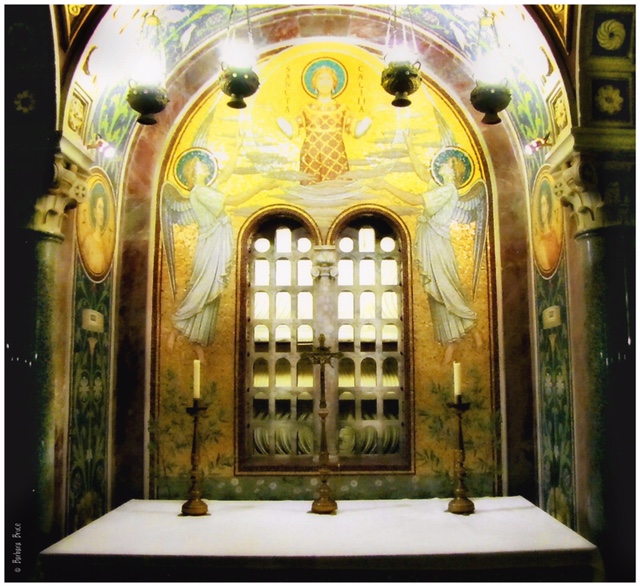
The two featured photos are from a visit to Rome in 2009. Below the main floor is the Church’s Chapel of Relics. The altar with the candlesticks is situated in front of the crypt. Behind the altar’s screened gate is the repository of the second century martyrs, St. Cecilia and her husband St. Valerian.

The Church of St. Cecilia in Trastevere (a Roman neighbourhood), was originally established in the 3rd century, and built on the site of her home after her martyrdom. At the time of her death, St. Cecilia’s body was interred for five centuries in the Catacomb Cemetery of St. Callixtus. However, in the early 800’s, the Pope returned her “home” again, to her own Basilica.

On the upper floor of the main church and in front of the main altar, is the later addition (commissioned in the 16th century), of a glass case enclosing the white marble statue of St. Cecilia. A marble slab on the floor in front of it, quotes the Italian sculptor Stefano Maderno’s sworn statement, recording her miraculously incorrupt body was positioned as seen, and seemingly asleep when the tomb was reopened during the renovations in 1599.

St. Cecilia is considered a patron saint of music in the west. During her undesired earthly wedding; she heard heavenly music, and sang hymns in her heart to Christ. (In the east, St. Romanos the Melodist is a patron saint of music.)

Here is a beautiful, short, 2 minute YouTube video, with detail of St. Cecilia’s Chapel Crypt.

Yet the Lord will command his lovingkindness in the day time, and in the night his song shall be with me, and my prayer unto the God of my life. ~ Psalm 42:8

Kontakion in the 4th Tone

Let us in Godly wise, the hosts of the faithful, / sing hymns to her wedded to Christ of her own will, Cecilia, / whose pure heart with virtues was adorned; / for she wholly put to shame the conceit of Almachius, / and she shone bright as the sun amidst them that pursued her / and then appeared to those upon the earth as a divine staff // that strengthened the holy Faith.

St. Cecilia’s radiant prayers continue to God for us, and are as ever-shining as stars in the heavens.

Immeasurably Manifest

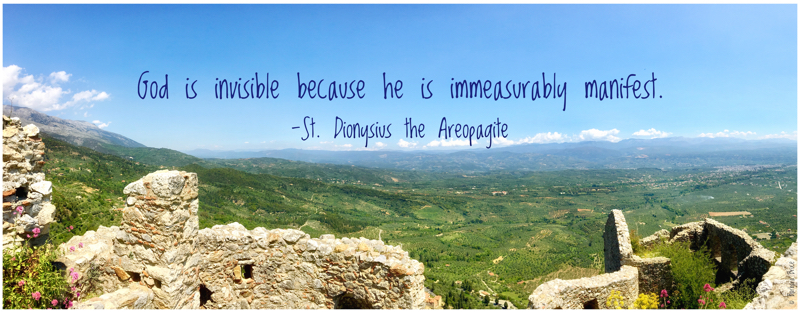
A Vantage View-Point in Mystras Greece – 2017

…The way of knowing God that is most worthy of Him is to know Him through unknowing, in a union that rises above all intellect. The intellect is first detached from all beings, then it goes out of itself and is united to rays more luminous than light itself. Thanks to these rays it shines in the unfathomable depths of Wisdom. It is no less true, however, as I have said, that this Wisdom can be known from every reality. ~ St. Dionysius the Areopagite

I’ve always been drawn to how even before St. Dionysius the Areopagite became a Christian, his numinous heart sensed why the sun hid its rays as if in shame, at the time of Christ’s Crucifixion.

Studying astronomy in Egypt, he witnessed the world-wide solar eclipse that occurred during our Lord’s death. So struck by this heavenly event, he exclaimed,“Either the Creator of all the world now suffers, or this visible world is coming to an end.”

Upon his return to Athens from Egypt, he was chosen as a member of the Areopagus Council, the Athenian high court, which would meet on the Hill of Ares (Mars)… across from the Acropolis.

St. Dionysius was present when Apostle Paul preached in the midst of the Areopagus, on Mars’ Hill, (Acts 17:16-34).

St. Paul’s sermon also described the supernatural darkness which occurred during our Lord’s Crucifixion, and St. Dionysius remembered what he witnessed in Egypt (which the other learned astronomers couldn’t explain). He became a Christian, was baptized by St. Paul, and is numbered among the Seventy Apostles.

The Areopagus in Athens on Mars’ Hill: 13 seconds into video shows the altar “To the Unknown God” as St. Paul saw and describes in Acts 17: 22-34

For three years St. Dionysius remained a companion of St. Paul in preaching the Word of God. St. Paul chose him as bishop of the city of Athens, and St. Dionysius later travelled to Jerusalem to meet the Virgin Mary. He was also present at her repose. There are four theological works attributed to St. Dionysius: The Divine NamesThe Mystical TheologyThe Celestial Hierarchy, and The Ecclesiastical Hierarchy, as well as eleven letters. 

Sometime after the death of the Apostle Paul, St. Dionysius set off with two others, to evangelize Germany, Spain and France. Eventually the three met martyrdom together. St. Dionysius’ Heavenly Birthday (Feast Day) is Oct. 16/3. He is the patron saint of Athens and venerated as the protector of the Judges and the Judiciary.

Let thy speech be better than silence, or be silent. ~ St. Dionysius the Areopagite

error: Content is protected !!