Courageous and Steadfast

Photo is from the week after Pascha called Bright Week, when the Royal Doors remain fully open. The unblocked view of the altar symbolizes the open door of Christ’s empty tomb as well as the rent veil of the Jewish Temple, which was divinely torn apart at the moment Christ died. The Artos (recalling Christ, the Bread of Life) is blessed, and stands covered, in a place of honour during Bright Week and is later cut up and distributed to the faithful on Thomas Sunday, the Sunday after Pascha.

Today is the Sunday of the Holy Myrrh-Bearers!
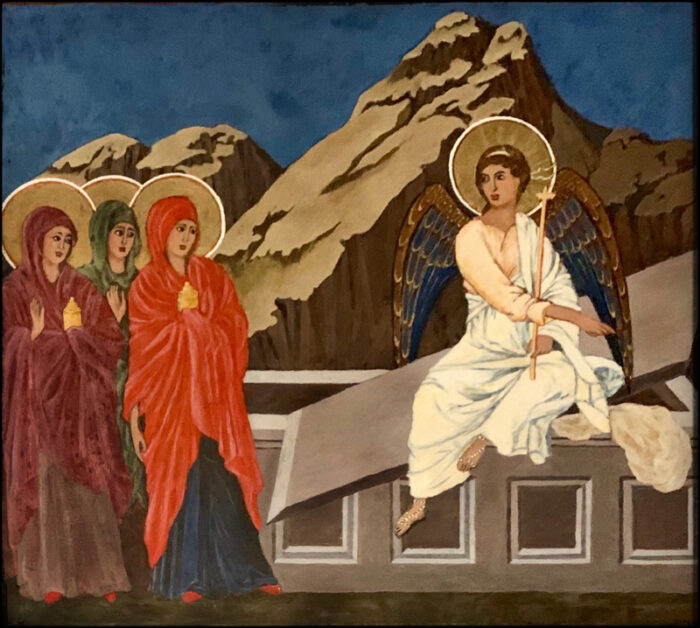
The third Sunday of Holy Pascha is designated as the Sunday of the Holy Myrrhbearers. These courageous and steadfast women disciples of the Lord followed Jesus Christ throughout His ministry… providing and caring for Him and His followers (St. Mark 15:41). They remained faithful to Him during the dangerous times of His arrest, crucifixion, and burial. On account of the preparation for the Sabbath, the initial burial preparations were incomplete and brief. As soon as the Sabbath passed, the women speedily returned, bringing precious myrrh and ointment to anoint His body. It was still dark and very early in the morning, when they arrived at the tomb. Christ’s Resurrection was revealed by an angel, and they were given the honour to announce the glad tidings to the apostles. Because of this, the Myrrhbearing Women, especially St. Mary Magdalene, are sometimes referred to as Equal to the Apostles.

The Holy Myrrhbearers represent all that’s good in our Christian faith. 

They are the spiritual-embodiment of Faith, Hope and Love!

Let God Arise Paschal Stichera (About the Holy-Myrrhbearers) – Circa-the Pandemic. A Parish’s beautiful Virtual Orthodox Choir sings ancient Znamenny Chant, arr. H. Benigsen

Memory Eternal Joanna!

Banquet of Faith

Some of our 2022 Pascha eggs (dyed brick-red with onion skins) sit on a nest of sweet lavender. These floral imprints are from marigold, barrenwort flowers, and a clover leaf.

Dying eggs red for Pascha is an ancient tradition, and symbolize the gift of eternal life though our Lord Jesus Christ’s glorious Resurrection.

Their shells represent the sealed tomb of Jesus, and when we crack our eggs together, we depict the end of the old and the beginning of the new… His Resurrection from the dead, the shattering of the Gates of Hell, and the Promise of Life Eternal!

The tradition of red eggs begins with St. Mary Magdalene, one of the Holy Myrrh-Bearers. As a witness of Christ’s Resurrection, and after His Ascension to the heavens, she began a life of ministry and also became known as an Equal-to-the-Apostles.

According to holy tradition, during her travels, St. Mary Magdalene gained an audience with the Emperor Tiberius in Rome… where she denounced the conduct of Jerusalem’s governor (Pontius Pilate) at Christ’s trial, by his condemning of an innocent man (whom he acknowledged to be) to death.

Then St. Mary Magdalene told the Emperor about the life and miracles of Jesus Christ, and His Resurrection from the dead. To illustrate the symbol of New Life (in Christ), she held an egg out to him, and joyously proclaimed, “Christ is Risen!”

The emperor mocked her saying, “There’s about as much chance of a human being returning to life again from the dead… as there is for that very egg in your hand to turn red!”

An instantaneous sign from God confirmed the truth of her message, and the egg immediately turned red!

Christ’s redemption transcends time and space. When we greet each other during the 40 days of Pascha-tide saying, “Christ is risen,” we confirm that not only did He rise all those years ago, but He remains risen right now.

Christ is risen! Truly He is Risen!

Sunday of the Holy Myrrhbearers

Memory Eternal, Joanna.

Christ is Risen!

The myrrh bearing women at the break of dawn, drew near to the tomb of the Giver of Life. There they found an angel seated upon the stone, and he greeted them with these words: “Why do ye seek the Living among the dead? Why mourn ye the Incorrupt amid corruption? Go: proclaim the glad tidings to His disciples.” This is the day which the Lord hath made! Let us rejoice and be glad therein. Pascha of beauty! The Pascha of the Lord! A Pascha worthy of all honour hath dawned for us. Pascha! Pascha, ransom from affliction! For today, as from a bridal chamber, Christ hath shone forth from the tomb, and filled the women with joy, saying “Proclaim the glad tidings to the apostles.” ~ Excerpt from the Aposticha Paschal Stichera; Let God Arise

The third Sunday of Holy Pascha is designated as the Sunday of the Holy Myrrhbearers. These courageous and steadfast women disciples of the Lord followed Jesus Christ throughout His ministry… providing and caring for Him and His followers (St. Mark 15:41). They remained faithful to Him during the dangerous times of His arrest, crucifixion, and burial. On account of the preparation for the Sabbath, the initial burial preparations were incomplete and brief. As soon as the Sabbath passed, the women speedily returned, bringing precious myrrh and ointment to anoint His body. It was still dark and very early in the morning, when they arrived at the tomb. Christ’s Resurrection was revealed by an angel, and they were given the honour to announce the glad tidings to the apostles. Because of this, the Myrrhbearing Women, especially St. Mary Magdalene, are sometimes referred to as Equal to the Apostles.

The Holy Myrrhbearers represent all that is good in our Christian faith. They are the spiritual-embodiment of Faith, Hope and Love.

Truly He is Risen!

error: Content is protected !!