Many Are Called…

Wishing you an Old-Style Calendar* Blessed Feast of St. Spyridon & St. Herman of Alaska Day! To my New-Style Calendar* Friends, Christ is Born!

On the church date December 12th, is the Feast of the Holy Wonderworker, St. Spyridon of Tremithus. (270 – 348 AD) St. Spyridon was born in Cyprus, and initially worked as a shepherd and known for his great piety. He married and had one daughter, Irene. Upon the death of his wife, Spyridon entered a monastery, and their daughter entered a convent. St. Spyridon eventually became Bishop of Tremithus and took part in the First Ecumenical Council of Nicaea (325), where he was instrumental in countering the erroneous theological arguments of Arius and his followers. There’s an account of his speech at this event, regarding the Holy Trinity…  At one point, St. Spyridon grasped a brick and squeezed it so hard that miraculously, a flame flew up, while at the same time water trickled downwards, leaving only a small amount of crushed clay within his hand. He exclaimed: “There are these three elements, but one brick; likewise, in the Holy Trinity, there are three Persons, but One God”.

Today we also remember and celebrate the Holy Wonderworker St. Herman of Alaska. St. Herman was a monk, missionary and miracle worker who brought the Orthodox Faith from Russia to the native peoples of Alaska in the late 18th century.  He taught the Holy Gospel of Jesus Christ and defended these people from exploitation by the Russian traders.  Here’s a recent miracle of St. Herman of Alaska on Mt. Denali, and a YouTube Visit to Spruce Island: The holy Relics of St. Herman the Wonderworker. 

For our good, for our happiness, let us make a vow that from this day forth, from this hour, from this minute, let us strive to love God above all else and seek to do His Holy Will. ~ St. Herman of Alaska

A Sermon by +Archpriest John Adams of Eternal Memory, on St. Herman of Alaska

Drawing closer to the Feast of the Nativity we read the gospel (Luke 14:16-24) about those who were invited to a great supper, and those who wouldn’t come, so others take their place. Many are called, but the chosen seem to be those who simply didn’t make an excuse. They came. No matter what their state was when they were called. It wasn’t more important than the feast.

What if there was someone to whom being chosen was more important than anything, more important than pleasure or comfort? To travel thousands of miles in difficult conditions, to live in the cold and dark alone, but always remembering the feast that would come. What would this person be like? Maybe they would be someone who wouldn’t lie, even though it meant death. Maybe when they chanted alone it would sound like a whole choir of angels singing. Maybe if you were alone they would take you in; if you were sick, he would pray for you and you would get well. Maybe if there was going to be disaster, like a tidal wave, maybe he would take the icon the Mother of God to the shore and the water wouldn’t come above it, and you were saved.

They might be like one candle burning in a whole dark continent, but one candle after another is lit from it, and hundreds of years later, they are still burning.

What if you saw the feast, and you saw them enter in to join the others and it was all joy and light, but you were standing on the outside looking in – for when you had been invited over and over, you always had an excuse?

…Today is December 12th on the church calendar and the commemoration of the first Orthodox missionaries to Alaska in 1794… St. Juvenal the first martyr, the martyr St. Peter the Aleut, and St. Herman the Wonderworker.

We are still invited to the feast.

We are still called.

It is still up to us to be one of the chosen.

*Until 1924, the Eastern Orthodox Church universally used the ancient Julian calendar, whereas the Roman Catholic Church, under Pope Gregory XIII, conducted a calendar reform resulting in the Gregorian (new, civil) calendar in 1582. The difference between the two calendars is 13 days between the years 1900 and 2100. Some branches of the Orthodox Church still keep liturgical dates according to the Julian calendar, while some others have adopted using the “new” calendar. However, Orthodox Christians who use both calendars, always strictly adhere and calculate the Great Feast of Pascha, only according to the Julian Calendar.

A Royal Visitation

We work, pray and hope every day to experience God’s mercy. Every day we experience a continuous miracle. Others begin to feel this and come to our church in order to give their souls a rest. ~ St. Elizabeth, Grand Duchess

She was a rare combination of exalted Christian spirit, moral nobility, enlightened mind, gentle heart, and refined taste. She possessed an extremely delicate and multifaceted spiritual composition and her outward appearance reflected the beauty and greatness of her spirit. Upon her brow lay the seal of an inborn, elevated dignity which set her apart from those around her. Under the cover of modesty, she often strove – though in vain, to conceal herself from the gaze of others, but one could not mistake her for another. Wherever she appeared, one would always ask: “Who is she who looketh forth as the morning, clear as the sun” (Song of Solomon 6:10)? Wherever she would go she emanated the pure fragrance of the lily. Perhaps it was for this reason that she loved the colour white – it was the reflection of her heart. All of her spiritual qualities were strictly balanced, one against another, never giving an impression of one-sidedness. Femininity was joined in her to a courageous character; her goodness never led to weakness and blind, unconditional trust of people. Even in her finest heartfelt inspirations she exhibited that gift of discernment which has always been so highly esteemed by Christian ascetics… ~ Metropolitan Anastassy + (1965)

This week our parish was blessed with an amazing 24 hours… the visitation of the Holy Relics of New-martyr Grand Duchess, St. Elizabeth and Nun Barbara. 

St. Elizabeth the Grand Duchess was the granddaughter of England’s Queen Victoria, (so was St. Elizabeth’s sister, the Tsarina Empress and Royal Martyr St. Alexandra). As Canadians, these are warm connections to our own country’s history.

The holy relics were carried to the church entrance over a welcoming walkway (see above feature image), strewn with hundreds of petals and herbs from parishioners’ gardens. The brisk afternoon breeze continuously swept the flowers in vibrant kaleidoscopes of colour.

The Saints’ Reliquary was venerated by the faithful and visitors to our parish… where many detected the relics emitting a gentle, heavenly fragrance of roses.

It was an extra blessing for those present, who have the New Martyr Grand Duchess Elizabeth as their Patron Saint.

Before and during the Hierarchical Divine Liturgy a new Reader was tonsured (Axios!), and our priest was awarded the right to wear the kamilavka (Axios!). The kamilavka is a special hat which reminds us of our Saviour’s Crown of Thorns.

After Divine Liturgy, a Molieben to St. Elizabeth was served, culminating with a joyful Procession around the church… where both the building and the congregation were blessed with refreshing and copious showers of Holy Water!

Holy New-Martyr Grand Duchess Elizabeth and Nun Barbara, pray to God for us!

Beautiful 6 minute Folk Hymn/Ballad about the life of St. Elizabeth, by Katina, (Memory Eternal)

Wake the Day With Gladness

This Morning’s Sonshine Broke Through Storm Clouds

Today we commemorate the heavenly birthday of sainted Good King Wenceslas! Many westerners have been introduced to him through an ancient Christmas Carol, retelling one of his miracles.

In this carol, St. Wenceslas helps distribute alms to the needy on the Eve of the Feast of St. Stephen the Apostle, Deacon, and Protomartyr (celebrated on the third day of Christmas); when the churches were opened and yearly collections from the Poor Alms Boxes were dispersed among the needy of the community. This was the original purpose and meaning of Boxing Day!

St. Wenceslas was martyred on today’s date (September 28/October 11) in the year 935. He is buried in Prague. 

A beautiful hymn was penned in the 9th century by St. Joseph the Hymnographer – a Greek monk, and one of the many liturgical poets and hymnographers of the Orthodox Church. The hymn was later translated into English, and woven into the ancient 13th century carol melody used for Good King Wenceslas.

This ancient hymn was also later sung on St. Stephen’s feast day and many other special days of the martyrs. Some churches add on St. Joseph the Hymnographer’s hymn to carol of Good King Wenceslas, as an extra and final verse:

Christian friends, your voices raise.
Wake the day with gladness.
God Himself to joy and praise 
turns our human sadness: 
Joy that martyrs won their crown, 
opened heav’ns bright portal, 
when they laid the mortal down 
for the life immortal.

Whatever we do, let us always try to do our very best to please God our Creator… that we may wake each day with gladness, and rejoice to see heaven’s bright portal break through the clouds… to illumine the way ahead!

Whatsoever thy hand findeth to do, do it with thy might

She Who is Quick to Hear

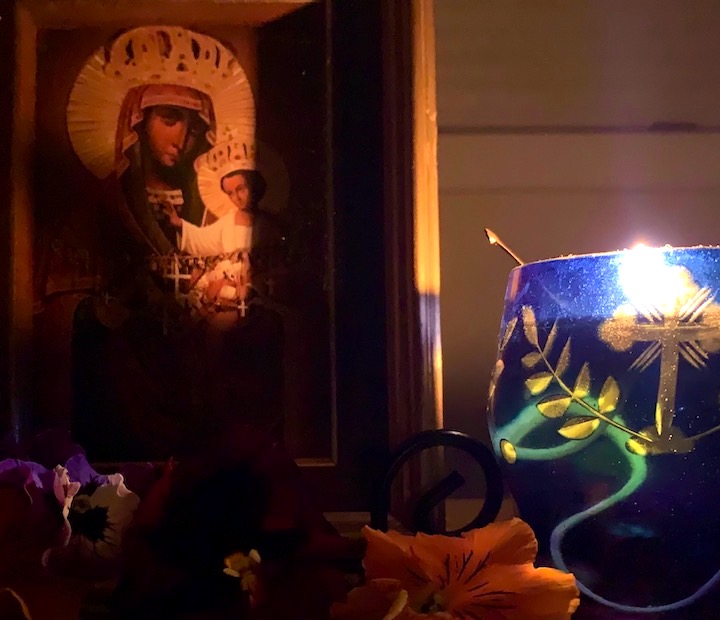
For the health of a dear friend, family prayers were recently said in front of this special Icon, She Who is Quick to Hear.

The original wonderworking icon resides on Holy Mount Athos at the Dokhiareia monastery. There are many copies of it throughout the world. Tradition states the icon was written in the tenth century when the head of this monastery was St. Neophytes – who is also commemorated on the Icon’s Feast Day November 22/9. At its first miracle in 1664 AD, our Most Holy Lady Theotokos and Ever Virgin Mary promised, “From this time on, my icon shalt be named Quick-Hearing, and for all hastening to it, shalt there quickly appear, mercy and fulfillment of entreaties.”

To this day, the Most Holy Mother of God continues to fulfill Her promise and quickly offers help and consolation for all, who with faith, hasten to her. She hears every prayer!

This icon, a copy of She Who is Quick to Hear, belonged to my grandmother and given upon her baptism at 89 years of age, by a venerable matushka (the same age as she), who became her godmother, by proxy.

I’ll always remember my grandmother’s first visit to the church after her baptism. It was an arduous journey, for at that time we had no Orthodox church in our city and had to travel by car and ferry, a trip (3-4 hours each way) to church.

Her godmother – an aged matushka, could only speak Russian, and my grandmother could only speak English. However, upon greeting each other joyfully for the first time (before the church service began – and what would be their last time to ever see one another upon this earth), they embraced and chatted non-stop with each other… Matushka Eudocia in Russian, and my grandmother in English! I stood perplexed at this exchange. Then one of them apparently said something amusing to the other, and they both glanced over at me, giggled simultaneously over the anecdote… and happily continued their conversation until the service began.

Journeying home after church, I was bursting to know what my grandma and matushka Eudocia were chatting about? She responded matter-of-factly, “Surely you heard, my dear? You were standing there right beside us… and now Eudocia and I know each other better – before one of us heads off to Glory!”

I asked my grandma how could she understand matushka Eudocia, because matushka was speaking Russian?!

My grandmother smiled serenely, looked out the car window at the passing scenery and said, “We understood each other perfectly, my dear”.

And that was that!

Little Miracles occur everyday!

Memory Eternal dear Faith, and matushka Eudocia, who through the Power and Mystery of the Holy Spirit… transcended the barrier of language! Amen!

error: Content is protected !!