…speaking to one another in psalms and hymns and spiritual songs, singing and making melody in your heart to the Lord. ~ Ephesians 5:19
…A sacred song is not unlike a holy Icon; except that the holy Icon is seen and the sacred song is heard, the functions are the same. This painting of words and sounds has as its purpose the bringing of the community into the presence and the awareness of sacred mystery. Bringing us together is no small part of sacred music’s function. Just as receiving Holy Communion together is a sacred sign that all who partake become one body in Christ, so singing must be the expression of this same unity of hearts and minds, drawing us harmoniously together into one voice. For ultimately, it is Christ Who is our Song. ~ These Truths We Hold – The Holy Orthodox Church: Her Life and Teachings, St. Tikhon’s Monastery
A friend recently shared an ancient and amazing Latin quote attributed to St. Athanasius the Great. Nibicula est, transibit which translates to “It is a small cloud; it will pass”.
Trials and tribulations are just for now, Nibicula Est, Transibit – are exactly like those fleeting clouds on the horizon!
Christ is our Siloam. He is our Bright Sun of Righteousness in a cloudless sky.
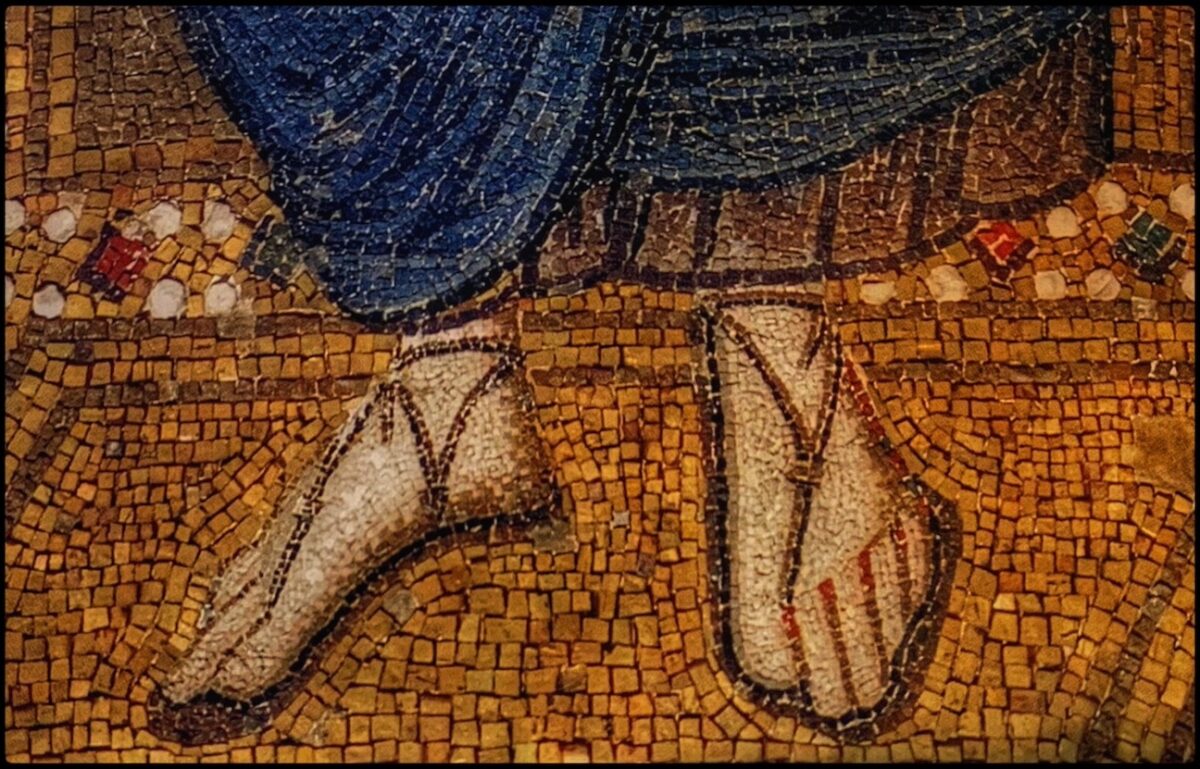
Come! Let us kiss His Precious Feet – those very sameFeet which once trod Eden’s dusky paths, and are still fragrant with the Petals of Paradise!
…When a problem is acute…tell it to the Angels so they may place it at the Lord’s Feet, and pray the Lord for an Angel of Peace to calm your soul. How beautiful is the Mystery of Tomorrow! ~St. Gavrilia
…Wonderful is God in His works! Through all His works, He teaches us humility and obedience. He hides Himself behind His works, as the sun at night behind the shining of the stars, as a nightingale in the bush behind its song. He lends light to the sun, and the sun shines as though with its own light, while the fact that it is God’s light is ignored. He lends a voice to His thunder and His winds, and they are heard; but He is not heard. He lends beauty to His mountains and meadows, and they are resplendent in beauty as though it were their own, while God’s beauty remains shrouded in mystery. He lends beauty and fragrance to the flowers of the field, and the beauteous flowers give off their fragrance as though it were their own; while God’s fragrance goes un-noticed. He lends strength to every creature, and each creature preens itself in front of the others, showing off its strength as though it were its own; while God’s immeasurable strength neither preens itself nor cries for attention. He lends of His mind to men, and men cogitate and think as though with their own minds; while God’s mind stands in a calm from tumult, turning from the world’s praise. So God teaches us humility. All that He does, He does both in accordance with His own nature and for the sake of men, that man may be ashamed and aware of his foolish pride; that man may not be puffed up with himself, having of himself no good work; but that he should let his works go before him, and he walk behind them, as God does with His works, scarcely seen or heard, as a shepherd behind his large flock… ~ Homily Excerpt on Theophany by St. Nikolai Velimirovic
Love all creation, the whole of it and every grain of sand within it. Love every leaf, every ray of God’s light. Love the animals, love the plants, love everything. If you love everything, you will perceive the divine mystery in things. ~ Staretz Zosima; The Brothers Karamazov – by Fyodor Dostoevsky
All created things are marked with the seal of the Trinity... The contemplation of nature has two correlative aspects. First, it means appreciating the “thusness” or “thisness” of particular things, persons and moments. We are to see each stone, each leaf, each blade of grass, each frog, each human face, for what it truly is, in all the distinctness and intensity of its specific being. As the prophet Zechariah warns us, we are not to “despise the day of small things” (4:10). “True mysticism”, says Olivier Clément, “is to discover the extraordinary in the ordinary.” ~ Metropolitan Kallistos Ware; The Orthodox Way
I discovered my first moss forest, around the age of 6, after attempting an exuberant cartwheel, and taking a nose-dive into a shady emerald pillow of puffy moss. Its mini forest seemed like a microscopic jungle, with perhaps millions of tiny tree-like spore stalks! If one were an actual fairy tale giant, this would be (no doubt) how one would view the world from on high.
When walking through nature I marvel at the many layers of forests. There are forests within forests. I may be in a forest, but, there on the nursing log laying beside the trail, is another kind of forest! Moss is an ancient organism, and has many uses. It’s amazing.
Truly, the so-called little things in life, when noticed, are actually Huge. Cosmic.
St. John Chrysostom says, “Nature is our best teacher.”
Indeed.
God’s Gift of Creation is intricately and mysteriously connected.
Let us open the noetic eyes of our heart to discover the extraordinary in the ordinary.
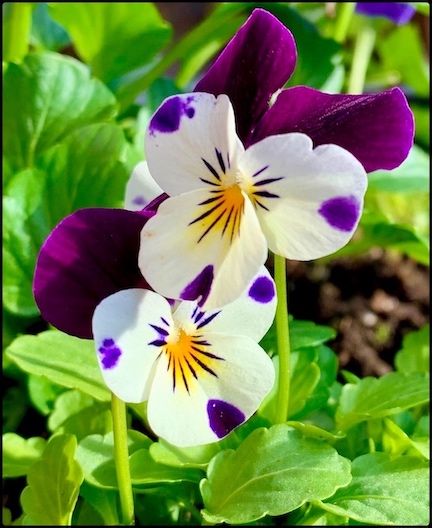
Our garden’s Johnny Jump Ups (Winter Pansies) thrive and flourish in brilliant autumnal Sonshine.
Withinnan is an Old English word (before 1000 A.D.) referring to a motion “from within”.
The Cause of all things, through the beauty, goodness and profusion of His intense Love for everything, goes out of Himself in His Providential care for the whole creation… He relinquishes His utter transcendence in order to dwell in all things while yet remaining within Himself… ~ St. Maximos the Confessor (The Philokalia)
This icon is frequently referred to as the Anastasis or Resurrection Icon. It is an icon of Pascha(Easter).
The golden bars by Christ’s feet are the gates of Hades, which He has broken and torn apart. At Pascha, a tradition includes the cracking of our blessed Pascha eggs together. This represents how Christ shattered the gates of Hades.
There are keys floating in the abyss below, which symbolizes that he has entered and conquered both death and Hades. Some icons have a skeletal figure who is chained up: that’s Death. He has been bound and killed by Christ. All throughout Pascha-tide until the Ascension, we greet each other with,“Christ is Risen, Truly He is Risen!”
The two figures whom Christ has grasped and is pulling out of Hades are Adam and Eve, symbolizing that His Victory redeems all mankind, even back to the beginning.
This Resurrection scene is taking place in the past, present, and future.
To His left, we see three Old Testament saints: Kings David and Solomon, two of His ancestors according to his fleshly nature. We also see, closest to him St. John the Baptist, who was his Forerunner in both life and death. On the right, we have the New Testament, including the apostles who are alive. The purpose is to show that Christ’s redemption transcends time and space. This is an act that happened in the past, is happening right now, and will happen in the future. Christ is always in the state of redeeming and setting us free.
The blue shape around Christ is called the Mandorla (which is Italian for almond, which describes its shape). The Mandorla is the Uncreated, Eternal Light of Christ. In the writings of the Eastern Orthodox mystics, God is often prayerfully experienced as Light. This is not simply a beautiful bright light. It is the same Light which filled the apostles with wonder when they witnessed His Transfiguration. It is the Light which Christ Himself described as the power of the Kingdom of God (Mark 9:1, Matt. 16:28, Luke 9:27). It is also the Light that is seen when one purifies their heart and mind (Blessed are the pure in heart, for they shall see God).
Those who seek God will find that the more they know Him, the less they comprehend Him.
To know God, to experience Him, is to walk from the darkness of sin, into His Light, to enter into the mystery of His Presence. ~ The Ark Youth Quarterly– St. Sophia Orthodox Church
Thank you Fr. Serafim Mull Monastery for kind permission to use St. Caedmon’s Icon.
O sing unto the Lord a new song: sing unto the Lord, all the earth. ~ Psalm 96:1
Speaking to yourselves in psalms and hymns and spiritual songs, singing and making melody in your heart to the Lord; ~ Ephesians 5:19
…a psalm is the work of angels, a heavenly institution, the spiritual incense. ~ St. Basil the Great
Today is St. Caedmon’s Day! This 7th British Saint heard angels sing and wrote the earliest English poem in existence.
It’s heart-piercingly beautiful, and after wading through theseLatin, Northumbrian, West Saxon translationsand sources of his work… I knew this poem was just aching to be adapted into a simpler, modern English read.
Sadly, no original music remains of St. Caedmon’s hymn, and alas and alack, I never found any olden West Saxon melodies to work with… They’re scarcer than hen’s teeth!
You can imagine how thrilling it was to encounter the ancient 13th century Byzantine Greek Chant, Defte Lai–and know how the majestic melody would also suit the adaptation of St. Caedmon’s poem. It’s pure joy to reclaim Defte Lai’s ageless air for another venerable Orthodox Hymn.
Here’s the pdf sheet music for my 2022 adaptation and recording below of St. Caedmon’s Hymn.
3 chords used in this recording – while strumming on my ukulele crutch are: Fm; Cm; and B♭m
St. Caedmon’s Creation Hymn:
Come magnify Him, Creator of the firmament, Author of each and all, And glorify His purpose; Love, Invincible. Come and honour Him, Protector of Fair Paradise, Holy, Mighty, Immortal, Architect, Omnipotent; Father of Glory. Blessed, Timeless, Lord, Thou hast established Thy wonders, Before middle earth* was formed, Or adorned with Thought of Mind; Lord, God Almighty! For the sons of men; Thou formed the Roof of Heaven!
* Middle earth (not just a Tolkien invention)- it means the world, the middle enclosure – which exists between heaven and hell. From Middle English middel-erde, and Old English middangeard.
Through the Holy Prayers of St. Caedmon, may we – through the Wonderful Mystery of Creation, magnify our Blessed and Timeless Lord!
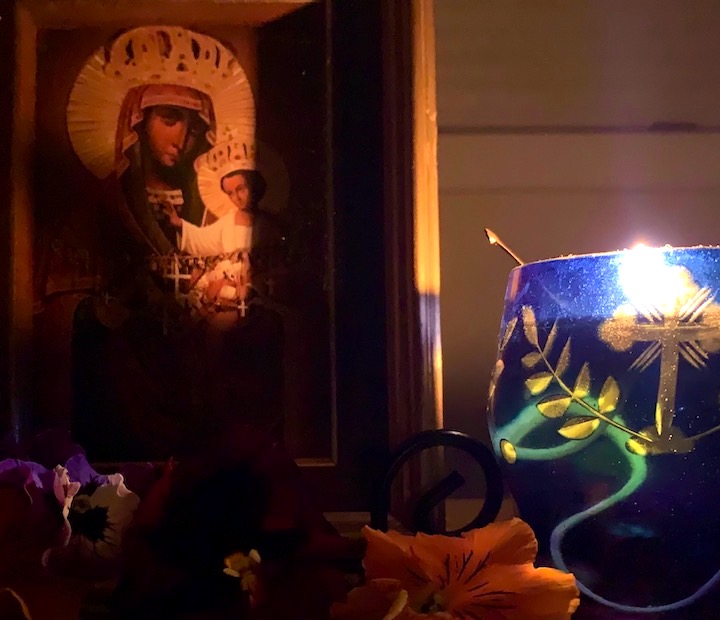
For the health of a dear friend, family prayers were recently said in front of this special Icon, She Who is Quick to Hear.
The original wonderworking icon resides on Holy Mount Athos at the Dokhiareia monastery. There are many copies of it throughout the world. Tradition states the icon was written in the tenth century when the head of this monastery was St. Neophytes – who is also commemorated on theIcon’s Feast DayNovember 22/9. At its first miracle in 1664 AD, our Most Holy Lady Theotokos and Ever Virgin Mary promised, “From this time on, my icon shalt be named Quick-Hearing, and for all hastening to it, shalt there quickly appear, mercy and fulfillment of entreaties.”
To this day, the Most Holy Mother of God continues to fulfill Her promise and quickly offers help and consolation for all, who with faith, hasten to her. She hears every prayer!
This icon, a copy of She Who is Quick to Hear, belonged to my grandmother and given upon her baptism at 89 years of age, by a venerable matushka (the same age as she), who became her godmother, by proxy.
I’ll always remember my grandmother’s first visit to the church after her baptism. It was an arduous journey, for at that time we had no Orthodox church in our city and had to travel by car and ferry, a trip (3-4 hours each way) to church.
Her godmother – an aged matushka, could only speak Russian, and my grandmother could only speak English. However,upon greeting each other joyfully for the first time (before the church service began – and what would be their last time to ever see one another upon this earth), they embraced and chatted non-stop with each other… Matushka Eudocia in Russian, and my grandmother in English! I stood perplexed at this exchange. Then one of them apparently said something amusing to the other, and they both glanced over at me, giggled simultaneously over the anecdote… and happily continued their conversation until the service began.
Journeying home after church, I was bursting to know what my grandma and matushka Eudocia were chatting about? She responded matter-of-factly, “Surely you heard, my dear? You were standing there right beside us… and now Eudocia and I know each other better – before one of us heads off to Glory!”
I asked my grandma howcould she understand matushka Eudocia, because matushka was speaking Russian?!
My grandmother smiled serenely, looked out the car window at the passing scenery and said, “We understood each other perfectly, my dear”.
And that was that!
Little Miracles occur everyday!
Memory Eternal dear Faith, and matushka Eudocia, who through the Power and Mystery of the Holy Spirit… transcended the barrier of language! Amen!
My heart is steadfast, O God, my heart is steadfast! For your steadfast love is great to the heavens, your faithfulness to the clouds. Be exalted, O God, above the heavens! Let your glory be over all the earth! ~ Psalm 7: 7, 10-11
Look at the heavens, and see; and behold the clouds, which are higher than you. ~ Job 35:5
In love did God bring the world into existence; in love does He guide it during its temporal existence; in love is He going to bring it to that wondrous transformed state, and in love will the world be swallowed up in the Great Mystery of Him who has performed all these things. ~ St. Isaac the Syrian
Orthodoxy is a faith that is deep enough to allow her believers to confront the complexities of our human experience, while at the same time recognizing that not all is understood in this life, but viewed as a Mystery. So, the view that believers never doubt, is simply not true. Doubt is not the opposite of faith, but rather the vehicle by which we are challenged to go deeper into the Mystery that is true faith. Nothing keeps we true believers from struggling with uncertainty, for it is this very uncertainty that keeps us from complacency. Complacency is the true enemy of faith, and the inhibitor of spiritual growth. It is complacency that keeps us from the Kingdom of God, and the joy that comes when we are in Communion with Christ. It is not a question of choosing sides, but of surrendering to Divine Wisdom. ~ Abbot Tryphon
In the mystical theology of the Orthodox Church, Wisdom is understood as the Divine Logos (God the Word), Who became Incarnate as Jesus Christ. In Greek, Ἁγία Σοφία (Hagia Sophia) is defined “Holy Wisdom” meaning “Jesus Christ”…The Wisdom and Power of God. ~ 1 Corinthians 1: 24,30; 1 Corinthians 2:7
In the beginning was the Word, and the Word was with God, and the Word was God. The same was in the beginning with God. All things were made by Him, and without Him was not anything made that was made… And the Word was made flesh, and dwelt amongst us; and we beheld His glory, the glory as of the only Begotten of the Father, full of grace and truth… No man hath seen God at any time; the only begotten Son, who is in the bosom of the Father, He hath declared Him. ~ First chapter of 1 John
Shared by a friend… Some Aspects of Surrendering to Divine Wisdom
Surrender = Conscious, Willing, Choice. Surrender = Unconditional Seeking Refuge within the Divine. Surrender = Faith. Surrender = Effort. Surrender = Hope. Surrender = Love. Surrender = Trust. Surrender = Strength. Surrender = Recognizing Blessings. Surrender = Gratitude, Thankfulness. Surrender = Action with Consistent Prayer. Surrender = Communication. Surrender = Understanding that Christ Knows What’s Best For Us.
Accepting God’s Will = Learning to let go, andlet God!