This Icon of Christ the Good Shepherd is used with Fr. Serafim’s kind permission (Mull Monastery).
Make a joyful noise unto the Lord, all ye lands. Serve the Lord with gladness: come before his presence with singing. Know ye that the Lord he is God: it is he that hath made us, and not we ourselves; we are his people, and the sheep of his pasture. Enter into his gates with thanksgiving, and into his courts with praise: be thankful unto him, and bless his name. For the Lord is good; his mercy is everlasting; and his truth endureth to all generations. ~ Psalm 100
Parish Youth Choir recently making a joyful noise unto the Lord, and singing praises!
After reading St. Caedmon’s Hymn from theseLatin, Moore/Leningrad Northumbrian Dialects/Bodleian West Saxon sources and translations – this poem achingly called to me, asking to be adapted further.
I translated it into a more contemporary old English and put my adaptation to the ancient melody of the 13th century Byzantine Hymn: Defte Lai.
Below is my version of St. Caedmon’s Creation Hymn, rusticly sung and recorded, accompanied by my faux-lyre (ukulele) using the chords: Fm; Cm; and B♭m.
Come magnify Him, Creator of the firmament, Author of each and all, And glorify His purpose; Love, Invincible. Come and honour Him, Protector of Fair Paradise, Holy, Mighty, Immortal, Architect, Omnipotent; Father of Glory. Blessed, Timeless, Lord, Thou hast established Thy wonders, Before middle earth* was formed, Or adorned with Thought of Mind; Lord, God Almighty! For the sons of men; Thou formed the Roof of Heaven!
* Middle earth (not just a Tolkien invention)- it means the world, the middle enclosure – which exists between heaven and hell. From Middle English middel-erde, and Old English middangeard.
I’m grateful for the heavenly hymn St. Caedmon has bequeathed to us, and his role in the early English Orthodox church… From his beginnings as a humble shepherd – to his subsequent life as a meek monk in a great, historic, monastery.
When the song of the lips becomes the song of the soul, we’re able to – bit by bit, acquire a small, uplifting, repertoire of prayerful Psalmody from the heart – by singing anytimepraises to the Glory of God!
Thank you Fr. Serafim Mull Monastery for kind permission to use St. Caedmon’s Icon.
O sing unto the Lord a new song: sing unto the Lord, all the earth. ~ Psalm 96:1
Speaking to yourselves in psalms and hymns and spiritual songs, singing and making melody in your heart to the Lord; ~ Ephesians 5:19
…a psalm is the work of angels, a heavenly institution, the spiritual incense. ~ St. Basil the Great
Today is St. Caedmon’s Day! This 7th British Saint heard angels sing and wrote the earliest English poem in existence.
It’s heart-piercingly beautiful, and after wading through theseLatin, Northumbrian, West Saxon translationsand sources of his work… I knew this poem was just aching to be adapted into a simpler, modern English read.
Sadly, no original music remains of St. Caedmon’s hymn, and alas and alack, I never found any olden West Saxon melodies to work with… They’re scarcer than hen’s teeth!
You can imagine how thrilling it was to encounter the ancient 13th century Byzantine Greek Chant, Defte Lai–and know how the majestic melody would also suit the adaptation of St. Caedmon’s poem. It’s pure joy to reclaim Defte Lai’s ageless air for another venerable Orthodox Hymn.
Here’s the pdf sheet music for my 2022 adaptation and recording below of St. Caedmon’s Hymn.
3 chords used in this recording – while strumming on my ukulele crutch are: Fm; Cm; and B♭m
St. Caedmon’s Creation Hymn:
Come magnify Him, Creator of the firmament, Author of each and all, And glorify His purpose; Love, Invincible. Come and honour Him, Protector of Fair Paradise, Holy, Mighty, Immortal, Architect, Omnipotent; Father of Glory. Blessed, Timeless, Lord, Thou hast established Thy wonders, Before middle earth* was formed, Or adorned with Thought of Mind; Lord, God Almighty! For the sons of men; Thou formed the Roof of Heaven!
* Middle earth (not just a Tolkien invention)- it means the world, the middle enclosure – which exists between heaven and hell. From Middle English middel-erde, and Old English middangeard.
Through the Holy Prayers of St. Caedmon, may we – through the Wonderful Mystery of Creation, magnify our Blessed and Timeless Lord!
One thing have I asked of the Lord, that will I seek after: that I may dwell in the house of the Lord all the days of my life, to gaze upon the beauty of the Lord and to meditate in his temple. ~ Psalm 27:4
Sanctify those that love the beauty of Thy house. Glorify them in return by Thy divine power. ~ Prayer behind the Ambo
…whatsoever things are true, whatsoever things are honest, whatsoever things are just, whatsoever things are pure, whatsoever things are lovely, whatsoever things are of good report; if there be any virtue, and if there be any praise, think on these things. ~ Philippians 4:8
Numinous beauty is found in the physical and spiritual splendour surrounding us!
We perceive God’s grace through the noetic beauty of nature. Our souls sense itwhen we throw open the doors of our heart and gaze upon the holy icons at Church. We smell it in the sweet fragrance of pure beeswax candles, the bouquets of flowers, and the clouds of billowing incense. We hearit in the joyful voices singing hymns and psalms of praise. We tasteit in the Holy Mysteries, the antidoron and prosphora. We experience His Mercy of Peace through the powerful permeation of communal prayer at Divine Liturgy.
Fyodor Dostoevsky once wrote: Beauty will save the world.
True Beauty points to God… Who exudes and transcends Inexpressible Beauty in everything, through the Glorious, Gladsome Light of His Divinity!
Nothing elevates the soul, nothing gives it wings as a liturgical hymn does. A holy hymn gives birth to piety of soul, creates a good conscience, and is accepted by God in the treasuries of the heavens. ~ St. John Chrysostom
Bis orat qui cantat. (Means) He who chants prays twice. ~ Ancient Proverb
Psalmody – bringing about choral singing, a bond, as it were, toward unity, and joining people into a harmonious union of one choir – produces also the greatest of blessings: love. ~ St. Basil the Great
When you worship God with hymns, you should be worshipping Him with your entire being: your voice should sing; your heart should also sing; and your life should also sing. Everything should sing! ~ Blessed Augustine
Music is unique among the liturgical arts in that it’s something we have to do every time we come to church. Iconography, architecture, church furnishings, liturgical books, all these are things an artist can produce once and be done with. But music is never finished. As soon as you sing a note it vanishes forever. As soon as the service is over, whatever beauty you achieved during it has to be produced all over again in the next service. ~ Rowan Benedict Sheehan
Prayer is food for the soul. Do not starve the soul, it is better to let the body go hungry… ~St. Joseph of Optina
You don’t have a soul. You are a soul. You have a body. ~C. S. Lewis
Through greed we underwent the first stripping, overcome by the bitter tasting of the fruit, and we became exiles from God. But let us turn back to repentance and, fasting from the food that gives us pleasure, let us cleanse our senses on which the enemy makes war. Let us strengthen our hearts with the hope of grace, and not with foods which brought no benefit to those who trusted in them. Our food shall be the Lamb of God, on the holy and radiant night of His Awakening: the Victim offered for us, given in communion to the disciples on the evening of the Mystery, who disperses the darkness of ignorance by the Light of His Resurrection. ~ Aposticha, Vespers – evening of Sunday of the Last Judgement
Do that which is good, and no evil shall touch you. Prayer is good with fasting and alms and righteousness. A little with righteousness is better than much with unrighteousness. It is better to give alms than to lay up gold: For alms doth deliver from death, and shall purge away all sin. Those that exercise alms and righteousness shall be filled with life: But they that sin are enemies to their own life. ~ Archangel Raphael, Tobit 12:7-10
One should not think about the doings of God when one’s stomach is full; on a full stomach there can be no vision of the Divine mysteries. ~St. Seraphim of Sarov
It is necessary for a Christian to fast, in order to clear his mind, to rouse and develop his feelings, and to stimulate his will to useful activity. These three human capabilities we darken and stifle above all by ‘surfeiting, and drunkenness, and cares of this life’ (Lk. 21:34). ~ St. John of Kronstadt
Many human activities, good in themselves, are not good because of the motive for which they are done. For example, fasting and vigils, prayer and psalmody, acts of charity and hospitality are by nature good, but when performed for the sake of self-esteem they are not good. ~ St. Maximos the Confessor
Devils take great delight in fullness, and drunkenness and bodily comfort. Fasting possesses great power and it works glorious things. To fast is to banquet with angels. ~ St. Athanasius the Great
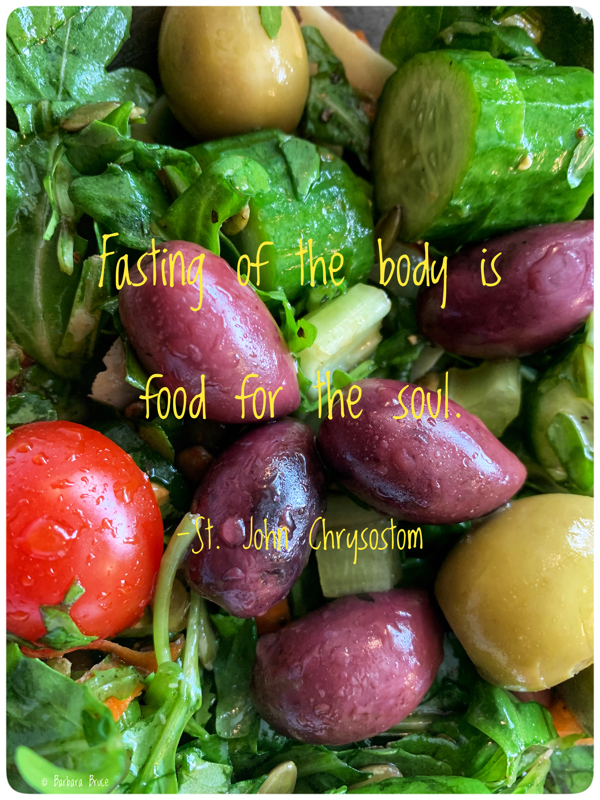
Let the mouth also fast from disgraceful speeches and railings. For what does it profit if we abstain from fish and fowl and yet bite and devour our brothers and sisters? The evil speaker eats the flesh of his brother and bites the body of his neighbour. ~St. John Chrysostom