Eve of Nativity Greetings

Past Orthodox Christmas Postings Resource ⭐️

On the Night of Nativity ~ 7th Century Homily

This Nativity night [Christ] bestowed peace on the whole world;
So let no one threaten;
This is the night of the Most Gentle One –
Let no one be cruel;
This is the night of the Humble One –
Let no one be proud.
Now is the day of joy –
Let us not revenge;
Now is the day of Good Will –
Let us not be mean.
In this Day of Peace –
Let us not be conquered by anger.
Today the Bountiful One impoverished Himself for our sake;
So, rich one, invite the poor to your table.
Today we receive a Gift for which we did not ask;
So let us give alms to those who implore and beg us.
This Day opens the heavenly doors to our prayers;
Let us open our door to those who ask our forgiveness.
Today the Divine One took upon Himself the seal of our humanity,
In order for humanity to be adorned by the Seal of Divinity.

~ by St. Isaac the Syrian, 7th century

Parish Youth Choir sang this short Nativity piece (virtually), back in 2020. Their merry voices rang out like silver trumpets, with the lyrics from St. Isaac the Syrian’s poem above, and put to my music.

Below, our Parish Choir (recorded in 2014) sings the ancient Nativity Kontakion (a short hymn of a feast or a saint) composed by 6th century St. Romanos the Melodist:


…Wishing you a blessed Nativity Feast tomorrow, and a joyous Twelve Days of Christmas!

Autumnal Prayer

Image by Joe from Pixabay

Satisfy us in the morning with your steadfast love, that we may rejoice and be glad all our days. ~ Psalm 90:14

November 27/14

Happy Eve of the Nativity Fast!

Tomorrow we begin our spiritual pilgrimage into the Advent season… to contemplate the upcoming Great Feast of Christ’s Incarnation.

Just like Great Lent is before Easter/Pascha, the ancient Nativity Fast is a reflective, joyful time for spiritual preparation – nourished with prayer, love of one’s neighbour, and generous almsgiving.

Each fast is fresh, new, and a collective reminder to shift focus away from oneself, and onto the needs of others, instead.

Together we’ll begin the late autumnal journey with sweeping the dried leaves and debris away from body and soul.

We fast before we feast, and the feasting aspect is saved to start on the actual Nativity Feast Day itself, including the following bright “12 days of Christmastide”.  

May your Nativity Fast be peaceful and fruitful!

With love in Christ.

A Little is a Lot

Image by Myriams-Fotos from Pixabay

If you can help a person – help, if you cannot help – pray, if you do not know how to pray – think about the person in a good way! And this will already be a help, because godly thoughts [towards others] are also alms! ~ St. Nikolai Velimirovich

And He looked up and saw the rich putting their gifts into the treasury, and He saw also a certain poor widow putting in two mites [very small copper coins]  So He said, “Truly I say to you that this poor widow has put in more than all; for all these out of their abundance have put in offerings for God, but she out of her poverty put in all the livelihood that she had.” ~ St. Luke 21:1-4

Each one must give as he has decided in his heart, not reluctantly or under compulsion, for God loves a cheerful giver. ~ 2 Corinthians 9:7

It often seems those who possess the least (materially), are the most generous with others. Digging deeply into the pockets of their hearts, they’ll happily give away their own last “widow’s mite” to someone else… who, to them, appear to be in greater need.

God’s blessings abound, when we (without judging what others may do with what we give them, and without expecting anything in return) give from our needs, and not from our surplus.

It’s doubly blessed to give alms in memory of someone by saying, “Please accept this in memory of (Name).”

If we have no material alms available to give, we can always share the Gladsome Light and Love of Christ – through a warm smile, a kind word, and heartfelt prayer offered to God, on their behalf.

…And remember the words of the Lord Jesus, that He said, ‘It is more blessed to give than to receive.’ ~ Acts 20:35

 For I was an hungered, and ye gave me meat: I was thirsty, and ye gave me drink: I was a stranger, and ye took me in: Naked, and ye clothed me: I was sick, and ye visited me: I was in prison, and ye came unto me. Then shall the righteous answer him, saying, Lord, when saw we thee an hungered, and fed thee? or thirsty, and gave thee drink? When saw we thee a stranger, and took thee in? or naked, and clothed thee? Or when saw we thee sick, or in prison, and came unto thee? And the King shall answer and say unto them, Verily I say unto you, Inasmuch as ye have done it unto one of the least of these my brethren, ye have done it unto me. ~ St. Matthew 25:35-40

Blessed are the merciful: for they shall obtain mercy. ~ St. Matthew 5:7

Eleos

Image by congerdesign Pixabay

Greetings on Clean Friday!

The word alms in Old English was aelmysse. In Latin – eleemosyna.

Alms in Greek is eleemosune – meaning compassion; while eleemon and eleos, also used for alms – imply mercy.

Blessed are the merciful, for they shall obtain mercy. ~ Matthew 5:7

A poor man when he reaches out to you does not beg, but offers you the Kingdom of God. ~ St. Arsenie Papacioc

He who gives alms in imitation of God does not discriminate between the wicked and the virtuous, the just and the unjust, when providing for men’s bodily needs. ~ St. Maximos the Confessor

Sins are purged by alms and acts of faith. ~ St. Clement of Alexandria

May your Lenten Journey be peaceful and fruitful.

In His Garden

Candlelight Streams onto Flowers by the Most Holy Theotokos Icon

We have so many things to be thankful for! Our daily bread, health, family, friends, prayers and kindness from others, and all the so-called ordinary things mistakenly taken for granted – that aren’t ordinary at all.

Children seem more observant of blessings. A mother just shared something precious. Their family baked a Saint Basil’s Day Cake for the Feast yesterday, and her youngest received the special $2 coin hidden in the cake. The thoughtful child insisted the mother take the coin and find a way to give it to the homeless. The child said, “I have everyfing, and some don’t have nuffin’!”

Everything is God’s and we are His guests… although sometimes we feel that everything belongs to us. We become used to His many blessings and blindly expect that all good things are a given.

Nothing stays the same. Everything changes… Except God.

Let’s make efforts to be considerate houseguests appreciating our Divine Host’s Bountiful Blessings.

For, when we’re out in nature, or in church, or going about our daily lives, we are in His Garden, surrounded by the Beauteous Art of Creation.

With opened eyes, we glimpse it… everywhere.

For as long as you are on earth, consider yourself a guest in the Household of Christ. If you are at the table, it is He who treats you. If you breathe air, it is His air you breathe. If you bathe, it is in His water you are bathing. If you are traveling, it is over His land that you are traveling. If you are amassing goods, it is His goods you are amassing. If you are squandering, it is His goods that you are squandering. If you are powerful, it is by His permission that you are strong. If you are in the company of men, you and the others are His guests. If you are out in nature, you are in His garden. If you are alone, He is present. If you set out or turn anywhere, He sees you. If you do anything, He remembers. He is the most considerate Householder by Whom you were ever hosted. Be careful then toward Him. In a good household, the guest is required to behave. These are all simple words but they convey to you a great truth. All the saints knew this truth and they governed their lives by it. That is why the Eternal Householder rewarded them with eternal life in heaven and glory on earth. ~St. Nikolai Velimirovich

Happy 3rd Day of Christmas

Christ is Born!

Today we celebrate Righteous Joseph the Betrothed, protector of the Virgin Mary, as well as the Feast of St. Stephen the Archdeacon and Protomartyr.

St. Stephen was one of the seven original deacons of the Church, ordained by the Apostles to care for widows and the poor.

The eastern church observes St. Stephen’s Day on the third day of Nativity, and not on the second day, as western churches do. Since times of antiquity, on this day the Church Collection Boxes, of cash, food and clothing hampers were opened and given to the poor and needy... the Original meaning of Boxing Day!

Of course, it’s spiritually beneficial to distribute alms in the memory of a loved one, not only at Christmas, but on any day of the year. …Ye who now will bless the poor, shall yourselves find blessing! Many have heard about the “Feast of St. Stephen” from Good King Wenceslas(Prince of Czechs), a carol set to a 13th century melody. (St. Wenceslas’s grandmother was St. Ludmilla)

An Everyday Carol below – by 9th century St. Joseph the Hymnographercan be sung to the 13th century melody we know as Good King Wenceslas!

Christian friends, your voices raise, wake the day with gladness.

God Himself to joy and praise, turns our human sadness:

Joy that martyrs won their crown, opened heaven’s portal,

When they laid the mortal down, for the Life Immortal.

Christ is Born! Glorify Him!

Perfect Love

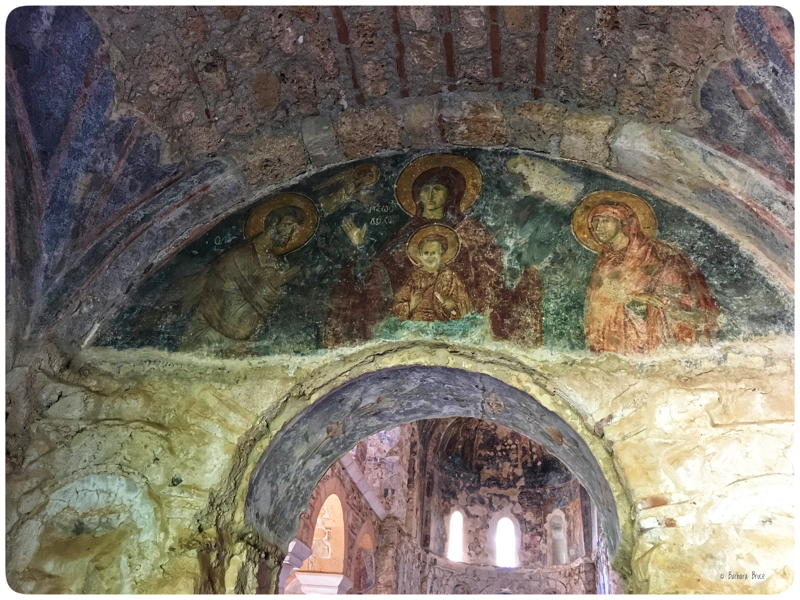
Ruins in Mystras, Greece 2006

He has yet no perfect love, whose disposition towards men depends on what they are like, loving one and despising another for this or that, or sometimes hating one and the same man. Blessed is the man who can love all men equally. ~ St. Maximos the Confessor (Philokalia)

If you cannot find Christ in the beggar at the church door, you will not find him in the chalice. ~ St. John Chrysostom

Almsgiving

Widow with the Two Mites – Mosaic, St. Sophia Orthodox Church, Canada

Jesus looked up and saw the rich putting their gifts into the offering box, and he saw a poor widow putting in two mites *. And he said, “Truly, I tell you, this poor widow has put in more than all of them. For they all contributed out of their abundance, but she out of her poverty put in all she had to live on. ~ St. Luke 21: 1-4. [* Mites, from the Greek lepta, meaning very small copper coins]

Almsgiving above all else requires money, but even this shines with a brighter luster when the alms are given from our poverty. The widow who paid in the two mites was poorer than any human, but she outdid them all. ~ St. John Chrysostom

Feeding the hungry is a greater work than raising the dead. ~ St. John Chrysostom

He who gives alms in imitation of God does not discriminate between the wicked and the virtuous, the just and the unjust, when providing for men’s bodily needs. ~ St. Maximos the Confessor 

Love the poor, and through them you will find mercy... If you give something to one in need, let the cheerfulness of your face precede your gift, and comfort his sorrow with kind words. When you do this, by your gift the gladness of his mind surpasses even the needs of his body. ~ St. Isaac the Syrian

The bread you do not use is the bread of the hungry. The garment hanging in your wardrobe is the garment of the person who is naked. The shoes you do not wear are the shoes of the one who is barefoot. The money you keep locked away is the money of the poor. The acts of charity you do not perform are the injustices you commit. ~ St. Basil the Great

Radonitsa

Christ is Risen!

The Tuesday of St. Thomas week is called Radonitsa, and known as the Day of Rejoicing.

On this day, and with Paschal Joy, we remember all who have reposed in the faith. Orthodox graves are blessed by priests and visited by the faithful.

It is hard for most parishes to gather at the graves on weekdays. So, the graves are blessed instead on St. Thomas Sunday, after the Divine Liturgy. When possible, this is followed by a traditional, joyous, communal picnic at the cemetery.

In any case, is important, to visit the graves of loved ones at any time during the 40 days of Pascha-tide; and to greet them saying or singing Christ is Risen

For he is not a God of the dead, but of the living: for all live unto him.

Truly He is Risen!

Soul Food

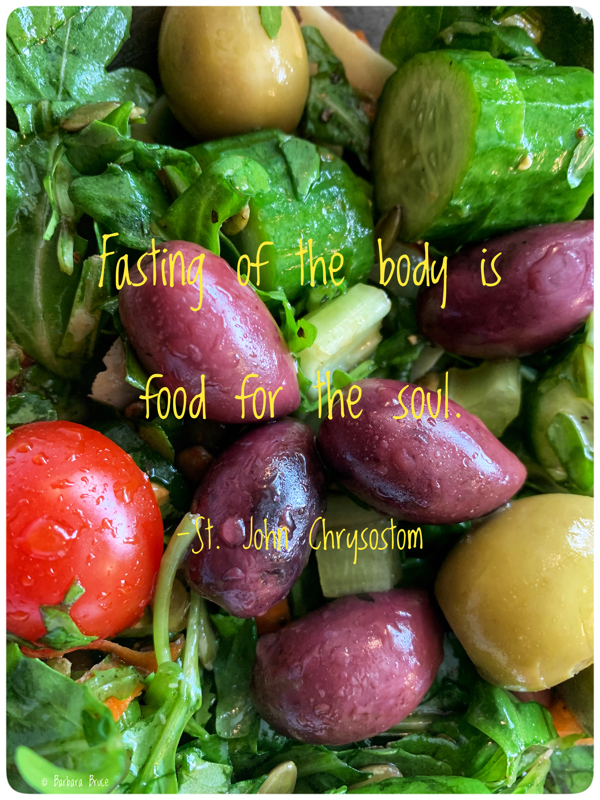
Prayer is food for the soul. Do not starve the soul, it is better to let the body go hungry… ~ St. Joseph of Optina

You don’t have a soul. You are a soul. You have a body. ~C. S. Lewis

Through greed we underwent the first stripping, overcome by the bitter tasting of the fruit, and we became exiles from God. But let us turn back to repentance and, fasting from the food that gives us pleasure, let us cleanse our senses on which the enemy makes war. Let us strengthen our hearts with the hope of grace, and not with foods which brought no benefit to those who trusted in them. Our food shall be the Lamb of God, on the holy and radiant night of His Awakening: the Victim offered for us, given in communion to the disciples on the evening of the Mystery, who disperses the darkness of ignorance by the Light of His Resurrection. ~ Aposticha, Vespers – evening of Sunday of the Last Judgement

Do that which is good, and no evil shall touch you. Prayer is good with fasting and alms and righteousness. A little with righteousness is better than much with unrighteousness. It is better to give alms than to lay up gold: For alms doth deliver from death, and shall purge away all sin. Those that exercise alms and righteousness shall be filled with life: But they that sin are enemies to their own life. ~ Archangel Raphael, Tobit 12:7-10

 One should not think about the doings of God when one’s stomach is full; on a full stomach there can be no vision of the Divine mysteries. ~St. Seraphim of Sarov

It is necessary for a Christian to fast, in order to clear his mind, to rouse and develop his feelings, and to stimulate his will to useful activity. These three human capabilities we darken and stifle above all by ‘surfeiting, and drunkenness, and cares of this life’ (Lk. 21:34). ~ St. John of Kronstadt

Many human activities, good in themselves, are not good because of the motive for which they are done. For example, fasting and vigils, prayer and psalmody, acts of charity and hospitality are by nature good, but when performed for the sake of self-esteem they are not good. ~ St. Maximos the Confessor

Devils take great delight in fullness, and drunkenness and bodily comfort. Fasting possesses great power and it works glorious things. To fast is to banquet with angels. ~ St. Athanasius the Great

Let the mouth also fast from disgraceful speeches and railings. For what does it profit if we abstain from fish and fowl and yet bite and devour our brothers and sisters? The evil speaker eats the flesh of his brother and bites the body of his neighbour. ~St. John Chrysostom

error: Content is protected !!