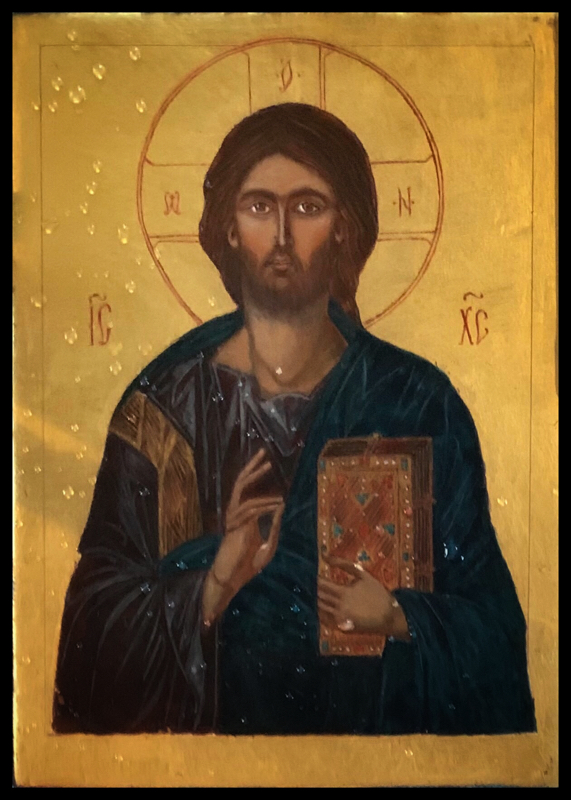
The Splendour of Icons

Beaded droplets of Holy Water grace a newly blessed icon of Our Lord Jesus Christ. Note the ancient lettering style inscriptions. Icons are venerated and not worshipped. They are beautiful, spiritual, windows into heaven.

– I venerate the Creator… who came down to his creation without being lowered or weakened, that He might glorify my nature and bring about communion with the divine nature. …Therefore I am emboldened to depict the invisible God, not as invisible, but as He became visible for our sake, by participation in flesh and blood. I do not depict the invisible divinity, but I depict God made visible in the Flesh. ~ St. John Damascene

The Church, through the temple and Divine service, acts upon the entire man, educates him wholly; acts upon his sight, hearing, smelling, feeling, taste, imagination, mind, and will, by the splendour of icons and of the whole temple, by the ringing of bells, by the singing of the choir, by the fragrance of the incense, the kissing of the Gospel, of the cross and the holy icons, by the prosphoras, the singing, and sweet sound of the readings of Scripture. ~ St. John of Kronstadt (My Life in Christ)

Icons in churches and houses are necessary because they remind us of the immortality of the saints; that they live unto Him, that in God they see, hear, and help us. ~ St. John of Kronstadt

Church services, that is, all the daily services, together with the entire arrangement of the church’s icons, candles, censing, singing, chanting, movements of the clergy, as well as the services for various needs (e.g., Molebens, Pannikhidas, etc.); then services in the home, also using ecclesiastical objects such as sanctified icons, holy oil, candles, holy water, the Cross, and incense – all of these holy things together acting upon all the senses – sight, hearing, smell, touch, and taste – are the cloths that wipe clean the senses of a deadened soul. They are the strongest and only reliable way to do it… The entire structure of our Church services, with their tone, meaning, power of faith, and especially the grace concealed within them, have an invincible power to drive away the spirit of the world. ~ St. Theophan the Recluse (The Path to Salvation)
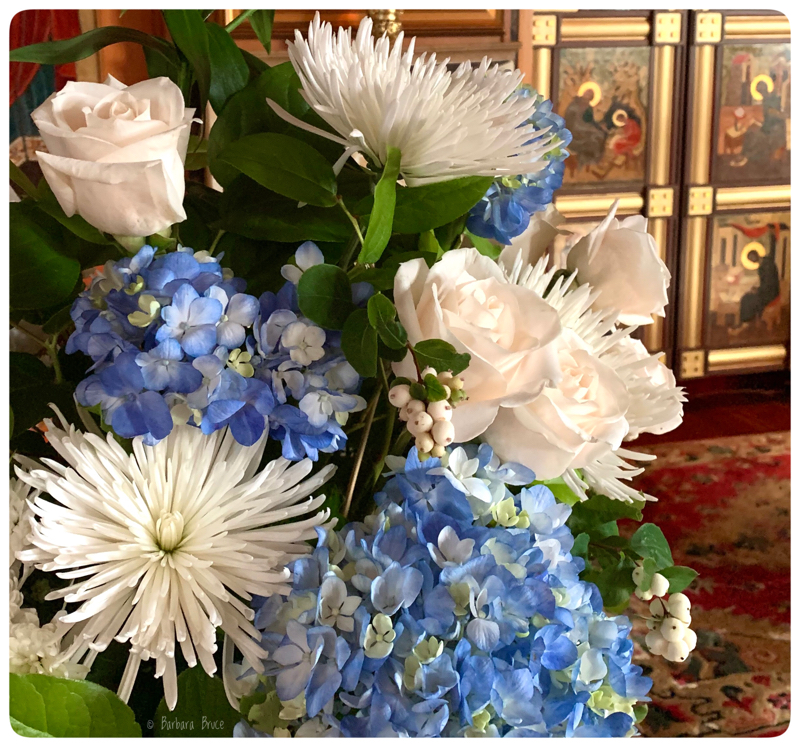
As From One Great Heart

You cannot pray at home, like you can at church, where there is a great multitude; where exclamations are cried out to God as from one great heart, and where there is something more: the unions of minds, the accord of souls, the bond of charity, the prayers of priests. ~ St. John Chrysostom

The Church, through the temple and Divine service, acts upon the entire man, educates him wholly; acts upon his sight, hearing, smelling, feeling, taste, imagination, mind, and will, by the splendour of the icons and of the whole temple, by the ringing of the bells, by the singing of the choir, by the fragrance of the incense, the kissing of the Gospel, of the cross and the holy icons, by the prosphoras, the singing, and sweet sound of readings of the Scriptures. ~St. John of Kronstadt

We ought to have the most lively spiritual union with the heavenly inhabitants, with all the saints, apostles, prophets, martyrs, prelates, venerable and righteous men, as they are all members of one single body, The Church of Christ, to which we sinners also belong, and the living Head of which is the Lord Jesus Christ Himself. This is why we call upon them in prayer, converse with them, thank and praise them. It is urgently necessary for all Christians to be in union with them, if they desire to make Christian progress; for the saints are our friends, our guides to salvation, who pray and intercede for us. ~ St. John of Kronstadt

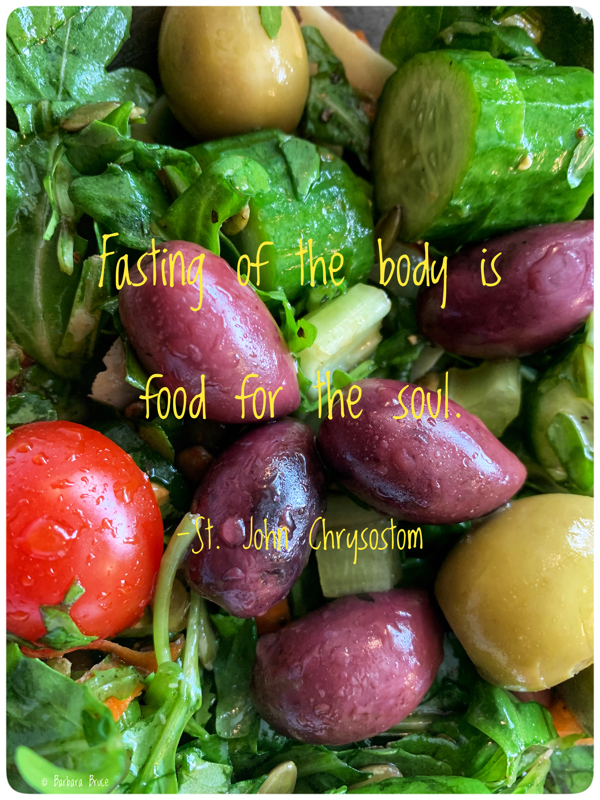
Soul Food

Prayer is food for the soul. Do not starve the soul, it is better to let the body go hungry… ~ St. Joseph of Optina

You don’t have a soul. You are a soul. You have a body. ~C. S. Lewis

Through greed we underwent the first stripping, overcome by the bitter tasting of the fruit, and we became exiles from God. But let us turn back to repentance and, fasting from the food that gives us pleasure, let us cleanse our senses on which the enemy makes war. Let us strengthen our hearts with the hope of grace, and not with foods which brought no benefit to those who trusted in them. Our food shall be the Lamb of God, on the holy and radiant night of His Awakening: the Victim offered for us, given in communion to the disciples on the evening of the Mystery, who disperses the darkness of ignorance by the Light of His Resurrection. ~ Aposticha, Vespers – evening of Sunday of the Last Judgement

Do that which is good, and no evil shall touch you. Prayer is good with fasting and alms and righteousness. A little with righteousness is better than much with unrighteousness. It is better to give alms than to lay up gold: For alms doth deliver from death, and shall purge away all sin. Those that exercise alms and righteousness shall be filled with life: But they that sin are enemies to their own life. ~ Archangel Raphael, Tobit 12:7-10

 One should not think about the doings of God when one’s stomach is full; on a full stomach there can be no vision of the Divine mysteries. ~St. Seraphim of Sarov

It is necessary for a Christian to fast, in order to clear his mind, to rouse and develop his feelings, and to stimulate his will to useful activity. These three human capabilities we darken and stifle above all by ‘surfeiting, and drunkenness, and cares of this life’ (Lk. 21:34). ~ St. John of Kronstadt

Many human activities, good in themselves, are not good because of the motive for which they are done. For example, fasting and vigils, prayer and psalmody, acts of charity and hospitality are by nature good, but when performed for the sake of self-esteem they are not good. ~ St. Maximos the Confessor

Devils take great delight in fullness, and drunkenness and bodily comfort. Fasting possesses great power and it works glorious things. To fast is to banquet with angels. ~ St. Athanasius the Great

Let the mouth also fast from disgraceful speeches and railings. For what does it profit if we abstain from fish and fowl and yet bite and devour our brothers and sisters? The evil speaker eats the flesh of his brother and bites the body of his neighbour. ~St. John Chrysostom

error: Content is protected !!