The Isles of the Sea

Icon of All the Saints of the British Isles

Today we celebrate All the Saints of Great Britain.

These Spiritual Blossoms of the Isles (circa 37 A.D. to 1054 A.D.) are rooted in England, Scotland, Ireland, Cornwall, and Wales, and continue to exude their Spiritual Fragrance today!

The saints are shown to be fair blossoms of the Garden of Eden, laden with the nectar of good works and the sweet scent of Orthodox teachings, whereby our souls are fed and our spiritual thirst is quenched, Come ye therefore, let us hasten beneath their shade and let us bless them as the delight and adornment of the Isles, and as a model and pattern for our lives, for they have received unfading crowns of glory and all together they beseech the Pre-Eternal God for us. ~ Ikos

A Brief History of Orthodox England

Timeline of Orthodoxy in the British Isles

Throughout the whole world, God’s Name is glorified in the memory of His saints, and as all are alive in Christ, the saints are our friends, and alive in Heaven. They are venerated, but not worshipped… and having run the race and the course of faith, they are glorified.

We live together with them (the Saints in heaven), in the house of the Heavenly Father, only in different parts of it. We live in the earthly, they in the heavenly half; but we can converse with them, and they with us. ~ St. John of Kronstadt

In God and in His Church there is no division between the living and the departed, but all are one in the love of the Father. Whether we are alive or whether we are dead, as members of the Church we still belong to the same family, and still have a duty to bear one another’s burdens. Therefore just as Orthodox Christians here on earth pray for one another and ask for one another’s prayers, so they pray for the faithful departed and ask the faithful departed to pray for them. Death cannot sever the bond of mutual love which links the members of the Church together. ~ Metropolitan Kallistos Ware

Wherefore seeing we also are compassed about with so great a cloud of witnesses, let us lay aside every weight, and the sin which doth so easily beset us, and let us run with patience the race that is set before us, Looking unto Jesus the author and finisher of our faith… Hebrews 12:1-2

From the ends of the earth, O Lord, the Isles of the Sea offer Thee all the saints who have shone forth therein as the fair fruit of Thy salvific splendour. Through their supplications and through the Theotokos, preserve Thy Church and Thine Isles in the profoundest peace, O most Merciful One. ~ Festal Troparion for All the Saints of the British Isles

Today the choirs of the saints who have pleased God in the Isles, standeth in the Church and invisibly prayeth to God for us. With them the angels give glory; and all the saints of the Church of Christ celebrate with them, and all together they beseech the Pre-Eternal God for us. ~ Kontakion Tone 3

We magnify thee, O all ye saints who have shone forth in the Isles, and we honour thy holy memory, for ye intercede with Christ our God on our behalf. ~ Saints of the British Isles Magnification

O all ye Saints of the British Isles, pray to God for us!
My God, My Confidence

Featured Image shared by Anastasia

Is not your reverence your confidence? And the integrity of your ways your hope? ~ Job 4:6

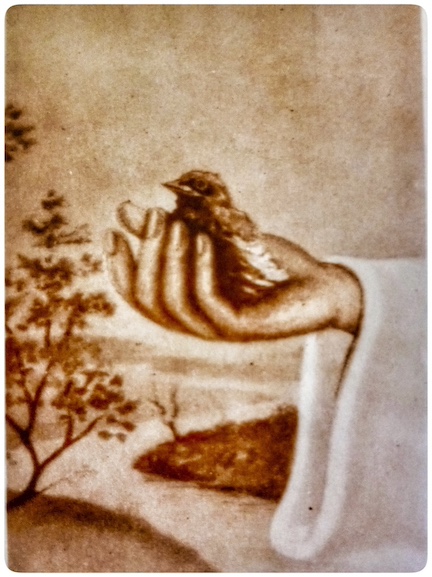
“A visible thought for today these many years later… from a beautiful card, celebrating my friend’s high school graduation in 1963. The sentiment on the back of the card reads, My God, my Confidence. The girl whose graduation this card announced attended a program sponsored by the saintly Little Sisters of the Poor in Los Angeles, for high school girls interested in joining their Community. Her name was Cecilia and her elder sister was and still is a Little Sister of the Poor. Cecilia died a few years ago. Eternal Memory to her who introduced me to the Little Sisters at their Home For the Aged where we volunteered in high school. Now, I’m the “Aged” referenced in the title!” ~ Anastasia

Memory Eternal Julia and family on the day of Julia’s interment. Julia was a wonderful Sister in Christ, and an amazing alto singer in the church choir, whose warm, rich voice reminded me of a heavenly bird’s. In the past, she raised finches, and I can remember them singing joyfully in her home as they flitted about in their large cages by the bright window. Julia was an accomplished, professional artist and art teacher, who loved to draw and paint many things, including all kinds of birds. Anastasia’s card with the sparrow being held in God’s Hands reminded me of Julia, her love for birds, and that right now, God has Julia’s gentle soul in His Loving Hands.

Even the sparrow has found a home… ~ Psalm 84:3

Do not fear therefore; you are of more value than many sparrows. ~ St. Matthew 10:31

Are not five sparrows sold for two copper coins? And not one of them is forgotten before God. But the very hairs of your head are all numbered. Do not fear therefore; you are of more value than many sparrows. ~ St. Luke 12:6-7

The feature image of the 1963 Graduation Card, reminds me of hope. I pray that some day after completing this School of Life, we may all take flight and Graduate in Heaven! Amen!

Divine Choreography

A Gardener’s Delight!

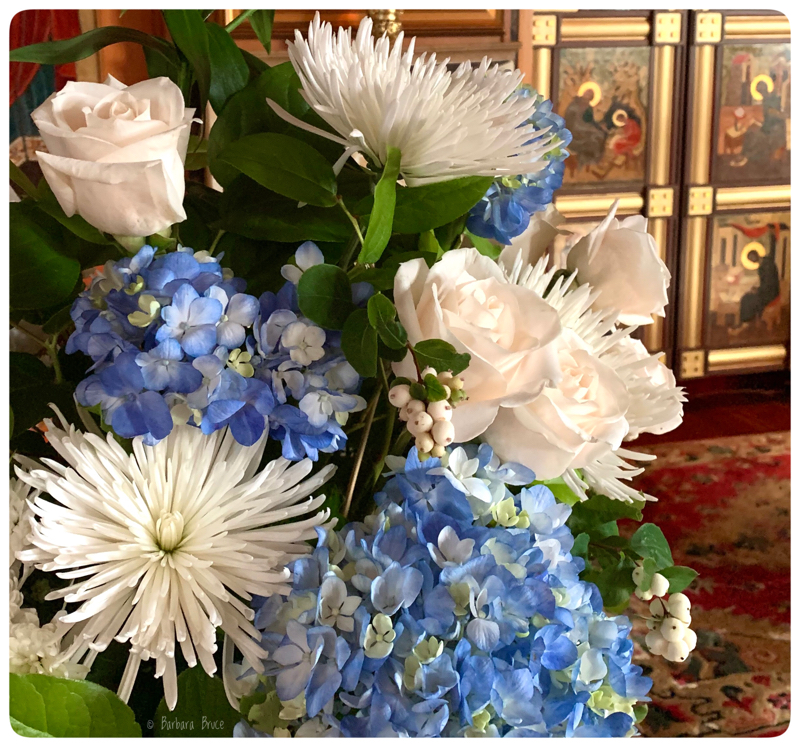
Final Encore of one diverse Floral Troupe’s whirling, spinning, Petal Pirouette [Pronounced pee-rooet]! ~ photo shared by Melania

Christ is Risen!

Celestial Music
Out of Eternity
Music was heard,
And into Infinity
Straightaway flowed,
All chaos along with it
Taking away.
In the chasm like a whirlwind
The stars began swirling,
Their every ray singing
Like musical strings,
And life, being stirred
By this Divine Vibration,
Shows only to him
Its true inspiration,

Who is sometimes attune
To this music celestial,
Whose mind is wide open,
Whose heart is aflame.
~ Y.P. Polonsky

In the Sacrament of Holy Baptism, the godparent holds or follows the newly-illumined (depending on their age) behind the priest, three times around the Baptismal Font, clasping a baptismal candle which symbolizes the Divine Light of Christ. The Procession is like a joyful dance as we embark upon the first few steps of our new life in Christ, while the clergy and choir sing, “As many as have been baptised into Christ, have put on Christ. Alleluia!”

In the Sacrament of Holy Matrimony, the Priest leads the couple in a Procession around the stand on which the Holy Gospel and Blessing Cross have been placed. Here too, the choir sings as the husband and wife take their first steps of holy wedlock together, and the Church (symbolized by the Priest leading the way) will help guide them in the way they should step. This part of the ceremony is sometimes called the Dance of Isaiah or the Dance of Life.

Let all the trees of the forest dance and sing, let all the trees clap their hands. ~ Sunday of the Cross

Whether with people or in nature, there is a Divine Choreography and it’s on us (of free will) to learn the Qualities of Movement to Life’s Dance of Truth. Through practice, we can move gracefully to any new melody. If we inadvertently have our own toes painfully trod upon during the Great Dance of Life, there is St. Paisios’ dynamic quote: So in every test, let us say: “Thank you, my God, because this was needed for my salvation.” Remembering this helps reset our internal rhythm… it enables us to glide forward… it inspires us to kick up our heels again with joyattuned anew… to the Divine Vibration!

The grass withers, the flower fades, but the word of our God will stand forever. ~ Isaiah 40:8

Like Fragrant Incense

Image by Dimitris Vetsikas from Pixabay

An Upstairs Cliros Where Choir Sings Behind Congregation

Music is unique among the liturgical arts in that it’s something we have to do every time we come to church. Iconography, architecture, church furnishings, liturgical books, all these are things an artist can produce once and be done with. But music is never finished. As soon as you sing a note it vanishes forever. As soon as the service is over, whatever beauty you achieved during it has to be produced all over again in the next service. ~Benedict Sheehan

Beautiful church singing comes through prayer, attention to the hymns’ text, and by actively watching the director. Liturgical singing is both a physical and spiritual effort… It’s our living Prayer Before the Ambo.

St. Augustine says, When you sing, you pray twice.

For millennium, while Christian Choristers have basked in the spiritual blessings of psalmody, science has more recently determined the physical health benefits of singing. It’s been documented that choral singing synchronizes the choir’s heart rates – especially during slow chants.

In choral church singing, single voices should never stand out. Individuality ceases when we humbly work on hearing each another. Listening carefully is the only way a choir can blend properly to create true harmony. This could be said in regards to many other things in life.

When one has spare time, it’s wonderful to also sing at home… with or without accompaniment. It literally keeps one out of mischief for awhile (yes!), and uplifts our spirits.

Singing spiritual songs from the heart at any time is a musical metamorphosis. Hymns of consolation, joy and thanksgiving help us grow closer to God… and He blesses all who engage in the beauty of His Church!

We ought to offer up doxologies to God with a humble heart, in order that they may be welcome, like fragrant incense. ~ St. John Chrysostom

Let the word of Christ dwell in you richly, teaching and admonishing one another in all wisdom, singing psalms and hymns and spiritual songs, with thankfulness in your hearts to God. ~ Colossians 3:16 

Sing praises to God, sing praises! Sing praises to our King, sing praises! ~ Psalm 47:6 

Oh sing to the Lord a new song; sing to the Lord, all the earth! ~ Psalm 96:1

Make a joyful noise to the Lord, all the earth; break forth into joyous song and sing praises! ~ Psalm 98:4 

Serve the Lord with gladness! Come into his presence with singing!  ~ Psalm 100:2

I will sing to the Lord as long as I live; I will sing praise to my God while I have being. ~ Psalm 104:33

Sing to him, sing praises to him; tell of all his wondrous works!  ~ Psalm 105:2

Mondegreens

Spring garden flowers line our Pascha Basket.

Christ is Risen!

I would like to share just a couple of past musical mondegreens. A mondegreen is a mis-hearing or misinterpretation of a phrase that gives it a new meaning. 

For instance… during my early childhood years in the Baptist Church, there’s a lovely Easter hymn I adored, which (I thought) was titled “At Calgary” Couldn’t really say why we were singing about a Canadian city at Easter, but people in the pews would nod and smile when us kids belted out those last two words to the refrains: Mercy there was great and grace was free, Pardon there was multiplied to me, There my burdened soul found liberty, At Calgary! One year at Easter, when I could read better, I sheepishly realized the last line of each stanza was actually At Calvary… a holy location which had nothing to do with the province of Alberta.

As an adult in the Orthodox Church, I sing in the choir and for awhile my music stand housed an older choir book. At the ends of certain sections on the faded liturgical sheet music, there was hand-printed in a thick, dull, stubby pencil, the word “repent”. This huge WOW-factor made me wonder occasionally about the book’s previous (obviously devout) owner who would unsparingly post themselves repentance reminders! One day an unexpected pattern emerged. I noticed the numerous repents were always pencilled in at the ends of certain bars of faded music… where one could barely make out the 2 dots of a musicalrepeat” sign. The pencilled words weren’t “repent” they were actually “repeat” albeit, in poor penmanship. *Smacks Forehead* Nevertheless, repentance, and repeat repentance are indeed crucial. Sometimes, to this very day, if I see a musical repeat” sign, or have a fleeting thought of Calgary… I can’t help but smile.

Truly He is Risen!

Crystalline Cantatas

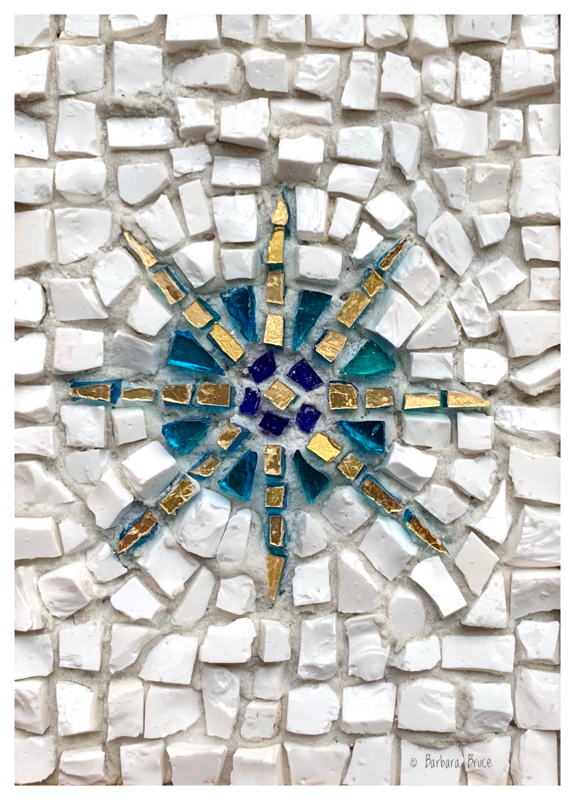
Beautiful Star Mosaic by Melania

If we could hear stars sing their crystalline cantatas of praise to the Creator, our hearts would be so effused with such Divine sweetness and yearning; it would be unbearably impossible to not join in chorus of jubilation with them.

What sort of praise can I give Thee? I have never heard the song of the Cherubim, a joy reserved for the spirits above. But I know the praises that nature sings to Thee. In winter, I have beheld how silently in the moonlight the whole earth offers Thee prayer, clad in its white mantle of snow, sparkling like diamonds. I have seen how the rising sun rejoices in Thee, how the song of the birds is a chorus of praise to Thee. I have heard the mysterious mutterings of the forests about Thee, and the winds singing Thy praise as they stir the waters. I have understood how the choirs of stars proclaim Thy glory as they move forever in the depths of infinite space. What is my poor worship! All nature obeys Thee, I do not. Yet while I live, I see Thy love, I long to thank Thee, and call upon Thy name. ~ Ikos 12, (The Akathist Hymn: Glory to God for All Things)

The firmament has the stars for its beauty, and dispassion has the virtues for its adornments. ~ St. John of the Ladder

The Splendour of Icons

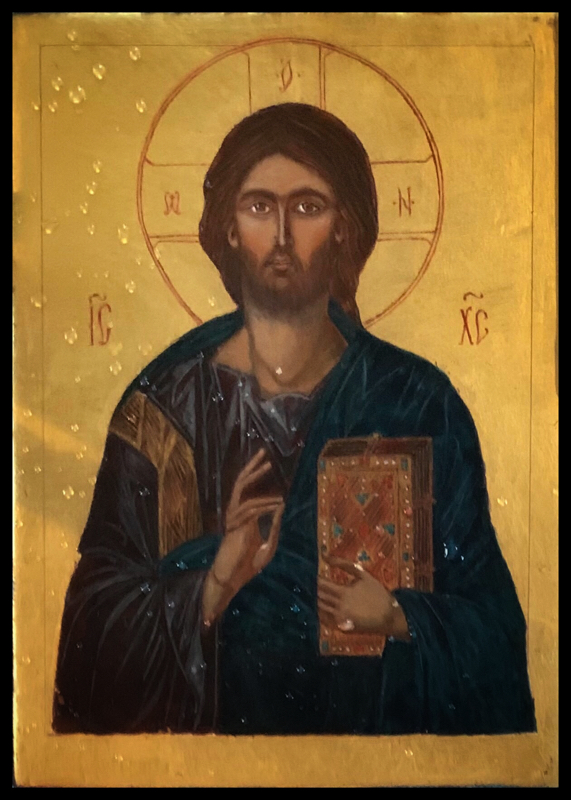
Beaded droplets of Holy Water grace a newly blessed icon of Our Lord Jesus Christ. Note the ancient lettering style inscriptions. Icons are venerated and not worshipped. They are beautiful, spiritual, windows into heaven.

– I venerate the Creator… who came down to his creation without being lowered or weakened, that He might glorify my nature and bring about communion with the divine nature. …Therefore I am emboldened to depict the invisible God, not as invisible, but as He became visible for our sake, by participation in flesh and blood. I do not depict the invisible divinity, but I depict God made visible in the Flesh. ~ St. John Damascene

The Church, through the temple and Divine service, acts upon the entire man, educates him wholly; acts upon his sight, hearing, smelling, feeling, taste, imagination, mind, and will, by the splendour of icons and of the whole temple, by the ringing of bells, by the singing of the choir, by the fragrance of the incense, the kissing of the Gospel, of the cross and the holy icons, by the prosphoras, the singing, and sweet sound of the readings of Scripture. ~ St. John of Kronstadt (My Life in Christ)

Icons in churches and houses are necessary because they remind us of the immortality of the saints; that they live unto Him, that in God they see, hear, and help us. ~ St. John of Kronstadt

Church services, that is, all the daily services, together with the entire arrangement of the church’s icons, candles, censing, singing, chanting, movements of the clergy, as well as the services for various needs (e.g., Molebens, Pannikhidas, etc.); then services in the home, also using ecclesiastical objects such as sanctified icons, holy oil, candles, holy water, the Cross, and incense – all of these holy things together acting upon all the senses – sight, hearing, smell, touch, and taste – are the cloths that wipe clean the senses of a deadened soul. They are the strongest and only reliable way to do it… The entire structure of our Church services, with their tone, meaning, power of faith, and especially the grace concealed within them, have an invincible power to drive away the spirit of the world. ~ St. Theophan the Recluse (The Path to Salvation)

As From One Great Heart

You cannot pray at home, like you can at church, where there is a great multitude; where exclamations are cried out to God as from one great heart, and where there is something more: the unions of minds, the accord of souls, the bond of charity, the prayers of priests. ~ St. John Chrysostom

The Church, through the temple and Divine service, acts upon the entire man, educates him wholly; acts upon his sight, hearing, smelling, feeling, taste, imagination, mind, and will, by the splendour of the icons and of the whole temple, by the ringing of the bells, by the singing of the choir, by the fragrance of the incense, the kissing of the Gospel, of the cross and the holy icons, by the prosphoras, the singing, and sweet sound of readings of the Scriptures. ~St. John of Kronstadt

We ought to have the most lively spiritual union with the heavenly inhabitants, with all the saints, apostles, prophets, martyrs, prelates, venerable and righteous men, as they are all members of one single body, The Church of Christ, to which we sinners also belong, and the living Head of which is the Lord Jesus Christ Himself. This is why we call upon them in prayer, converse with them, thank and praise them. It is urgently necessary for all Christians to be in union with them, if they desire to make Christian progress; for the saints are our friends, our guides to salvation, who pray and intercede for us. ~ St. John of Kronstadt

Thrice Holy

Entrance with Trisagion Prayer in Ancient Greek

Trisagion from Greek, means thrice [tris] and holy [agios]. This Thrice Holy Prayer to the Holy Trinity is used during private prayer, and throughout the Church’s daily worship cycle.

Trisagion in English: Holy God, Holy Mighty, Holy Immortal, have mercy on us.

Trisagion in Greek Pronounced: Agios O Theos, Agios Eeskhiros, Agios Athanatos, eleison imas)

History and Miracle of the Trisagion Hymn

Above, the hosts of angels sing praise; below, men form choirs in the churches and imitate them by singing the same doxology. Above the Seraphim cry out the Trisagion Hymn; below, the human throng sends up the same cry. The inhabitants of heaven and earth are brought together in a common assembly; there is one thanksgiving, one shout of delight, one joyful chorus. ~ St. John Chrysostom

The unceasing and sanctifying doxology by the holy angels in the Trisagion signifies, in general, the equality in the way of life and conduct and the harmony in the divine praising which will take place in the age to come by both heavenly and earthly powers, when the human body now rendered immortal by the resurrection will no longer weigh down the soul by corruption and will not itself be weighed down but will take on, by the change into incorruption, potency and aptitude to receive God’s coming. In particular it signifies, for the faithful, the theological rivalry with the angels in faith; for the active ones, it symbolizes the splendor of life equal to the angels, so far as this is possible for men, and the persistence in the theological hymnology; for those who have knowledge, endless thoughts, hymns, and movements concerning the Godhead which are equal to the angels, so far as humanly possible. ~ St. Maximus the Confessor

error: Content is protected !!