This icon is frequently referred to as the Anastasis or Resurrection Icon. It is an icon of Pascha(Easter).
The golden bars by Christ’s feet are the gates of Hades, which He has broken and torn apart. At Pascha, a tradition includes the cracking of our blessed Pascha eggs together. This represents how Christ shattered the gates of Hades.
There are keys floating in the abyss below, which symbolizes that he has entered and conquered both death and Hades. Some icons have a skeletal figure who is chained up: that’s Death. He has been bound and killed by Christ. All throughout Pascha-tide until the Ascension, we greet each other with,“Christ is Risen, Truly He is Risen!”
The two figures whom Christ has grasped and is pulling out of Hades are Adam and Eve, symbolizing that His Victory redeems all mankind, even back to the beginning.
This Resurrection scene is taking place in the past, present, and future.
To His left, we see three Old Testament saints: Kings David and Solomon, two of His ancestors according to his fleshly nature. We also see, closest to him St. John the Baptist, who was his Forerunner in both life and death. On the right, we have the New Testament, including the apostles who are alive. The purpose is to show that Christ’s redemption transcends time and space. This is an act that happened in the past, is happening right now, and will happen in the future. Christ is always in the state of redeeming and setting us free.
The blue shape around Christ is called the Mandorla (which is Italian for almond, which describes its shape). The Mandorla is the Uncreated, Eternal Light of Christ. In the writings of the Eastern Orthodox mystics, God is often prayerfully experienced as Light. This is not simply a beautiful bright light. It is the same Light which filled the apostles with wonder when they witnessed His Transfiguration. It is the Light which Christ Himself described as the power of the Kingdom of God (Mark 9:1, Matt. 16:28, Luke 9:27). It is also the Light that is seen when one purifies their heart and mind (Blessed are the pure in heart, for they shall see God).
Those who seek God will find that the more they know Him, the less they comprehend Him.
To know God, to experience Him, is to walk from the darkness of sin, into His Light, to enter into the mystery of His Presence. ~ The Ark Youth Quarterly– St. Sophia Orthodox Church
…Silence fosters stillness; it is indispensable for stillness. Inner stillness, however, goes beyond silence insofar as its aim is to purify the heart and issue in pure prayer. That purification involves the body in its entirety, because body and soul, like mind and heart, are ultimately inseparable. In the words of St. Mark the Ascetic, “The intellect cannot be still unless the body is still also; and the wall between them cannot be demolished without stillness and prayer.”Silence is the prerequisite for inner stillness, and only inner stillness enables us truly to listen to God, to hear His voice, and to commune with Him in the depths of our being. Yet silence and stillness are, like prayer itself, gifts that God can and wants to bestow upon us. The greatest truth about us is that God has created us with a profound longing, a burning thirst for communion with Himself. We can easily pervert that longing into an idolatrous quest for something other than God. Yet God remains faithful even in our times of apostasy. Like the father of the Prodigal Son, He always awaits our return. Once we begin that journey homeward, through repentance and an ongoing struggle against our most destructive passions, God reaches out to embrace, to forgive and to heal all that is broken, wounded and wasted. He reaches into the very fabric of our life, to restore within us the sublime image in which we were made… ~ Fr. John Breck
It’s coming to that amazing time again of recharging our spiritual batteries together. With purpose, we prepare our own humble journeys home to the GreatestChristian Feast of Feasts, Holy Pascha (Easter), the Resurrection of our Lord God and Saviour Jesus Christ. Travelling the quiet routes of the Great Lentenroads ahead, we choose to make bright efforts in good faith, and to the best of our abilities. Our dear Lord desires us to come to Him and fill us with good things… now and forever!
I would like to share just a couple of past musical mondegreens. A mondegreen is a mis-hearing or misinterpretation of a phrase that gives it a new meaning.
For instance… during my early childhood years in the Baptist Church, there’s a lovely Easter hymn I adored, which (I thought) was titled “At Calgary” Couldn’t really say why we were singing about a Canadian city at Easter, but people in the pews would nod and smile when us kids belted out those last two words to the refrains: Mercy there was great and grace was free, Pardon there was multiplied to me, There my burdened soul found liberty, At Calgary! One year at Easter, when I could read better, I sheepishly realized the last line of each stanza was actually At Calvary… a holy location which had nothing to do with the province of Alberta.
As an adult in the Orthodox Church, I sing in the choir and for awhile my music stand housed an older choir book. At the ends of certain sections on the faded liturgical sheet music, there was hand-printed in a thick, dull, stubby pencil, the word “repent”. This huge WOW-factor made me wonder occasionally about the book’s previous (obviously devout) owner who would unsparinglypost themselves repentancereminders! One day an unexpected pattern emerged. I noticed the numerous repents were always pencilled inat the ends of certain bars of faded music… where one could barely make out the 2 dots of a musical “repeat” sign. The pencilled words weren’t “repent” they were actually “repeat” albeit, in poor penmanship. *Smacks Forehead* Nevertheless, repentance, and repeat repentanceare indeed crucial. Sometimes, to this very day, if I see a musical “repeat” sign, or have a fleeting thought of Calgary… I can’t help but smile.
The wilderness and the dry land shall be glad; the desert shall rejoice and blossom like the crocus; it shall blossom abundantly and rejoice with joy and singing… ~ Isaiah 35:1-2
At winter’s end, the crocus – also known as the penitent flower, appears before thespiritual springofGreat Lent… a season of forgiveness, repentance, efforts, hope, and renewal.
The week preceding Great Lent is called Cheesefare(Maslenitsa), and in 2022, Cheesefare begins Monday, February 28th. Meat is now excluded until Pascha (Easter). Dairy and seafood are (thoroughly) enjoyed this week, and it’s traditional to include blini crepes or pancakes to use up remaining dairy – before the more strict plant-basedfare of Great Lent.
This year Great Lent begins on Monday, March 7th.
May we all cultivate fragrant buds of virtue, and Blossom Forth!
Christ is Risen from the dead, trampling down death by death, and upon those in the tombs bestowing Life! ~Paschal Tropar
What is dying? Just what it is to put off a garment. For the body is about the soul as a garment; and after laying this aside for a short time by means of death, we shall resume it again with more splendour. ~ St. John Chrysostom
Congratulations on entering the Nativity Fast! Although we’re in a different “liturgical season” than the Great Lent which precedes Pascha (Easter)… We are nonetheless, on day #3 into the40 day Nativity Lenten period. Advent helps us properly prepare for the upcoming Great Feast of the Nativity of Christ.
The birth and death of Christ are very connected. Sometimes Nativity (Christmas) is even called the Winter Pascha.
Today is also a friend’s funeral… and the Mystery ofPascha is very much on my mind.
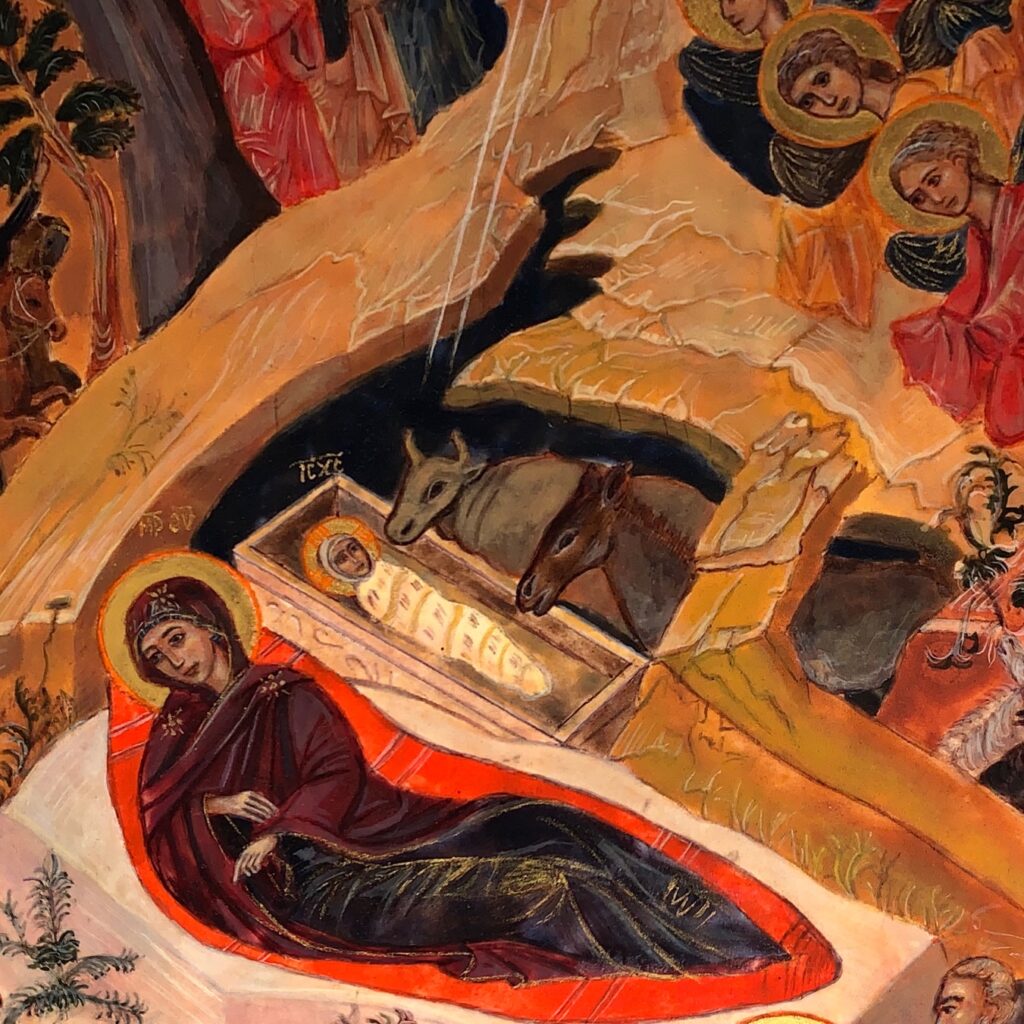
The Nativity Icon deliberately connects events… the manger resembles a stone coffin, the swaddling clothes resemble a burial shroud, and the cave itself prefigures Christ’s tomb. Theox and ass portrayed, are from the prophesy of Isaiah.
Jesus came to us in order to die, and this was known by Him even from the very beginning.He took away death, by conquering death, through His Glorious Resurrection!
Sin entered the world through Adam and Eve, the first created man and woman, and now we all sin. There are big sins and little sins, but everyone sins, and any sin separates us from God.
Because of God’s great love for each one of us, He did something incredibly special. Jesus Christ the Son of God, willingly took all the sins of everyone ever born, that means you, me, the whole world, and put them all upon Himself.When Jesus died and was buried, all our sins died and were buried too. We also remember this at our baptism, and are now forgiven because of what Jesus did for us on the cross!
He is the Son of God – and arose victorious, from the dead!
This is why we no longer fear death.
Death is a new beginning.
Those who have gone on before us, are alive in Christ… For he is not a God of the dead, but of the living: for all live unto him. ~St. Luke 20:38
I’ve been singing and humming the Paschal Tropar a lot today. It helps softens sadness, and bestows hope and joy.
Paschal Tropar – Appalachian melody, English
And God shall wipe away all tears from their eyes; and there shall be no more death, neither sorrow, nor crying, neither shall there be any more pain: for the former things are passed away. ~ Revelation 21:4
With the saints give rest, O Christ our God to the soul of Thy servant, Nicholas. Memory Eternal.
It shall blossom abundantly, and rejoice even with joy and singing: the glory of Lebanon shall be given unto it, the excellency of Carmel and Sharon, they shall see the glory of the Lord, and the excellency of our God. ~ Isaiah 35:2
Venerable Bede (7th century), likened the Virgin Mary to a white lily… symbolizing her purity, innocence and virginity. The floral centre of yellow anthers, are as the golden radiance of her soul.
The Archangel Gabriel is often depicted in scenes of the Annunciation as giving the Virgin Mary a lily. In August, around the time of the Dormition, blooming hostas are called Assumption Lilies.
Lilies, were also called the white-robed apostles of hope. Their colour symbolizes the sinless Christ. The shape of the Easter lily represents a trumpet, resounding the message that Christ is risen. The nature in which lilies grow is also symbolic of the Resurrection.