Spring, flowers, and sunshine… Brighter days ahead!
No sooner do I conceive of the one than I am illumined by the splendour of the three; no sooner do I distinguish them than I am carried back to the one. When I think of any one of the three I think of him as the whole, and my eyes are filled, and the greater part of what I am thinking escapes me. I cannot grasp the greatness of that one so as to attribute a greater greatness to the rest. When I contemplate the three together, I see but one torch, and cannot divide or measure out the undivided light. ~ St. Gregory the Theologian
How Glorious is God How great our Lord on high in Zion, Our mortal tongue cannot convey; Beneath His throne the stardust flying, Is one with windswept grasses’ sway. Throughout the Universe His glory By day and night is bright and holy. O Lord, Thy Lamb of golden haloes Reflects Thy face for our eyes; With psalter-sounds we send our prayers, Like smoke from censers, to the skies. Accept, Lord God, from Thy creation Incense and songs of adoration. Thy radiance to us revealing, Thy love transcends a father’s care; While feeding us, our ailments healing, Thou showest us Thy Kingdom fair. Sweet mercy Thou to sinners sendest – Their hunger with Thy substance endest.
Theophany comes from the Greek word theophania, which means “appearance of God” revealing the manifestation of the Most Holy Trinity to the world through the Baptism of Christ, the Son of God.(Matthew 3:13-17; Mark 1:9-11; Luke 3:21-22).
As we joyfully celebrate Holy Theophany, and the additional Great Blessing of the Water service for Holy Water, we are reminded of the Great Sacrament and Mystery of our own baptism.
The Father was revealed to the sense of hearing; the Spirit was revealed to the sense of sight, and in addition to these, the Son was revealed to the sense of touch. The Father uttered His witness about the Son, the Son was baptized in the water, and the Holy Spirit in the form of a dove hovered above the water. When John the Baptist witnessed and said about Christ, “Behold, the Lamb of God, Who takes away the sins of the world” (John 1:29), and when John immersed and baptized the Lord in the Jordan, the mission of Christ in the world and the path of our salvation was shown. That is to say: The Lord took upon Himself the sins of mankind and died under them [immersion] and became alive again [the coming out of the water]; and we must die as the old sinful man and become alive again as cleansed, renewed and regenerated. This is the Saviour and this is the path of salvation. ~ St. Nikolai Velimirovich
Theophany Troparion (Hymn); (Tone 1 Melody)
When Thou, O Lord, was baptized in the Jordan, the worship of the Trinity was made manifest; for the voice of the Father bore witness unto Thee, calling Thee His beloved Son. And the Spirit in the form of a dove confirmed the truth as steadfast and sure. O Christ our God, Who hath appeared and enlightened the world, glory to Thee.
Theophany Kontakion (Hymn); (Tone 4 Melody)
Thou hast appeared today to the inhabited world, and Thy light, O Lord, hath been signed upon us, who sing Thy praises and chant with gladness: Thou hast come, Thou hast appeared, O Light unapproachable.
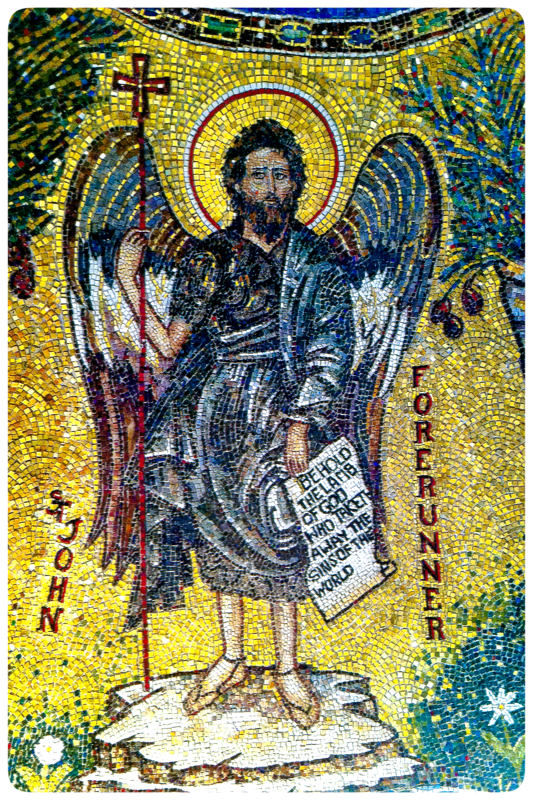
Dome Mosaic of St. John the Baptist – St. Sophia Orthodox Church, Canada
St. John the Baptist is called the voice of the Word, the Lampstand of the Light, the morning star and Forerunner of the Sun of Righteousness.
He is named Forerunner, as he preceded Christ… being sent as a Messenger to prepare the people for Christ’s ministry. Angel in Greek means messenger, and some icons of St. John the Baptist depict him with angelic wings, on account of Malachi’s prophecy from the Old Testament.
On September 11 (August 29, Julian calendar) we remember St. John the Baptist’s heavenly birthday and martyrdom. In honour of the greatest of all prophets who have ever lived, and since ancient times, the Church has celebrated this leading luminary by establishing this day as a fast.
There was a man sent from God, whose name was John. The same came for a witness, to bear witness of the Light, that all men through him might believe. He was not that Light, but was sent to bear witness of that Light. That was the true Light, which lighteth every man that cometh into the world. ~ St. John 1:6-9
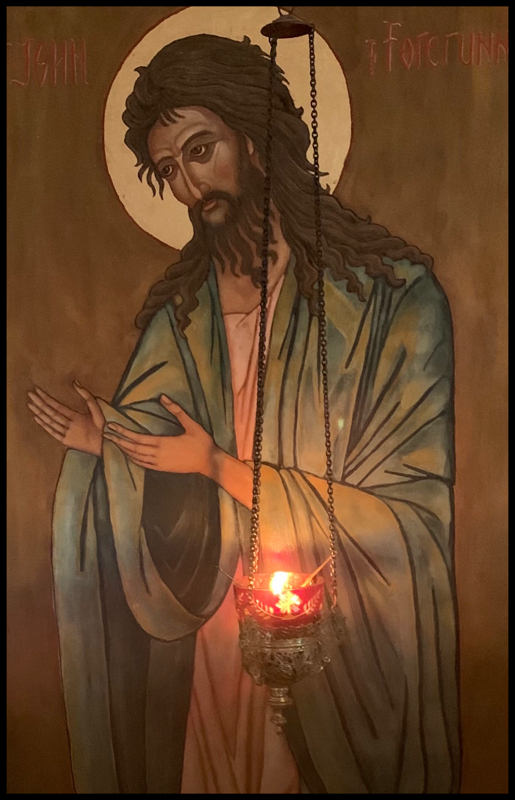
St. John the Baptist – St. Sophia Orthodox Church, Canada
700 years before the birth of Christ, the Prophet Isaiah foretold the preaching of John the Baptist. Isaiah called St. John “the voice of him that crieth in the wilderness” (Isaiah 40:3); who was to “prepare the way of the Lord, make straight in the desert a highway for our God.”
Malachi, the last of the Old Testament prophets, who lived more than 400 years before the birth of Christ foretold the coming of St. John the Baptist, and refers to him as an angel. Behold I will send My Angel, and he shall prepare the way before Me; and the Lord, whom ye seek, shall suddenly come to His temple, even the Angel of the covenant, whom ye delight in: behold, He shall come, saith the Lord of hosts.~ Malachi 3:1-2
There was a man sent from God, whose name was John. The same came for a witness, to bear witness of the Light, that all men through him might believe. He was not that Light, but was sent to bear witness of that Light. That was the true Light, which lighteth every man that cometh into the world.~ St. John 1:6-9
Christ Himself said:Verily I say unto you, Among them that are born of women there hath not risen a greater than John the Baptist: notwithstanding he that is least in the kingdom of heaven is greater than he. ~ St. Matthew 11:11
Through the holy prayers of St. John the Forerunner and Baptist of Christ, our Leading Luminary, may we, too, stand as steadfast shining candles before the Lord; radiating His Effulgent and Gladsome Light!
Traditional Ascension Greeting: “Christ has Ascended!“
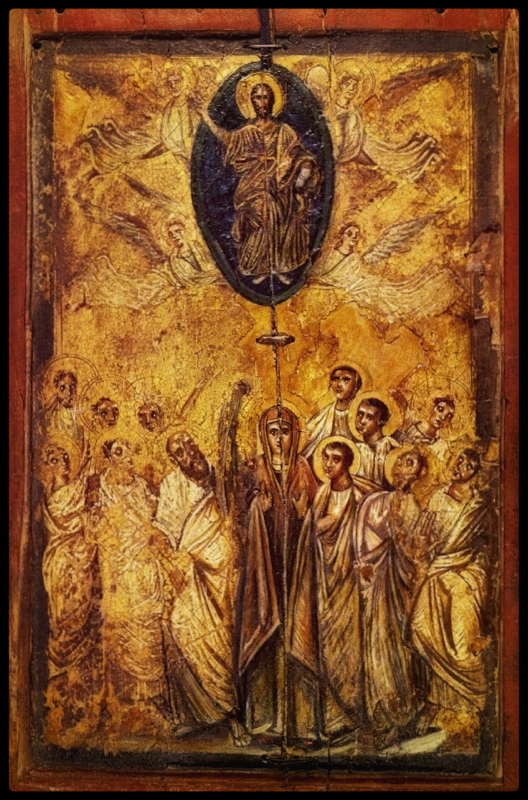
The Feast Day of Christ’s Ascensioncomes forty days after Pascha. Todayfrom the Mount of Olives, the risen Lord ascends to Paradise upon a Divine Cloud! He ascends in the Flesh, to the place where He Was before Time.
Some Ascension Customs
Of course, if at all possible, the most important thing to do on the Ascension, is to attend Divine Liturgy!
As with any Great Feast, those who have to work on this day try to give some of their earnings to the poor.
Cloud-watching today is popular, as Christ went up in a cloud. If the weather is good, some go for a mountain hike, as Jesus went up the Mount of Olives for the Ascension. Throw a blanket on the grass or scrub, lay back, enjoy the clouds (search for a Lamb-shape), and have a picnic. If there are white wildflowers available to pick and you’re not too far from home, pick a few and bring them home to your icon corner. If you live where there are olive trees, a few branches are also collected for the icon bouquet.
Last year on the Ascension, there wererainbow clouds in our area, and a super large one was shaped like the Greek letter Omega!
Clergy traditionally wear white vestments today. Some lay people also wear white on the Ascension – because of the clouds, and decorate their icon corner with white flowers.
It’s also a custom to take a dip in the ocean on the Ascension, as the sea draws its water from the clouds.
On the Ascension, farmers share the milk with friends, neighbours and relatives. Remaining milk is used to make the traditional rice pudding.
Here’s something sweet and new… Some families make “Cloud Cookies” for the Ascension. Bake a flat sugar cookie, and after cooling, decorate the top with blue icing for the sky, and then pop a few white mini marshmallows on top, as clouds.
An old English country custom was to collect rainwater if it rained on the Ascension, and drink it. I tried this once. However, as I live in the city, rainwater from the overhead clouds tasted a bit odd… so I shared the remainder with my thirsty garden!
Traditional response for the Ascension greeting is, “From Earth to Heaven!”
His footprint is imprinted into the rock and can be seen in the Chapel of the Ascension, which was built over the spot.
Prayer is food for the soul. Do not starve the soul, it is better to let the body go hungry… ~St. Joseph of Optina
You don’t have a soul. You are a soul. You have a body. ~C. S. Lewis
Through greed we underwent the first stripping, overcome by the bitter tasting of the fruit, and we became exiles from God. But let us turn back to repentance and, fasting from the food that gives us pleasure, let us cleanse our senses on which the enemy makes war. Let us strengthen our hearts with the hope of grace, and not with foods which brought no benefit to those who trusted in them. Our food shall be the Lamb of God, on the holy and radiant night of His Awakening: the Victim offered for us, given in communion to the disciples on the evening of the Mystery, who disperses the darkness of ignorance by the Light of His Resurrection. ~ Aposticha, Vespers – evening of Sunday of the Last Judgement
Do that which is good, and no evil shall touch you. Prayer is good with fasting and alms and righteousness. A little with righteousness is better than much with unrighteousness. It is better to give alms than to lay up gold: For alms doth deliver from death, and shall purge away all sin. Those that exercise alms and righteousness shall be filled with life: But they that sin are enemies to their own life. ~ Archangel Raphael, Tobit 12:7-10
One should not think about the doings of God when one’s stomach is full; on a full stomach there can be no vision of the Divine mysteries. ~St. Seraphim of Sarov
It is necessary for a Christian to fast, in order to clear his mind, to rouse and develop his feelings, and to stimulate his will to useful activity. These three human capabilities we darken and stifle above all by ‘surfeiting, and drunkenness, and cares of this life’ (Lk. 21:34). ~ St. John of Kronstadt
Many human activities, good in themselves, are not good because of the motive for which they are done. For example, fasting and vigils, prayer and psalmody, acts of charity and hospitality are by nature good, but when performed for the sake of self-esteem they are not good. ~ St. Maximos the Confessor
Devils take great delight in fullness, and drunkenness and bodily comfort. Fasting possesses great power and it works glorious things. To fast is to banquet with angels. ~ St. Athanasius the Great
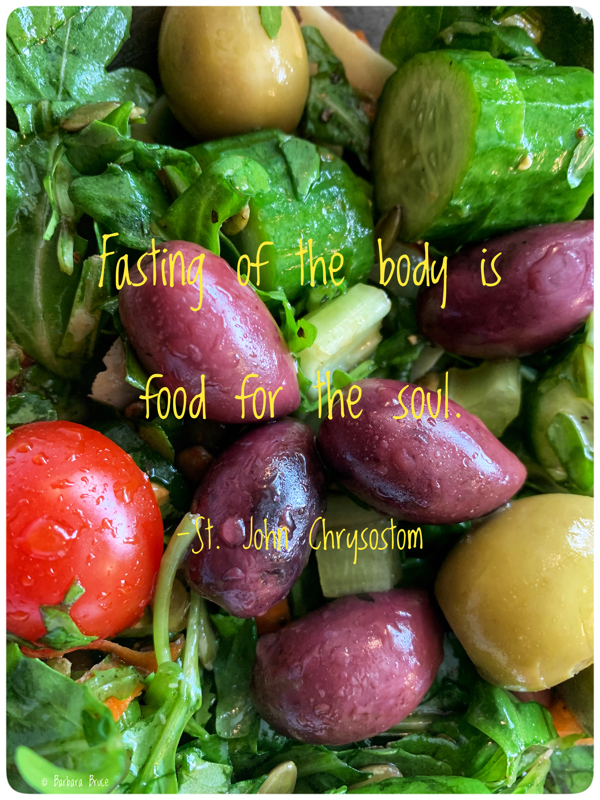
Let the mouth also fast from disgraceful speeches and railings. For what does it profit if we abstain from fish and fowl and yet bite and devour our brothers and sisters? The evil speaker eats the flesh of his brother and bites the body of his neighbour. ~St. John Chrysostom