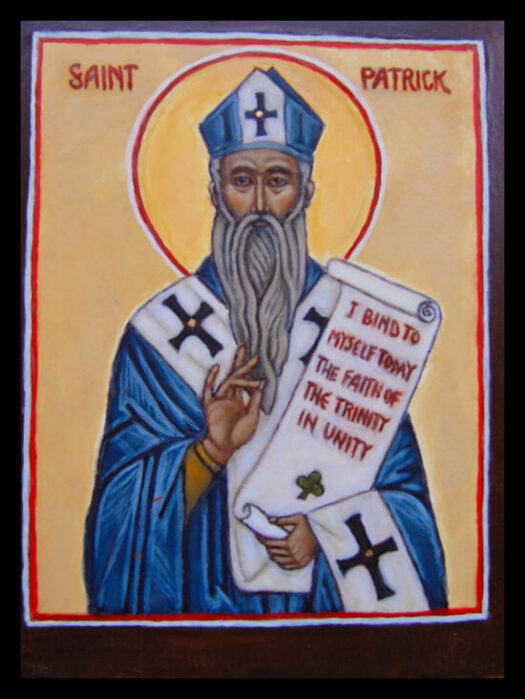
Icons of 5th Century St. Patrick often show him with or holding a three-leafed shamrock growing on a single stem. When he was asked to explain the Mystery of the Holy Trinity in a simple manner, St. Patrick picked a tiny shamrock (a low growing plant of the clover family) and with its three lobed leaves on a single stem, demonstrated how God the Father-God the Son-and God the Holy Spirit, are the Holy Trinity – One in Essence, and Undivided… Our One God in Three Persons!
Please see this fascinating material from the Royal Irish Academy about St. Patrick, written by the 7th century monk Muirchú.
Here are some fascinating historical documents about St. Patrick, written by the 7th century monk Muirchú from the Royal Irish Academy.
Icons of St. Patrick often show him holding a three-leafed shamrock growing on a single stem, he used this to illustrate the Holy Trinity – our One God in Three Persons.
St. Patrick wrote many hymns. Here is an excerpt from a beautiful, longer hymn, the Lorica (Breastplate) of St. Patrick.“I bind unto myself today, the Strong Name of the Trinity! By Invocation of the same, the Three in One, and One in Three!” ~ St. Patrick
Abbreviated Lorica Hymn of St. Patrick’s Prayer, recorded and sung below, by our Youth Choir in 2019.
One of his many miracles: During a perilous journey to share the Christian faith in King Loegaire’s territory, the saint discovered they were in mortal danger of an ambush. He prayed the Lorica Prayer, and to those lying in ambush, the saint and his company of monks appeared to them as if they were wild deer, and not humans. Because of this miracle, the Lorica Prayer is also known as The Deer’s Cry.
The early fifth century Enlightenment of Ireland by St. Patrick and his brethren, has been called the most successful single missionary venture in the history of the church.
A short recording by my GG’s
Today is also the 4th anniversary of my first Blisswood posting (A Shamrock Day) which fell upon St. Patrick’s Day in 2020! Thank you for visiting!
Below are two easy, tasty, recipes to celebrate St. Patrick’s day – or any day!
An online Plant Based Colcannon (Potato/Cabbage) Side Dish Recipe, and…
You are all children of light and children of the day. We are not of the night nor of darkness… But let us who are of the day be sober, putting on the breastplate of faith and love, and as a helmet the hope of salvation. ~ 1 Thessalonians 5:5,8
For now we see through a glass, darkly; but then face to face: ~ 1 Corinthians 13: 12
Through the Holy Spirit comes our restoration to paradise, our ascension into the kingdom of heaven, our return to the adoption of sons, our liberty to call God our Father, our being made partakers of the grace of Christ, our being called children of light, our sharing in eternal glory, and, in a word, our being brought into a state of all “fullness of blessing,” both in this world and in the world to come, of all the good gifts that are in store for us, by promise hereof, through faith, beholding the reflection of their grace as though they were already present, we await the full enjoyment. ~ St. Basil the Great
Without first experiencing darkness, how would we recognize light?
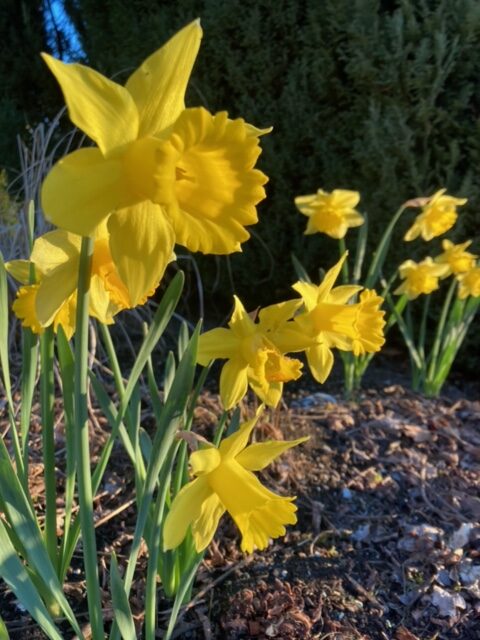
I just received this joyful golden Lenten Lily (Daffodil) photo from a dear (anonymous) friend this morning, along with beautiful heart-warming greetings, which I’m allowed to share.
May you be Protected and Inspired by Real Gold – God’s Promises, and the Mystical Enlightenment of St. Patrick – today and always.
Another friend has sent me this about St. Patrick, written by the 7th century monk Muirchú from the Royal Irish Academy.
Today, St. Patrick’s Day March 30/17 (Julian), is also the second anniversary of the beginning of my Blisswood “Posts” section.
St. Patrick is so beloved and well-known, that I’m posting this today… for both calendars (March 17/March 30).
St. Patrick led an amazing life. Born in Scotland around the year 385 AD, he was the son of a deacon and the grandson of a priest. Patrick wasn’t particularly religious during his youth, but he lived a quiet life.
That all changed at the age of sixteen, when he was kidnapped by pirates raiding the British coast. Taken to Ireland and sold as a slave, Patrick spent the next six years as a herder on an isolated mountain.
Labouring in solitude, he remembered the faith of his youth, and turned to prayer, finding solace in God. Patrick had a vision revealing he would soon be free and that a ship would be waiting for him. An opportunity arose for his escape, and he fled… traveling many days on foot, until he reached the coast to find the ship from his vision, preparing to sail to Gaul (France).
St. Patrick studied for several years in a monastery under the holy Bishop Germanus. He was ordained a priest and eventually consecrated a bishop. St. Patrick had another vision, that the people in the land of his captors were calling him back to Eire. St. Patrick understood that this was to be his mission… he was to return to Ireland and help establish the Church there. He was one of several missionaries who arrived in Ireland around 432 AD.
When asked to explain the mystery of the Holy Trinity in a simple manner, St. Patrick used a tiny shamrock (a low growing plant of the clover family) with its three lobed leaves on a single stem, to demonstrate how God the Father- God the Son- and God the Holy Spirit are the Holy Trinity; Three in One, One in Three… Undivided.
Once, during his travels, he destroyed an idol where human sacrifices would occur. This idol sat on a large rock. When the saint struck the idol with his crozier (bishop staff), the idol crumbled to dust, and the imprint of the crozier remained upon the rock.
As a bishop he faced many struggles and dangers, including hostility from those loyal to the pagan gods. With God’s help, St. Patrick worked through these obstacles while guiding his flock, and baptising new converts. St. Patrick prayed tirelessly, and continued his work of establishing churches and monasteries. It is said he chanted the entire Psalter every day.
His writings include several works of prayers, and letters. One of these prayers is well known as theLorica (Breastplate) of St. Patrick… A prayer for protection.
During a perilous journey to share the Christian faith in King Loegaire’s territory, the saint discovered they were in mortal danger of an ambush. He prayed the Lorica Prayer, and to those lying in ambush, the saint and his company of monks appeared to them as if they were wild deer, and not humans. Because of this miracle, the Lorica Prayer is also known as The Deer’s Cry.
The early fifth century Enlightenment of Ireland by St. Patrick and his brethren, has been called the most successful single missionary venture in the history of the church.
This post is collected from various sources over the years… and are but a smidgeon of the countless, wondrous, and miraculous events, regarding the life of St. Patrick, Enlightener of Ireland.