In our spiritual vision we are not only to see each thing in sharp relief, standing out in all the brilliance of its specific being, but we are also to to see each thing as transparent: in and through each created thing we are to discern the Creator...
The contemplation of nature has two correlative aspects. First, it means appreciating the “thusness” or “thisness” of particular things, persons and moments. We are to see each stone, each leaf, each blade of grass, each frog, each human face, for what it truly is, in all the distinctness and intensity of its specific being. As the prophet Zephaniah warns us, we are not to “despise the day of small things” (4:10). “True mysticism” says Olivier Clément, “is to discover the extraordinary in the ordinary.”
Shards of ice crystals cover my windshield, hindering clear vision. With a bit of effort, they can be scraped off and kept off… by keeping the car engine warm.
God is a fire that warms and kindles the heart and inward parts. Hence, if we feel in our hearts the cold which comes from the devil – for the devil is cold – let us call on the Lord. He will come to warm our hearts with perfect love, not only for Him but also for our neighbour, and the cold of him who hates the good, will flee before the heat of His countenance. ~ St. Seraphim of Sarov
It is of great significance if there is a person who truly prays in a family. Prayer attracts God’s Grace and all the members of the family feel it, even those whose hearts have grown cold. Pray always. ~ Elder Thaddeus of Vitovnica(Our Thoughts Determine Our Lives)
If you find that there is no love in you, but you want to have it, then do deeds of love, even though you do them without love in the beginning. The Lord will see your desire and striving, and will put love in your heart. ~ St. Ambrose of Optina
Outdoor Mosaic, St. Sophia Orthodox Church, Canada
But as it is written, Eye hath not seen, nor ear heard, neither have entered into the heart of man, the things which God hath prepared for them that love him. But God hath revealed them unto us by his Spirit: for the Spirit searcheth all things, yea, the deep things of God. For what man knoweth the things of a man, save the spirit of man which is in him? even so the things of God knoweth no man, but the Spirit of God. Now we have received, not the spirit of the world, but the spirit which is of God; that we might know the things that are freely given to us of God. ~ 1 Corinthians 2: 9-12
The soul leaves all surface appearances, not only those that can be grasped by the senses but also those which the mind itself seems to see, and it keeps going deeper until by the operation of the spirit it penetrates the invisible and incomprehensible, and it is there that it sees God. The true vision and the true knowledge of what we seek consists precisely in not seeing, in an awareness that our goal transcends all knowledge… ~ St. Gregory of Nyssa
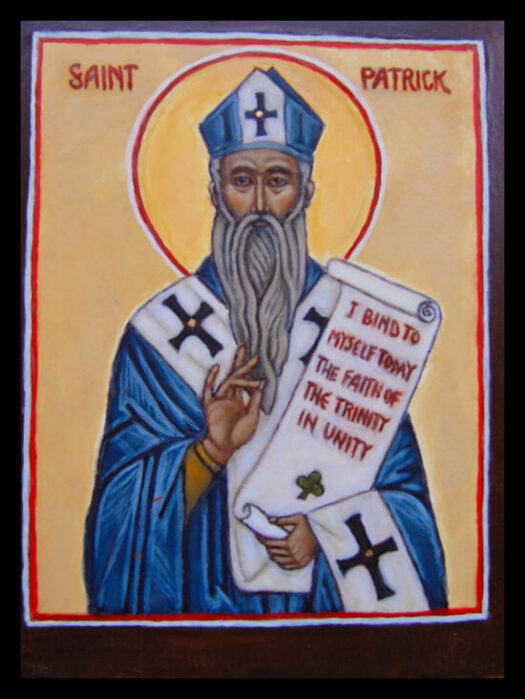
St. Patrick is so beloved and well-known, that I’m posting this today… for both calendars (March 17/March 30).
St. Patrick led an amazing life. Born in Scotland around the year 385 AD, he was the son of a deacon and the grandson of a priest. Patrick wasn’t particularly religious during his youth, but he lived a quiet life.
That all changed at the age of sixteen, when he was kidnapped by pirates raiding the British coast. Taken to Ireland and sold as a slave, Patrick spent the next six years as a herder on an isolated mountain.
Labouring in solitude, he remembered the faith of his youth, and turned to prayer, finding solace in God. Patrick had a vision revealing he would soon be free and that a ship would be waiting for him. An opportunity arose for his escape, and he fled… traveling many days on foot, until he reached the coast to find the ship from his vision, preparing to sail to Gaul (France).
St. Patrick studied for several years in a monastery under the holy Bishop Germanus. He was ordained a priest and eventually consecrated a bishop. St. Patrick had another vision, that the people in the land of his captors were calling him back to Eire. St. Patrick understood that this was to be his mission… he was to return to Ireland and help establish the Church there. He was one of several missionaries who arrived in Ireland around 432 AD.
When asked to explain the mystery of the Holy Trinity in a simple manner, St. Patrick used a tiny shamrock (a low growing plant of the clover family) with its three lobed leaves on a single stem, to demonstrate how God the Father- God the Son- and God the Holy Spirit are the Holy Trinity; Three in One, One in Three… Undivided.
Once, during his travels, he destroyed an idol where human sacrifices would occur. This idol sat on a large rock. When the saint struck the idol with his crozier (bishop staff), the idol crumbled to dust, and the imprint of the crozier remained upon the rock.
As a bishop he faced many struggles and dangers, including hostility from those loyal to the pagan gods. With God’s help, St. Patrick worked through these obstacles while guiding his flock, and baptising new converts. St. Patrick prayed tirelessly, and continued his work of establishing churches and monasteries. It is said he chanted the entire Psalter every day.
His writings include several works of prayers, and letters. One of these prayers is well known as theLorica (Breastplate) of St. Patrick… A prayer for protection.
During a perilous journey to share the Christian faith in King Loegaire’s territory, the saint discovered they were in mortal danger of an ambush. He prayed the Lorica Prayer, and to those lying in ambush, the saint and his company of monks appeared to them as if they were wild deer, and not humans. Because of this miracle, the Lorica Prayer is also known as The Deer’s Cry.
The early fifth century Enlightenment of Ireland by St. Patrick and his brethren, has been called the most successful single missionary venture in the history of the church.
This post is collected from various sources over the years… and are but a smidgeon of the countless, wondrous, and miraculous events, regarding the life of St. Patrick, Enlightener of Ireland.