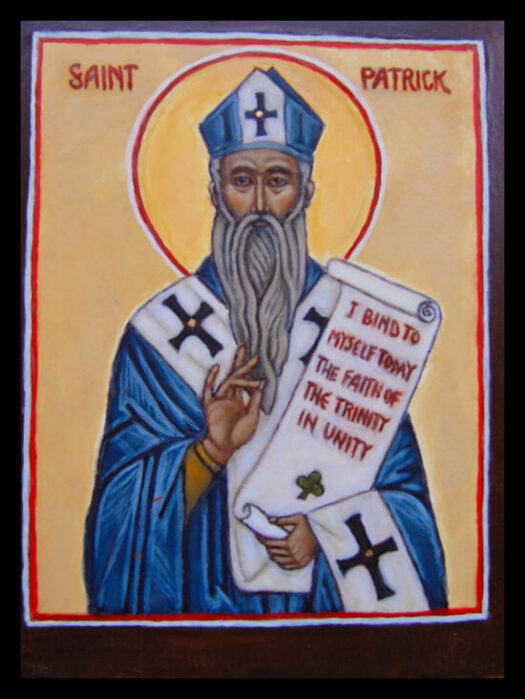
Wishing you an Old-Style Calendar* Blessed Feast of St. Spyridon & St. Herman of Alaska Day! To my New-Style Calendar* Friends, Christ is Born!
Before my fiancé I were baptised, we visited our first Orthodox Church Service on Western Christmas Day. It was a beautiful little chapel, steeped in holiness, and we walked in fully expecting Christmas. Surprised and perplexed by the apparent 13 day calendar* difference, we soon delighted in the golden glow of candlelight, and the smokey tendrils of incense that swirled like giant halos about the holy icons of saints. The tiny choir sang peacefully, matching the priest’s warm intonations. We stood, suspended within timeless Eternity. This was Heaven on Earth… for here, one acutely felt the Presence of Jesus Christ at the Eucharist. The priest’s concluding sermon reminded us that as we approach Christ’s Holy Nativity, that today we also celebrate two bright and special saints. One from of old, and one fairly new… St. Spyridon and St. Herman. Thus began our joyous journey home to the Orthodox Church.

On the church date December 12th, is the Feast of the Holy Wonderworker, St. Spyridon of Tremithus. (270 – 348 AD) St. Spyridon was born in Cyprus, and initially worked as a shepherd and known for his great piety. He married and had one daughter, Irene. Upon the death of his wife, Spyridon entered a monastery, and their daughter entered a convent. St. Spyridon eventually became Bishop of Tremithus and took part in the First Ecumenical Council of Nicaea (325), where he was instrumental in countering the erroneous theological arguments of Arius and his followers. There’s an account of his speech at this event, regarding the Holy Trinity… At one point, St. Spyridon grasped a brick and squeezed it so hard that miraculously, a flame flew up, while at the same time water trickled downwards, leaving only a small amount of crushed clay within his hand. He exclaimed: “There are these three elements, but one brick; likewise, in the Holy Trinity, there are three Persons, but One God”.

Today we also remember and celebrate the Holy Wonderworker St. Herman of Alaska. St. Herman was a monk, missionary and miracle worker who brought the Orthodox Faith from Russia to the native peoples of Alaska in the late 18th century. He taught the Holy Gospel of Jesus Christ and defended these people from exploitation by the Russian traders. Here’s a recent miracle of St. Herman of Alaska on Mt. Denali, and a YouTube Visit to Spruce Island: The holy Relics of St. Herman the Wonderworker.
For our good, for our happiness, let us make a vow that from this day forth, from this hour, from this minute, let us strive to love God above all else and seek to do His Holy Will. ~ St. Herman of Alaska
A Sermon by +Archpriest John Adams of Eternal Memory, on St. Herman of Alaska
Drawing closer to the Feast of the Nativity we read the gospel (Luke 14:16-24) about those who were invited to a great supper, and those who wouldn’t come, so others take their place. Many are called, but the chosen seem to be those who simply didn’t make an excuse. They came. No matter what their state was when they were called. It wasn’t more important than the feast.
What if there was someone to whom being chosen was more important than anything, more important than pleasure or comfort? To travel thousands of miles in difficult conditions, to live in the cold and dark alone, but always remembering the feast that would come. What would this person be like? Maybe they would be someone who wouldn’t lie, even though it meant death. Maybe when they chanted alone it would sound like a whole choir of angels singing. Maybe if you were alone they would take you in; if you were sick, he would pray for you and you would get well. Maybe if there was going to be disaster, like a tidal wave, maybe he would take the icon the Mother of God to the shore and the water wouldn’t come above it, and you were saved.
They might be like one candle burning in a whole dark continent, but one candle after another is lit from it, and hundreds of years later, they are still burning.
What if you saw the feast, and you saw them enter in to join the others and it was all joy and light, but you were standing on the outside looking in – for when you had been invited over and over, you always had an excuse?
…Today is December 12th on the church calendar and the commemoration of the first Orthodox missionaries to Alaska in 1794… St. Juvenal the first martyr, the martyr St. Peter the Aleut, and St. Herman the Wonderworker.
We are still invited to the feast.
We are still called.
It is still up to us to be one of the chosen.
*Until 1924, the Eastern Orthodox Church universally used the ancient Julian calendar, whereas the Roman Catholic Church, under Pope Gregory XIII, conducted a calendar reform resulting in the Gregorian (new, civil) calendar in 1582. The difference between the two calendars is 13 days between the years 1900 and 2100. Some branches of the Orthodox Church still keep liturgical dates according to the Julian calendar, while some others have adopted using the “new” calendar. However, Orthodox Christians who use both calendars, always strictly adhere and calculate the Great Feast of Pascha, only according to the Julian Calendar.