Great and Holy Friday

Photo of a Past Holy Friday

Today is the saddest day of the Church Year.

Today, He is slapped by hands that He, Himself, hath made.

Today all Creation weeps.

Today the sun hides its rays and the earth quakes with fear.

Today He who hung upon the earth upon the waters is hung upon the tree.The King of the angels is decked with a crown of thorns. He who wraps the heavens with clouds is wrapped in the purple of mockery. He who freed Adam in the Jordan is slapped on the face. The Bridegroom of the Church is affixed to the cross with nails. The Son of the Virgin is pierced by a spear. We worship Thy Passion, O Christ. We worship Thy Passion, O Christ. Show us also Thy Glorious Resurrection!

Lazarus Comes Forth!

I am the resurrection and the life: he that believeth in me, though he were dead, yet shall he live. And whosoever believeth in me shall never die. ~ St. John 11:25-26

Today Bethany proclaims beforehand the Resurrection of Christ, the owner of Life, and it rejoices at the raising of Lazarus. ~ 1st Ode in Orthros

From the earliest times, the Church has remembered the miracle of the Raising of Lazarus, and its celebration is closely tied to the Feast of the Entry of Jesus into Jerusalem. Marking the end of Great Lent, Lazarus Saturday and Palm Sunday are a two-day festal pause, prior to Holy Week

In Constantinople, Lazarus Saturday was one of the four ancient baptismal days of the Church. We sing the Traditional Trisagion hymn at the Divine Liturgy for this day, As many as have been baptized into Christ have put on Christ… Reminding us that we too, through the Sacrament of Holy Baptism, have buried our old nature. By putting on Christ, we come forth reborn anew.

Therefore we are buried with him by Baptism into death: that like as Christ was raised up from the dead by the glory of the Father, even so we should walk in the newness of life. ~ Romans 6:4

In giving us, before Thy Passion an assurance of the General Resurrection, Thou hast raised Lazarus from the dead, O Christ, our God. Therefore, like the children, we also carry tokens of victory, and cry to Thee, the Conqueror of Death: Hosanna in the highest; blessed is He that cometh in the name of the Lord. ~ Troparion, Tone 1

Displaying Thy two energies, O Saviour, Thou hast made manifest Thy two natures: for Thou art both God and man. Though Thou art the Abyss of knowledge, Thou dost ask where they have laid the body of Lazarus. For it was Thy purpose, O Giver of Life, to raise him from the dead. Going from one place to another, Thou hast, as mortal man, appeared circumscribed; but, as God uncircumscribed, Thou fillest all things. At Thy divine word, Thou hast raised Lazarus, O Christ. I pray Thee, raise me also, dead through my many sins. As true God Thou hast known of the falling asleep of Lazarus and hast announced it beforehand to Thy disciples, giving them a proof, O Master, of the infinite power of Thy divinity. Thou who art by nature uncircumscribed wast circumscribed in the flesh; coming to Bethany, O Master, as man Thou dost weep over Lazarus, and by Thy power as God Thou dost raise him on the fourth day from the dead. ~ Beatitude Verses: Ode 3, 4 6, of the Triodion

…If he was not flesh, who wept at Lazarus’ grave? And if he was not God, who by his command brought out one four days dead? If he was not flesh, who sat on the foal? And if he was not God, whom did the crowds go out to meet with glory? ~ St. Ephraim the Syrian

Lazarus Saturday ~ Glory to God for All Things by Fr. Stephen Freeman

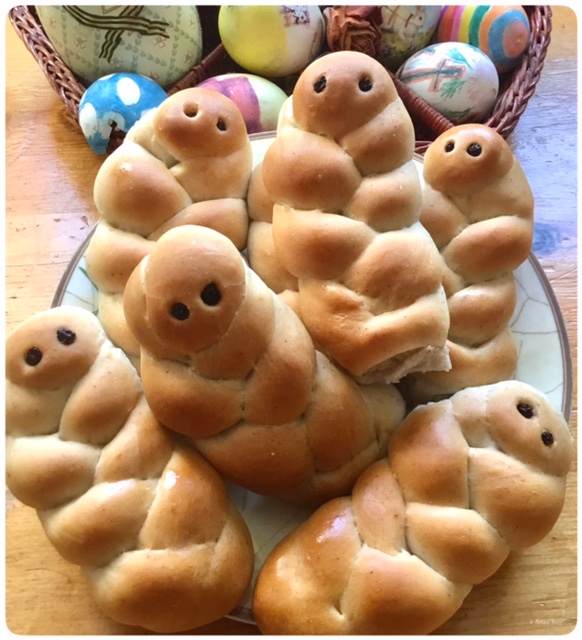
Lazarakia

Lazarakia in Greek, mean Little Lazaruses.

This special Greek bread is traditionally baked to serve on Lazarus Saturday, the day before Palm Sunday… to celebrate the miracle of Jesus raising Lazarus from the dead. Shaped like a man wrapped in a shroud, they are vegan, and contain several sweet spices. Lazarus Saturday ends at sundown, and Palm Sunday marks the beginning of Holy Week.

Lazarus Saturday is a special day in the Orthodox Church, and celebrates the final, great miracle of Jesus Christ before His Resurrection. Today prefigures His own death, and demonstrates His Authority over death. Seeing His friend is already four days dead, Jesus sheds tears and cries out: “Lazarus, come forth!”

St. John 11: 1-53

After the Resurrection of Christ, St. Lazarus lived for another 30 years and became the first Bishop of Kition in Cyprus.

In Orthodox countries, on Lazarus Saturday, children go house to house with decorated hand baskets, singing Lazarus Carols, and sharing Lazarakia. Sometimes coins are popped into the children’s baskets by parishioners, as a donation for the church. Some folks slip lenten treats to the children, which they take home and share with their families. It is also customary to collect wildflowers, palms, and branches on this day to adorn homes, as the next day is the feast of Palm Sunday.

There are many ways to make Lazarakia. Although fresh is best, you may certainly bake them ahead of time, and they freeze well.

Here is our own family recipe. It’s a bit different from the recipe on YouTube (seen near bottom of page), but it makes approximately the same quantity of Lazarakia buns as described in the video – depending of course… on the forms’ shapes and sizes. We basically do the same dough preparation as in the video. We make it a 3 braid and use peppercorns for the eyes (which are easier and safer to chew), instead of using whole clove sticks.

Ingredients

  • 1 and 1/2 cups lukewarm water
  • 2 tsp. yeast
  • 4 – 5 cups flour
  • Zest of half an orange
  • 1/3 cup white sugar
  • 1/4 cup liquid honey
  • 1/4 cup olive oil
  • 1 tsp. salt
  • 1 tsp. cinnamon
  • 1 tsp. nutmeg
  • 1 tsp. ground cloves
  • 1/2 tsp. ground cardamom
  • 1/8 tsp. ground anise (optional)
  • peppercorns for the eyes

Knead. Let rise as usual.

Round dough into approximately 3.5 ounce balls. Each ball will be enough to form a smaller circle ball for a head and 3 strips to braid. If you’d like to add a thin forehead headband strip, pull an extra minuscule amount from main ball, roll that out thinly too, and place across forehead. Push in the peppercorn eyes.

Bake in 370 degree oven for about 14 – 17 minutes, or until golden brown. (Baking time depends on the size of the Lazarakia.)

For “Bun-Shine” – a glossy vegan finish, use an extra couple of Tbsp. of olive oil for brushing onto the hot, baked, Lazarakia, after they come out of the oven. Extra yummy with a honey or syrup dip when nibbling.

Here is an excellent YouTube video. It’s easy to follow, with well explained how to’s… Step by step instructions show different ways to form the Lazarakia.

Lazarus Saturday will soon be here! I hope you enjoy the sweet venture of making and/or sharing traditional Lazarakia.

The Good Shepherd

Altar Mosaic – St. Sophia Orthodox Church, Canada

“I am the good shepherd. The good shepherd lays down his life for the sheep. He who is a hired hand and not a shepherd, who does not own the sheep, sees the wolf coming and leaves the sheep and flees, and the wolf snatches them and scatters them. He flees because he is a hired hand and cares nothing for the sheep.  I am the good shepherd. I know my own and my own know me,  just as the Father knows me and I know the Father; and I lay down my life for the sheep. And I have other sheep that are not of this fold. I must bring them also, and they will listen to my voice. So there will be one flock, one shepherd. For this reason the Father loves me, because I lay down my life that I may take it up again.  No one takes it from me, but I lay it down of my own accord. I have authority to lay it down, and I have authority to take it up again. This charge I have received from my Father.” ~ St. John 10:11-18

Thou art the good Shepherd; seek me, Thy lamb, and neglect not me who have gone astray. ~ Canon of St. Andrew of Crete

Dust and Clay

Camel rock in Goreme, Cappadocia, near St. Basil the Great’s carved rock monasteries and cave churches. ~2006

And the LORD God formed man ‭of‭ the dust of the ground, and breathed into his nostrils the breath of life; and man became a living soul. ~ Genesis 2:7

…for dust thou ‭art‭, and unto dust shalt thou return. ~Genesis 3:19

For he knoweth our frame; he remembereth that we are dust. ~ Psalm 103:14

He raiseth up the poor out of the dust, and lifteth the needy out of the dunghill… ~ Psalm 113:7

Then shall the dust return to the earth as it was: and the spirit shall return unto God who gave it. ~ Ecclesiastes 12:7

St. Lazarus (the Four Days Dead) of Bethany – was 30 years old when he first reposed and was raised again by Christ (St. John 11:1-45). He lived for another 30 years and became the first Bishop of Kition in Cyprus. An ancient tradition records that because of what St. Lazarus had seen in Hades before Christ raised him, St. Lazarus never smiled – except once… when he saw someone stealing a clay pot. With an amused expression, he observed, “The clay steals the clay.”

And as Jesus passed by, he saw a man which was blind from his birth. And his disciples asked him, saying, Master, who did sin, this man, or his parents, that he was born blind? Jesus answered, Neither hath this man sinned, nor his parents: but that the works of God should be made manifest in him. I must work the works of him that sent me, while it is day: the night cometh, when no man can work. As long as I am in the world, I am the light of the world. When he had thus spoken, he spat on the ground, and made clay of the spittle, and he anointed the eyes of the blind man with the clay, And said unto him, Go, wash in the pool of Siloam, (which is by interpretation, Sent.) He went his way therefore, and washed, and came seeing. The neighbours therefore, and they which before had seen him that he was blind, said, Is not this he that sat and begged? Some said, This is he: others said, He is like him: but he said, I am he. Therefore said they unto him, How were thine eyes opened? He answered and said, A man that is called Jesus made clay, and anointed mine eyes, and said unto me, Go to the pool of Siloam, and wash: and I went and washed, and I received sight. ~ St. John 9:1-9

All flesh is not the same flesh: but there is one kind of flesh of men, another flesh of beasts, another of fishes, and another of birds. There are also celestial bodies, and bodies terrestrial: but the glory of the celestial is one, and the glory of the terrestrial is another. There is one glory of the sun, and another glory of the moon, and another glory of the stars: for one star differeth from another star in glory. So also is the resurrection of the dead. It is sown in corruption; it is raised in incorruption: It is sown in dishonour; it is raised in glory: it is sown in weakness; it is raised in power: It is sown a natural body; it is raised a spiritual body. There is a natural body, and there is a spiritual body. And so it is written, The first man Adam was made a living soul; the last Adam was made a quickening spirit. Howbeit that was not first which is spiritual, but that which is natural; and afterward that which is spiritual. The first man is of the earth, earthy: the second man is the Lord from heaven. As is the earthy, such are they also that are earthy: and as is the heavenly, such are they also that are heavenly. And as we have borne the image of the earthy, we shall also bear the image of the heavenly. ~1 Corinthians 15:39-49

Blossom Abundantly

The beauty of today’s Feast of the Annunciation, surpasses these Fawn Lilies blooming in a local woodland.

It shall blossom abundantly, and rejoice even with joy and singing: the glory of Lebanon shall be given unto it, the excellency of Carmel and Sharon, they shall see the glory of the Lord, and the excellency of our God. ~ Isaiah 35:2

Venerable Bede (7th century), likened the Virgin Mary to a white lily… symbolizing her purity, innocence and virginity. The floral centre of yellow anthers, are as the golden radiance of her soul.

The Archangel Gabriel is often depicted in scenes of the Annunciation as giving the Virgin Mary a lily. In August, around the time of the Dormition, blooming hostas are called Assumption Lilies.

Lilies, were also called the white-robed apostles of hope. Their colour symbolizes the sinless Christ. The shape of the Easter lily represents a trumpet, resounding the message that Christ is risen. The nature in which lilies grow is also symbolic of the Resurrection.

Beauty for Ashes

To appoint unto them that mourn in Zion, to give unto them beauty for ashes, the oil of joy for mourning, the garment of praise for the spirit of heaviness; that they might be called trees of righteousness, the planting of the Lord, that he might be glorified. ~Isaiah 61:3

God’s love for us is greater than we could ever imagine. By Christ’s Resurrection, He takes the ashes of grief and sin, and transforms them into beauty, hope, and joy.

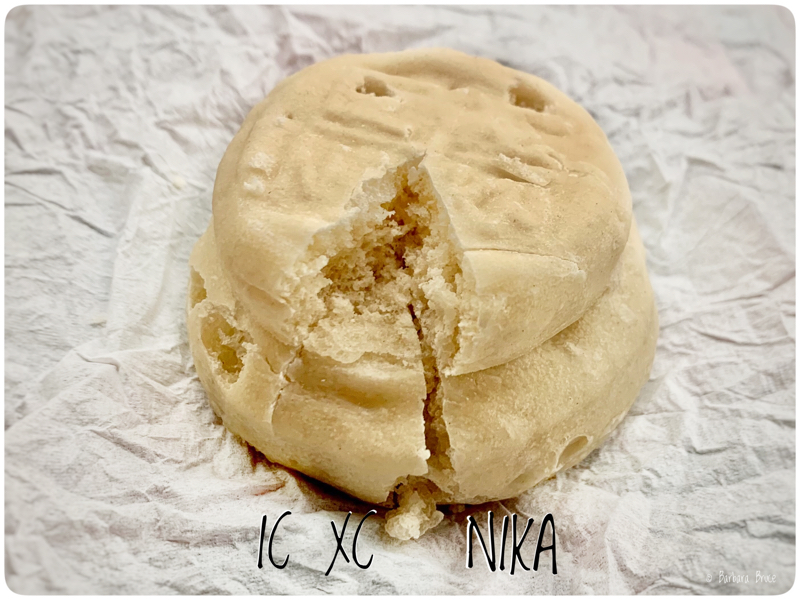
IC XC NIKA

IC XC ~ Jesus Christ (Abbreviated Greek for Jesus Christ. The lines above the letters indicate the words are abbreviated)

NIKA ~ Conquers

IC XC and NIKA (Greek) refer to Jesus Christ’s conquest of Hades and His victory over death and sin by His glorious Resurrection. IC XC and NIKA is stamped on Prosphora.

It’s a pious custom to keep holy bread and holy water in one’s icon corner. These are consumed upon breaking the previous night’s fast, along with morning prayers.

O Lord my God, may Thy holy gift and Thy Holy Water be unto forgiveness of my sins, unto enlightenment of my mind, unto strengthening of my spiritual and bodily powers, unto health of my soul and body, unto vanquishing of my passions and weaknesses, by Thy boundless merciful kindness, through the prayers of Thy Most-pure Mother and all Thy Saints. Amen. ~ Russian Orthodox Cathedral of St John the Baptist 

Soul Food

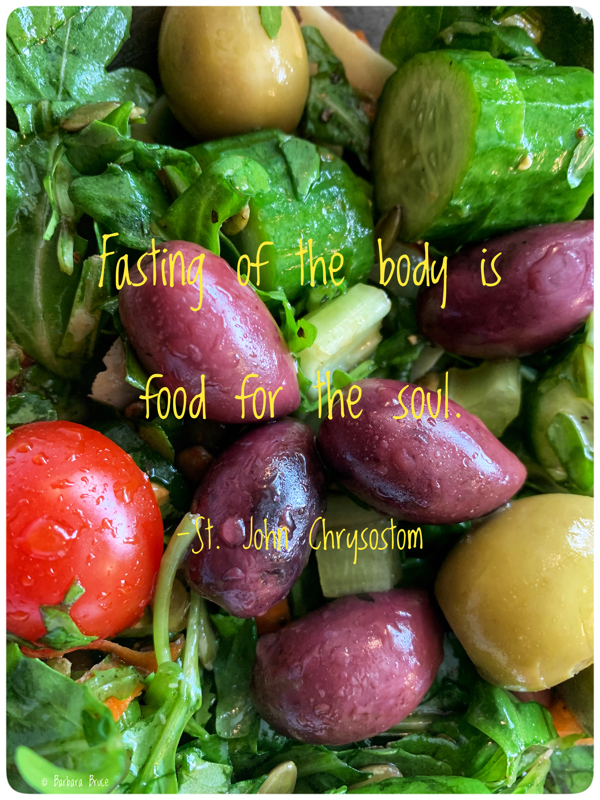
Prayer is food for the soul. Do not starve the soul, it is better to let the body go hungry… ~ St. Joseph of Optina

You don’t have a soul. You are a soul. You have a body. ~C. S. Lewis

Through greed we underwent the first stripping, overcome by the bitter tasting of the fruit, and we became exiles from God. But let us turn back to repentance and, fasting from the food that gives us pleasure, let us cleanse our senses on which the enemy makes war. Let us strengthen our hearts with the hope of grace, and not with foods which brought no benefit to those who trusted in them. Our food shall be the Lamb of God, on the holy and radiant night of His Awakening: the Victim offered for us, given in communion to the disciples on the evening of the Mystery, who disperses the darkness of ignorance by the Light of His Resurrection. ~ Aposticha, Vespers – evening of Sunday of the Last Judgement

Do that which is good, and no evil shall touch you. Prayer is good with fasting and alms and righteousness. A little with righteousness is better than much with unrighteousness. It is better to give alms than to lay up gold: For alms doth deliver from death, and shall purge away all sin. Those that exercise alms and righteousness shall be filled with life: But they that sin are enemies to their own life. ~ Archangel Raphael, Tobit 12:7-10

 One should not think about the doings of God when one’s stomach is full; on a full stomach there can be no vision of the Divine mysteries. ~St. Seraphim of Sarov

It is necessary for a Christian to fast, in order to clear his mind, to rouse and develop his feelings, and to stimulate his will to useful activity. These three human capabilities we darken and stifle above all by ‘surfeiting, and drunkenness, and cares of this life’ (Lk. 21:34). ~ St. John of Kronstadt

Many human activities, good in themselves, are not good because of the motive for which they are done. For example, fasting and vigils, prayer and psalmody, acts of charity and hospitality are by nature good, but when performed for the sake of self-esteem they are not good. ~ St. Maximos the Confessor

Devils take great delight in fullness, and drunkenness and bodily comfort. Fasting possesses great power and it works glorious things. To fast is to banquet with angels. ~ St. Athanasius the Great

Let the mouth also fast from disgraceful speeches and railings. For what does it profit if we abstain from fish and fowl and yet bite and devour our brothers and sisters? The evil speaker eats the flesh of his brother and bites the body of his neighbour. ~St. John Chrysostom

Thrice Holy

Entrance with Trisagion Prayer in Ancient Greek

Trisagion from Greek, means thrice [tris] and holy [agios]. This Thrice Holy Prayer to the Holy Trinity is used during private prayer, and throughout the Church’s daily worship cycle.

Trisagion in English: Holy God, Holy Mighty, Holy Immortal, have mercy on us.

Trisagion in Greek Pronounced: Agios O Theos, Agios Eeskhiros, Agios Athanatos, eleison imas)

History and Miracle of the Trisagion Hymn

Above, the hosts of angels sing praise; below, men form choirs in the churches and imitate them by singing the same doxology. Above the Seraphim cry out the Trisagion Hymn; below, the human throng sends up the same cry. The inhabitants of heaven and earth are brought together in a common assembly; there is one thanksgiving, one shout of delight, one joyful chorus. ~ St. John Chrysostom

The unceasing and sanctifying doxology by the holy angels in the Trisagion signifies, in general, the equality in the way of life and conduct and the harmony in the divine praising which will take place in the age to come by both heavenly and earthly powers, when the human body now rendered immortal by the resurrection will no longer weigh down the soul by corruption and will not itself be weighed down but will take on, by the change into incorruption, potency and aptitude to receive God’s coming. In particular it signifies, for the faithful, the theological rivalry with the angels in faith; for the active ones, it symbolizes the splendor of life equal to the angels, so far as this is possible for men, and the persistence in the theological hymnology; for those who have knowledge, endless thoughts, hymns, and movements concerning the Godhead which are equal to the angels, so far as humanly possible. ~ St. Maximus the Confessor

error: Content is protected !!