From the Depths of the Heart

St. Basil the Great’s Monastery Church, carved into soft, volcanic, Cappadocian rock. Goreme, Turkey – 2004

Love of God is not something that can be taught. We did not learn from someone else how to rejoice in light or want to live, or to love our parents or guardians. It is the same – perhaps even more so – with our love for God: it does not come by another’s teaching. ~ St. Basil the Great

Preserve gratitude like a precious deposit within your soul, and from it you will receive a double portion of delight. Remember the apostolic word, “Give thanks in all circumstances.” ~ St. Basil the Great

The radiance of divine beauty is altogether beyond the power of words to describe. ~ St. Basil the Great

A dear friend shared this beautiful, numinous, prayer: “Speaking with God from the Depths of the Heart” by St. Gregory of Narek (951-1003 AD); it’s beyond the power of words to describe.

St. Basil’s Feast Day

St. Basil the Great’s Monastery, carved in soft, volcanic, Cappadocian, rock. Goreme – 2004

Happy St. Basil’s Day!

Born in 329 AD, his Heavenly Birthday is January 14/1 in the year 379 AD.

…the time for prayer is one’s whole life. ~ St. Basil the Great

St. Basil the Great’s 4th century monastic vision inspired the building of numerous church communities throughout the ancient region over the next five and a half centuries. The rock churches provided the bonus of cool respite amid the surrounding hot, dry, landscape.

Below is a festive Vasilopita – a St. Basil’s Day Cake, which commemorates a certain miracle of St. Basil the Great. My husband baked the celebratory cake using this traditional recipe.

The caramelized sugar and chopped almonds topping the festive cake are reminiscent of the sandy, rocky, Cappadocian countryside landscape.

Cutting the Cake: At home, after the Divine Liturgy, the cake is loosely covered with a napkin, and the sign of the cross is made. The undercover cutting commences, so nobody can see where the secret coin might be. The slices are distributed in this order: First piece cut is in honour of Christ, the second is cut in honour of the Virgin Mary, and the third is cut for St. Basil. These three pieces are saved and given the same day to the elderly, or the poor. The next pieces are cut for the most senior member of the household down to the youngest member. Whoever finds the coin in their piece of cake puts it toward something special!

Preserve gratitude like a precious deposit within your soul, and from it you will receive a double portion of delight. Remember the apostolic word, “Give thanks in all circumstances.” ~ St. Basil the Great

Lovely St. Basil’s Day & New Year Greek Carol – Duet

Old sheet music of St. Basil’s Day & New Year Carol with the verses being sung above (but arranged in a different order on pdf).

With love in Christ.

Great-Martyr Barbara

December 17/4

Happy Feast and many years to all celebrating St. Barbara and St. Juliana today!

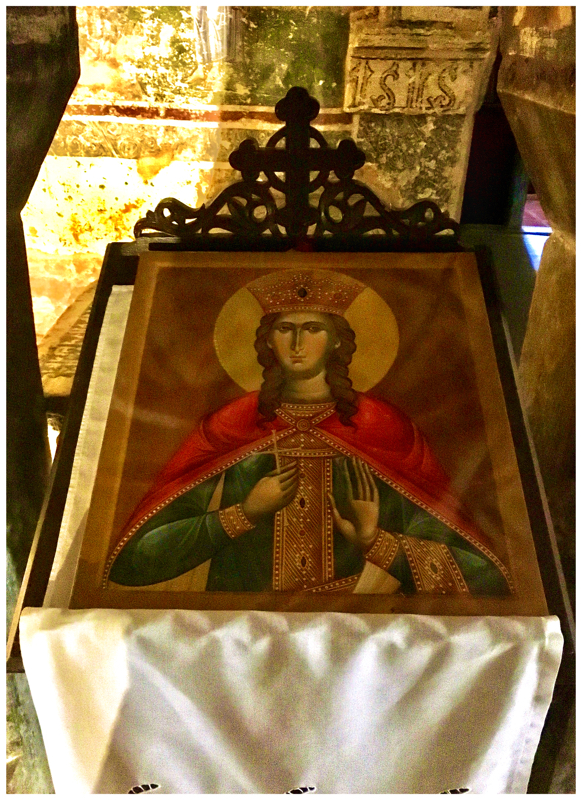
St. Barbara Icon seen above, in Hosios Loukas Monastery Church, Distomo, Greece – 2004. Reflections of the church’s ceiling arches above, are visible on the icon.

11th Century St. Barbara’s Church, Carved in Rock – Cappadocia, 2004

Great-Martyr Barbara and St. Juliana on Wall Fresco, Interior of 11th Century Church, Cappadocia – 2004

Interior of 11th Century St. Barbara’s Church, Cappadocia – 2004

Great-Martyr Barbara Troparion, Tone 8

Let us honour the holy Barbara; for the most honoured one broke the snares of the enemy// and was delivered from them like a bird, with the help and aid of the Cross.

St. Barbara is called upon for protection against sudden death, lightening, fire, and to aid soldiers, and firefighters.

St. Barbara was born in the Greek city of Heliopolis in Syria, now called Baalbek, in eastern Lebanon. St. Barbara’s feast day is known as Eid il-Burbara to Christians in Jordan, Syria and Lebanon, and there is a special St. Barbara’s Day dessert made to celebrate. Although the dish is traditionally prepared from boiled wheat hulls, rose water, cinnamon, anise and nuts, I like to use Cream of Wheat. This aromatic sweet recalls the tradition that freshly planted wheat fields miraculously sprung up behind St. Barbara covering her initial escape path to the mountains.

Here is my own festal and vegan (fasting-friendly) recipe for St. Barbara’s Day Dessert.

Holy Great-Martyr Barbara and St. Juliana, pray to God for us!

Dust and Clay

Camel rock in Goreme, Cappadocia, near St. Basil the Great’s carved rock monasteries and cave churches. ~2006

And the LORD God formed man ‭of‭ the dust of the ground, and breathed into his nostrils the breath of life; and man became a living soul. ~ Genesis 2:7

…for dust thou ‭art‭, and unto dust shalt thou return. ~Genesis 3:19

For he knoweth our frame; he remembereth that we are dust. ~ Psalm 103:14

He raiseth up the poor out of the dust, and lifteth the needy out of the dunghill… ~ Psalm 113:7

Then shall the dust return to the earth as it was: and the spirit shall return unto God who gave it. ~ Ecclesiastes 12:7

St. Lazarus (the Four Days Dead) of Bethany – was 30 years old when he first reposed and was raised again by Christ (St. John 11:1-45). He lived for another 30 years and became the first Bishop of Kition in Cyprus. An ancient tradition records that because of what St. Lazarus had seen in Hades before Christ raised him, St. Lazarus never smiled – except once… when he saw someone stealing a clay pot. With an amused expression, he observed, “The clay steals the clay.”

And as Jesus passed by, he saw a man which was blind from his birth. And his disciples asked him, saying, Master, who did sin, this man, or his parents, that he was born blind? Jesus answered, Neither hath this man sinned, nor his parents: but that the works of God should be made manifest in him. I must work the works of him that sent me, while it is day: the night cometh, when no man can work. As long as I am in the world, I am the light of the world. When he had thus spoken, he spat on the ground, and made clay of the spittle, and he anointed the eyes of the blind man with the clay, And said unto him, Go, wash in the pool of Siloam, (which is by interpretation, Sent.) He went his way therefore, and washed, and came seeing. The neighbours therefore, and they which before had seen him that he was blind, said, Is not this he that sat and begged? Some said, This is he: others said, He is like him: but he said, I am he. Therefore said they unto him, How were thine eyes opened? He answered and said, A man that is called Jesus made clay, and anointed mine eyes, and said unto me, Go to the pool of Siloam, and wash: and I went and washed, and I received sight. ~ St. John 9:1-9

All flesh is not the same flesh: but there is one kind of flesh of men, another flesh of beasts, another of fishes, and another of birds. There are also celestial bodies, and bodies terrestrial: but the glory of the celestial is one, and the glory of the terrestrial is another. There is one glory of the sun, and another glory of the moon, and another glory of the stars: for one star differeth from another star in glory. So also is the resurrection of the dead. It is sown in corruption; it is raised in incorruption: It is sown in dishonour; it is raised in glory: it is sown in weakness; it is raised in power: It is sown a natural body; it is raised a spiritual body. There is a natural body, and there is a spiritual body. And so it is written, The first man Adam was made a living soul; the last Adam was made a quickening spirit. Howbeit that was not first which is spiritual, but that which is natural; and afterward that which is spiritual. The first man is of the earth, earthy: the second man is the Lord from heaven. As is the earthy, such are they also that are earthy: and as is the heavenly, such are they also that are heavenly. And as we have borne the image of the earthy, we shall also bear the image of the heavenly. ~1 Corinthians 15:39-49

Skylark Buns Tradition

Skylark buns are traditionally baked to celebrate the Holy 40 Martyrs of Sebaste.

Sebaste, an ancient Roman town, is now called Ayas in modern-day Turkey. The date of the Holy Forty Martyrs’ “heavenly birthday” falls on March 22/9 (320 AD) and always within Great Lent.

The Holy Forty Martyrs were soldiers in the Roman 12th Legion called Fulminata (the Lightning -Thundering Legion). As Christians, they refused to offer sacrifice to the pagan gods, and were brought to trial before the commander. After enduring many sufferings, they attained the joyous reward reserved for those who give their lives for Christ. The unwavering fortitude of the Holy Forty Martyrs exemplifies great faith, and perseverance to the end.

The Holy Fathers of the Church refer to Great Lent as a fasting spring. During this period, the souls of the faithful are sown with seeds of divine grace, to yield a harvest of good deeds, throughout the year that follows. 

Buns shaped like birds (also known as skylarks) are traditionally baked to celebrate the Forty Martyrs of Sebaste’s feast day.  Skylark buns are also shared after church on the first Sunday closest to their feast day, which also occurs near the first day of spring.

The skylark buns remind us of the Forty Martyrs’ steadfastness… inspiring own our souls to soar heavenward like birds, upon the wings of divine love; looking unto Jesus, the Author and finisher of our lives.  

To Make the Larks    

Take a piece of risen yeasted bread dough, about the size of a medium egg, and roll it out into a long ropey piece, about 5 inches long. 

Tie it loosely into a knot, with approximately equal length protruding from both ends. 

Put on a lightly greased cookie sheet (or use parchment paper). With a pair of scissors, cut a “beak” on one end of the knot, and on the other end of the knot, cut a “tail” into about 3 or 4 feathered strands. 

Push 2 peppercorns firmly into the head, as eyes.  

Do not put birds on cookie sheet too closely together, as they spread a bit as they bake. Cover, let rise again for about half an hour. 

Pop into a preheated 370* oven and bake about 15-20 minutes or until golden brown. 

TIP: For tastier buns, use a bit of honey, a dash of cardamon, and lemon or orange zest in the dough. 

Some people prefer to use currants for the eyes, although these can turn gooey. 

Birds freeze very well if baking ahead of time. You may need to secure their eyes again, if they come loose in bag when thawing.

Off-Grid in Cappadocia

Goreme, Cappadocia – 2006

Cappadocia is an ancient central region in Asia Minor, and an important centre of early Christianity. Unusual coloured pinnacles of soft volcanic rock, dot the hot and dusty Cappadocian landscape.

St. Basil the Great (330 – 379 AD), Bishop of Caesarea and Cappadocia is known as one of the (Three Hierarchs) Cappadocian Fathers who lived in the region, along with his brother Saint Gregory of Nyssa , and St. Gregory the Theologian.

Under the directive of St. Basil the Great, the early Christians began carving numerous cave churches, and monastic communities. These were hewn by hand, and the projects continued over the next 500 years. Vast networks of underground cities were also created by these tenacious inhabitants.

Many of the cave churches in Goreme retain their colourful iconography to this very day, and are a highlight to any visit to Cappadocia.

They that live in the wilderness, have an unquenchable longing for God, as they are far from the tumult of life… Hymn of the Ascents

error: Content is protected !!