Nothing is Hidden

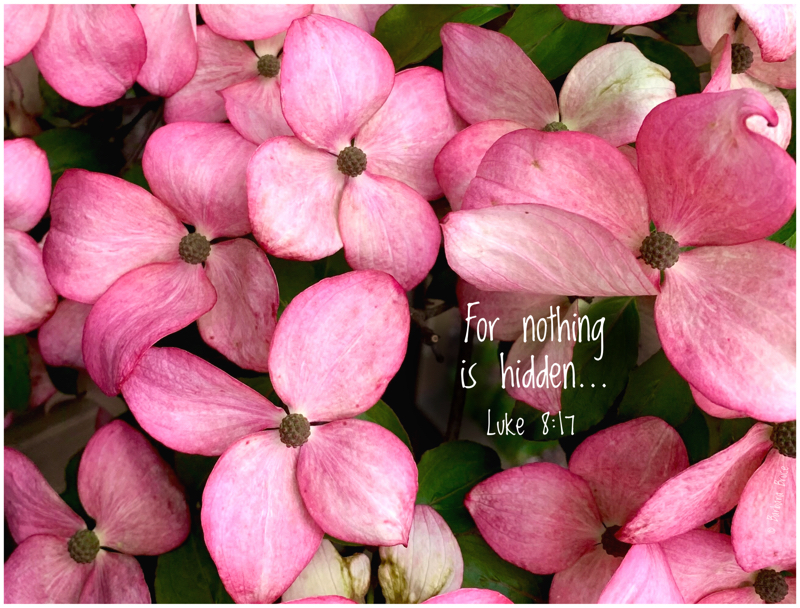
Pink Rosé Dogwood Tree Blossoms

For nothing is hidden that will not be made manifest, nor is anything secret that will not be known and come to light. ~ Luke 8:17

The wind bloweth where it listeth, and thou hearest the sound thereof, but canst not tell whence it cometh, and whither it goeth: so is every one that is born of the Spirit. ~ John 3:8

A few days ago, on the windy Post Feast, we took three (still amazingly fresh) floral Pentecost bouquets out to the cemetery.

The grassy gravesites were dotted with mantles of snow-white daisies and great golden dollops of buttercups. Purply-blue fields of floral confetti tangled with clover… and as quail, ravens and sparrows – scooted, soared and flitted nearby, the last line of the Creed came to mind: I look for the Resurrection of the dead, and the Life of the age to come. 

We stood where past, present and future are tightly entwined, for… He shall come again with glory, to judge the living and the dead; Whose Kingdom shall have no end…

Off to the side, and distracting my reverie, a pink dogwood tree’s blossomed boughs thrashed wildly to and fro in the gusty winds. Narrowing my eyes thoughtfully at it, I noted it was not at all like its more staid and demure counterpart… the white-flowered Pacific dogwood growing beside our church.

Once, during an Archbishop’s past parish visit and upon noticing the young dogwood sapling (official flower of BC, Canada) newly planted beside our church, he recounted how the dogwood tree had a long, Christian-themed history.

While some Biblical scholars assert Christ was crucified on a dogwood tree’s Cross, Orthodox Church tradition conveys that the Cross was made from three different types of wood: cedar, pine and cypress. Regardless, and depending on the country, dogwoods are often found planted on church grounds.

I’d like to share this unknown poet’s sweet poem called:

Legend of the Dogwood Tree

When Christ was on earth, the dogwood grew
To a towering size with a lovely hue.
Its branches were strong and interwoven
And for Christ’s cross its timbers were chosen
Being distressed at the use of the wood
Christ made a promise which still holds good:

“Not ever again shall the dogwood grow
To be large enough for a tree, and so
Slender and twisted it shall always be
With cross-shaped blossoms for all to see.
The petals shall have bloodstains marked brown
And in the blossom’s center a thorny crown.
All who see it will think of Me,
Nailed to a cross from a dogwood tree.
Protected and cherished this tree shall be
A reflection to all of My agony.”

Surprisingly, there are at least 60 species of Dogwood (Cornus) Trees, and they grow quite quickly. In Europe, Dogwood Trees were known as Whipple Trees. The origin of of the name Dogwood comes from the Scandinavian word dag meaning skewer, because the hardwood from this plant was traditionally used to make dags (daggers). Besides being used medicinally, it was used to fashion archery bows, and continues being used in woodworking today.

Dogwood flowers represent durability and ability to withstand various challenges in life. The white dogwood in particular, is symbolic of rebirth, purity and faith… Reminding us of Christ’s Holy Resurrection and the beginning of a new Life in Him.

I look for the Resurrection of the dead, and the Life of the age to come. 

The end part of the Creed reminds us death is not the end.

It’s a road we’ll all travel someday, and as Christians we look forward to beyond death, the resurrection of the dead, and life with God; Whose Kingdom shall have no end.

Which of course, is part of an even greater Mystery!

Truly He is Risen

Image by jplenio from Pixabay 

Truly He is risen!

and were He not, 

we should not have met

like cells of an enormous, incomprehensible fabric

our eyes are slowly opened 

to the miracle which binds us together

May the Lord continue to bless us

~ by an Anonymous Friend

I initially posted this with my friend’s permission and name, but he has since requested that “anon would do nicely” and gave me this humble reason…

The words that I write 
Are rarely my own 
But are more seeds of light  
That some Angel has sown 
They take root and flower 
And raising their heads 
By some mystical power 
They rise in their beds 
And sing the praise of their Sower. 

From the Belly of Hades

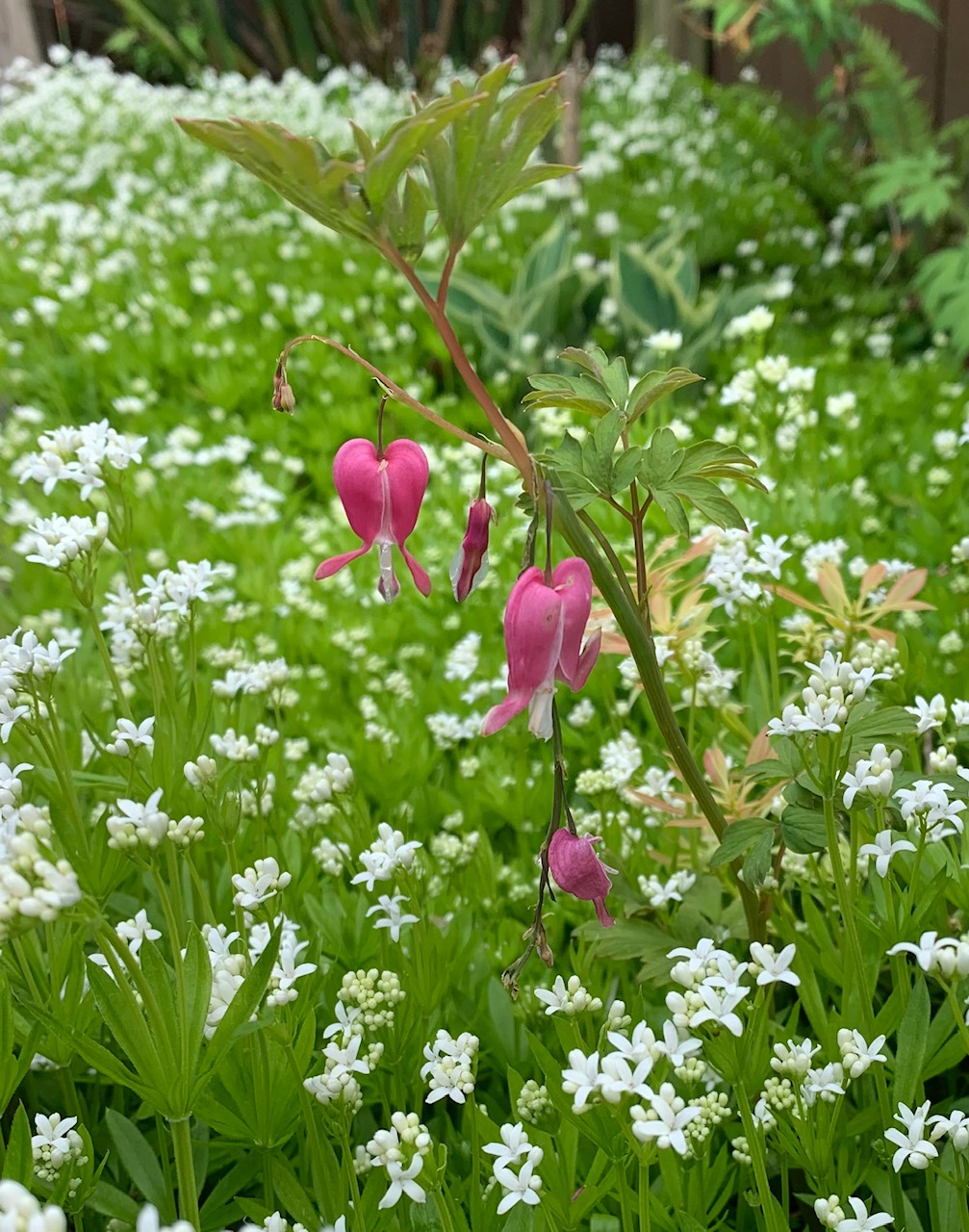
Bleeding Hearts are surrounded by the comforting starry cosmos of Sweet Woodruff’s white flowers.

Greetings on:
The (movable) Feast of MidPentecost!
The annual feast of the Wonderworking Icon of the Inexhaustible Cup (Chalice)!

The Icon’s Akathist to the Theotokos for help with the struggle of various addictions is here.

Congratulations to my dear friend Irena on her Saint’s Day!

In Christianity, the Bleeding Heart flower represents the suffering that Christ endured for our sins, and the Theotokos’ grief seeing her Son on the Cross.

Tiny white stars of Sweet Woodruff flowers are symbolic of hope and humility. This perennial ground cover spreads its cheer where other herbaceous plants may find it difficult to thrive. It bursts into burgeoning blooms come early spring, then quietly seems to diminish in the summer. Its fragrant fresh flowers (mildly reminiscent of vanilla) and leaves were used for everything from air fresheners to bed-straw stuffing. Its flowers flavoured wine and jellies, and were used for other medicinal purposes. (Of course, one should always check with a doctor before using any medical herb they’re not familiar with.) Last, but not least – marauding deer abhor sweet woodruff in gardens… and that alone makes it extra sweet to me!

That being said, and setting rascally deer aside…. the many blessings in our lives are unavoidably peppered with banes, but it’s the banes that make each new blessing a heartfelt consolation!

I do not understand what I do. For what I want to do I do not do, but what I hate I do. ~ Romans 7:15. For I do not do the good I want to do, but the evil I do not want to do — this I keep on doing. Now if I do what I do not want to do, it is no longer I who do it, but it is sin living in me that does it. ~ Romans 7:19-20

Like St. Paul in his epistle to the Romans, we find ourselves in spiritual battles. We want to do what’s right, yet sometimes we do the very things we hate… even when knowing we’re wrong.

Granted, we can look back on the past – but don’t stare. Staring backwards can make one disheartened, overwhelmed and anxious. Everyone has a heartache, and we’re all dealing with struggles of some sort. Focus Forward!

Anxiety about ourselves means lack of faith; anxiety about our neighbour means pain. Feeling the intensity of other’s pain from within is accompanied by prayer and then comes the divine consolation. Therefore, you should pray as much as you can and then leave everything in the hands of God and calm yourself. Does God hurt His creatures less than you? Why worry? God gives a lot of comfort to anyone who is in spiritual pain and suffering for others because otherwise, one could not bear this burden… But from this pain comes true joy. ~ St. Paisios

Let the heavens rejoice; let earthly things be glad; for the Lord hath wrought might with His arm. He hath trampled down death by death; the first-born of the dead hath He become. From the belly of Hades hath He delivered us, and hath granted to the world great mercy. ~ Troparion of the Resurrection (Tone 3)

Even When it’s Raining

The Lord upholds all who fall and lifts up all of us who are bowed down. ~ Psalm 145:14

It’s been said that sorrow looks back, worry looks around, but Faith looks up!

We glimpse this in our own gardens, with flowers blooming – regardless of debris from past storms.

For even when it’s raining, the Sun is shining above those clouds!

The fruit of the light consists in all goodness and righteousness and truth. ~ Ephesians 5:9

Sakura Steps

Fragrant sakura cherry blossoms congregate as pink snow drifts on church stairs.

People travel to wonder at the height of the mountains, at the huge waves of the seas, at the long course of the rivers, at the vast compass of the ocean, at the circular motion of the stars, and yet they pass by themselves without wondering. ~ St. Augustine of Hippo

Rock-Steady

Local Neighbourhood Stone Garage with Grass and Floral Roof

As powerful ocean waves smooth and polish sharp edges of rock and stone, so does the Holy Spirit with our souls. It surrounds us. It strengthens us. It refines and completes us. And… bit by bit, with less and less, we become more.

Everyone then who hears these words of mine and does them will be like a wise man who built his house on the rock. And the rain fell, and the floods came, and the winds blew and beat on that house, but it did not fall, because it had been founded on the rock. And everyone who hears these words of mine and does not do them will be like a foolish man who built his house on the sand. And the rain fell, and the floods came, and the winds blew and beat against that house, and it fell, and great was the fall of it. ~ Matthew 7:24-27

The Lord is my rock and my fortress and my deliverer, my God, my rock, in whom I take refuge, my shield, and the horn of my salvation, my stronghold. ~ Psalm 18:2

May your Lenten Journey be steady, peaceful, and fruitful.

Be Still

Camellias Bloom by Church Wall

In floral language, the Camellia Japonica is considered a symbol of purity.

I want creation to penetrate you with so much admiration that everywhere, wherever you may be, the least plant may bring to you the clear remembrance of the Creator. If you see the grass of the fields, think of human nature, and remember the comparison of the wise Isaiah. “All flesh is grass, and all the goodliness thereof is as the flower of the field.” ~ St. Basil the Great

The grass withers, the flower fades, but the word of our God stands forever. ~ Isaiah 40:8

Be still, and know that I am God… ~ Psalm 46:10

Silence is the mystery of the age to come. ~ St Isaac of Syria

May your Lenten Journey be quiet, peaceful, and fruitful.

It’s the New Growth

It’s the new growth… that bears the blooms!

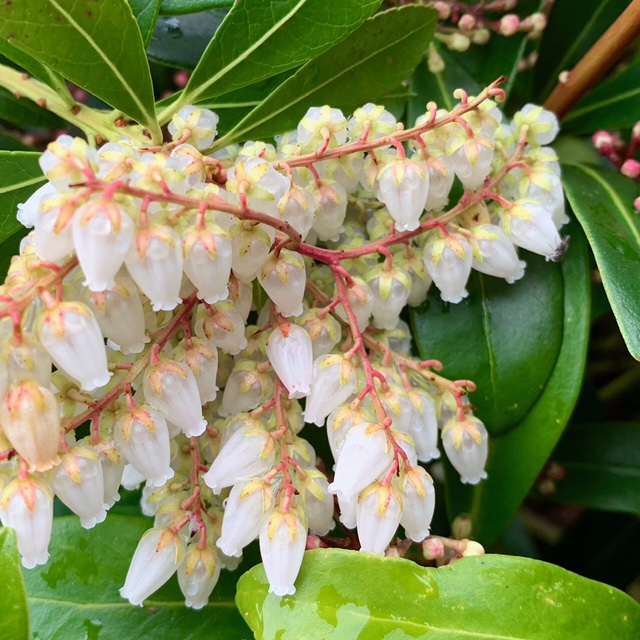
The Lily of the Valley Shrub, also known as Pieris Japonica, is a lovely evergreen shrub and early bloomer, belonging to the Heath family. It’s a joy to see and smell these pendulous, sweet, fragrant bells, especially during Lent.

From of old…. the teardrop shape flowers of both the Lily of the Valley bulb plant, and the Pieris Japonica shrub, are said to poignantly symbolize the tears that Eve shed upon leaving the Garden of Eden, and the Virgin Mary’s tears shed at the cross of Christ.

She is the flower of the field from whom bloomed the precious lily of the valley. ~ St. Augustine

Sometimes, a glimpse of Paradise is right outside our back door!

Happy Lenten Spring!

These Treasures

Purple Heath (Heather) and Snowdrops (Candlemas Bells, Fair Maids of February) Dot the Neighbourhood

The only requirements of our soul are righteousness, holiness, truth, love, mercy, meekness, peace, spiritual freedom, or the grace of God in the heart. These treasures give life to our whole being, and are eternal. ~ St. John of Kronstadt (My Life in Christ)

Flowers of Penitence

Vibrant Spring Crocus by Melania – © Divine Florals

The wilderness and the dry land shall be glad; the desert shall rejoice and blossom like the crocus; it shall blossom abundantly and rejoice with joy and singing… ~ Isaiah 35:1-2

At winter’s end, the crocus – also known as the penitent flower, appears before the spiritual spring of Great Lent… a season of forgiveness, repentance, efforts, hope, and renewal.

The week preceding Great Lent is called Cheesefare (Maslenitsa), and in 2022, Cheesefare begins Monday, February 28th. Meat is now excluded until Pascha (Easter). Dairy and seafood are (thoroughly) enjoyed this week, and it’s traditional to include blini crepes or pancakes to use up remaining dairy – before the more strict plant-based fare of Great Lent.

This year Great Lent begins on Monday, March 7th.

May we all cultivate fragrant buds of virtue, and Blossom Forth!

error: Content is protected !!