…unless you have suffered affliction – virtue has not been tested. ~ St. Mark the Ascetic
Virtue is nothing without the trial of temptation, for there is no conflict without an enemy, no victory without strife. ~ St. Leo the Great
…For the Holy Spirit, sweet and gracious, draws the soul to love the Lord, and in the sweetness of the Holy Spirit the soul loses her fear of suffering. ~ St. Silouan the Athonite
For one to be ill is a divine visitation. Illness is the greatest gift from God, and when the only thing that man can give back to God is pain. ~ Anonymous old monk
It is absurd to be grateful to doctors who give us bitter and unpleasant medicines to cure our bodies, and yet be ungrateful to God for what appears to us to be harsh, not grasping that all we encounter is for our benefit and in accordance with His providence. For knowledge of God and faith in Him is the salvation and perfection of the soul. ~ St. Anthony the Great
I have consciousness of my sinfulness, but I live with hope. It is bad to despair, because someone who despairs becomes embittered and loses willingness and strength. Someone who has hope, on the contrary, advances forward. ~ St. Porphyrios
Local sunset, on paddle board – photo shared by Katherine
Such, then, is our God: unknowable in his essence, yet known in his energies; beyond and above all that we can think or express, yet closer to us than our own heart. ~ Kallistos Ware
If I do not feel a sense of joy in God’s creation, if I forget to offer the world back to God with thankfulness, I have advanced very little upon the Way. I have not yet learnt to be truly human. For it is only through thanksgiving that I can become myself. ~ Kallistos Ware
We know that prayer in itself cannot and of itself cannot save us, but carrying it before God can. For when the Lord’s eyes are upon un, He sanctifies us, as the sun warms everything upon which it shines. ~ St. Gregory Palamas
Prayer is spiritual breathing; when we pray we breathe in the Holy Spirit; “praying in the Holy Spirit“. Thus, all church prayers are the breathing of the Holy Spirit; as it were spiritual air and also light, spiritual fire, spiritual food and spiritual raiment. ~ St. John of Kronstadt
Holy Apostles Sts. Peter and Paul on Epistle Book cover
The Holy Gospels are from Sts. Matthew, Mark, Luke and John. Most of the other New Testament Books are Epistles – Letters from Sts. Peter and Paul to the early Christians located in different cities.
Each day of the liturgical year has specific Gospel and Epistle readings. These pertain to the church calendar, and spiritually nourish millions of Orthodox Christians daily. If prayer is where we speak to God, the Scriptures are how we listen to Him.
As of 2021, private interpretations and individualistic opinions of Holy Scripture have globally birthed a staggering 45,000 separate Christian denominations.
Therefore, brethren, stand fast, and hold the traditions which ye have been taught, whether by word, or our epistle. ~ 2 Thessalonians 2:15
If from one burning lamp someone lights another, then another from that one, and so on in succession, he has light continuously. In the same way, through the Apostles ordaining their successors, and those successors ordaining others, and so on, the grace of the Holy Spirit is handed down through all generations and enlightens all who obey their spiritual shepherds and teachers. ~ St. Gregory Palamas
… we commemorate each of the saints with hymns and appropriate songs of praise, how much more should we celebrate the memory of Peter and Paul, the supreme Leaders of the pre-eminent company of the Apostles? They are the fathers and guides of all Christians: Apostles, martyrs, holy ascetics, priests, hierarchs, pastors and teachers. As chief shepherds and master builders of our common godliness and virtue, they tend and teach us all, like lights in the world, holding forth the word of life. ~ St. Gregory Palamas
… the Apostle Peter declared that the Church was built by the Holy Spirit. For you read that he said: ‘God, Who knows the hearts of men, bore witness, giving them the Holy Spirit, even as was given to us; and He made no distinction between us and them, purifying their hearts by faith’ Acts 15:8-9. In which is to be considered, that as Christ is the Cornerstone, Who joined together both peoples into one, so, too, the Holy Spirit made no distinction between the hearts of each people, but united them. ~ St. Ambrose of Milan
… the light that illumined St. Paul on the road to Damascus, the light through which he was raised to the third heaven where he heard unutterable mysteries, was not merely enlightenment of conceptual images or of spiritual knowledge. It was the effulgence of the power of the Holy Spirit shining in our Lord’s own person. Such was its brilliance that corporeal eyes were not able to bear it and were blinded; and through it all spiritual knowledge is revealed and God is truly known by the worthy and loving soul. ~ St. Makarios of Egypt
According to St. Paul you minister the Gospel only when, having yourself participated in the light of Christ, you can pass it on actively to others. Then you sow the Logos like a divine seed in the fields of your listeners’ souls... Elsewhere St. Paul, calls the teachers tillers and their pupils the field they till wisely, presents the former as ploughers and sowers of the divine Logos and the latter as fertile soil, yielding a rich crop of virtues. True ministry is not simply a celebration of sacred rites; it also involves participation in divine blessings and the communication of these blessings to others. ~ St. Gregory of Sinai
There’s a Daily Orthodox Church Calendar on Blisswood, located at the very bottom of each page and post; where one can easily access links for daily Gospel and Epistle readings.
I prefer to hold and read from an actual King James Bible, but when travel or convenience calls, there’s also a free, simple app, great for ipads or cells. It’s called Orthodox Calendar and contains lives of saints, fasting regulations, Scripture Readings, Troparion and Kontakion (Little Hymns pertaining to the day).
May your day and and all your spiritual endeavours be blessed!
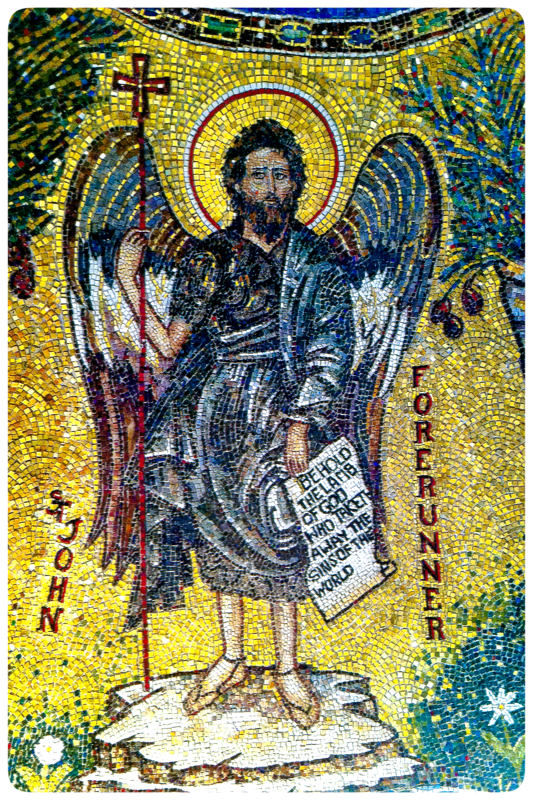
Dome Mosaic of St. John the Baptist – St. Sophia Orthodox Church, Canada
St. John the Baptist is called the voice of the Word, the Lampstand of the Light, the morning star and Forerunner of the Sun of Righteousness.
He is named Forerunner, as he preceded Christ… being sent as a Messenger to prepare the people for Christ’s ministry. Angel in Greek means messenger, and some icons of St. John the Baptist depict him with angelic wings, on account of Malachi’s prophecy from the Old Testament.
On September 11 (August 29, Julian calendar) we remember St. John the Baptist’s heavenly birthday and martyrdom. In honour of the greatest of all prophets who have ever lived, and since ancient times, the Church has celebrated this leading luminary by establishing this day as a fast.
There was a man sent from God, whose name was John. The same came for a witness, to bear witness of the Light, that all men through him might believe. He was not that Light, but was sent to bear witness of that Light. That was the true Light, which lighteth every man that cometh into the world. ~ St. John 1:6-9
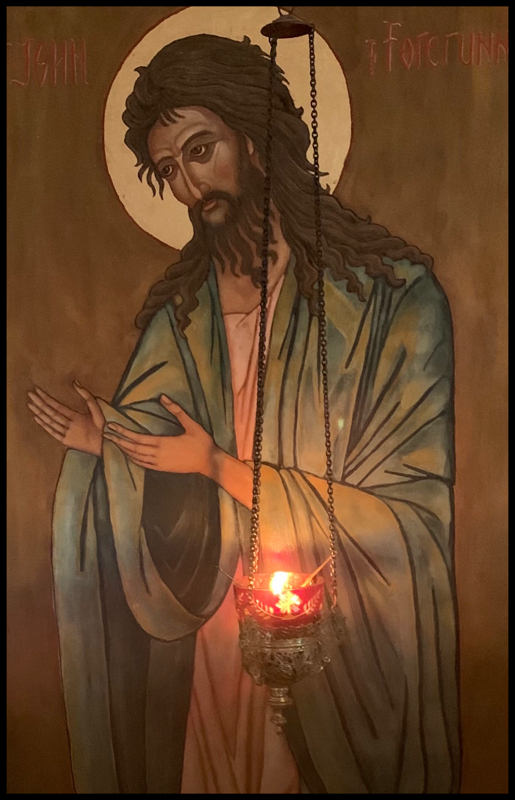
St. John the Baptist – St. Sophia Orthodox Church, Canada
700 years before the birth of Christ, the Prophet Isaiah foretold the preaching of John the Baptist. Isaiah called St. John “the voice of him that crieth in the wilderness” (Isaiah 40:3); who was to “prepare the way of the Lord, make straight in the desert a highway for our God.”
Malachi, the last of the Old Testament prophets, who lived more than 400 years before the birth of Christ foretold the coming of St. John the Baptist, and refers to him as an angel. Behold I will send My Angel, and he shall prepare the way before Me; and the Lord, whom ye seek, shall suddenly come to His temple, even the Angel of the covenant, whom ye delight in: behold, He shall come, saith the Lord of hosts.~ Malachi 3:1-2
There was a man sent from God, whose name was John. The same came for a witness, to bear witness of the Light, that all men through him might believe. He was not that Light, but was sent to bear witness of that Light. That was the true Light, which lighteth every man that cometh into the world.~ St. John 1:6-9
Christ Himself said:Verily I say unto you, Among them that are born of women there hath not risen a greater than John the Baptist: notwithstanding he that is least in the kingdom of heaven is greater than he. ~ St. Matthew 11:11
Through the holy prayers of St. John the Forerunner and Baptist of Christ, our Leading Luminary, may we, too, stand as steadfast shining candles before the Lord; radiating His Effulgent and Gladsome Light!
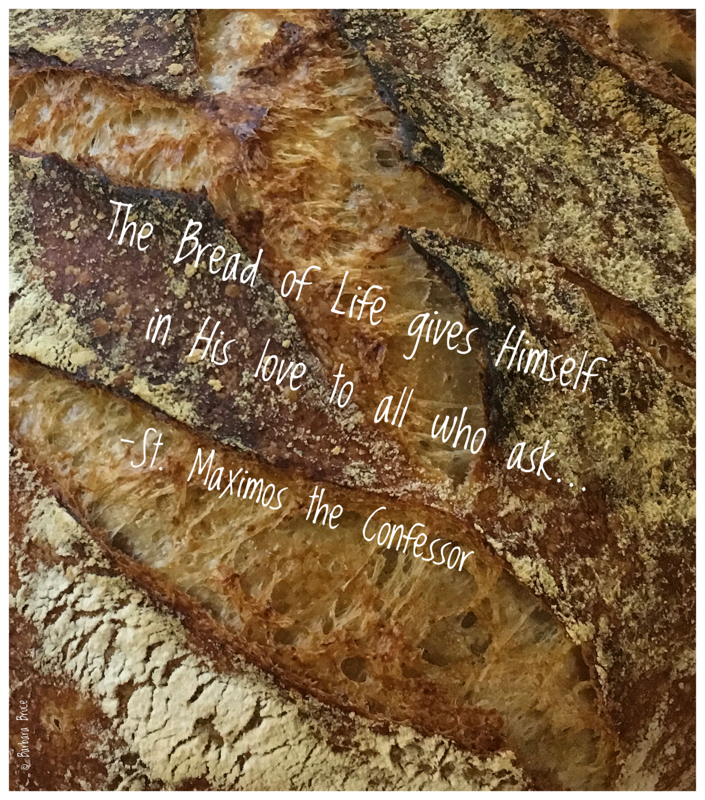
He who asks to receive his daily bread does not automatically receive it in its fullness as it is in itself: he receives it according to his own capacity as recipient. The Bread of Life (cf. St. John 6:35) gives Himself in His love to all who ask, but not in the same way to all; for He gives Himself more fully to those who have performed great acts of righteousness, and in smaller measure to those who have not achieved so much. He gives Himself to each person according to that person’s spiritual ability to receive Him. ~St. Maximos the Confessor
The Lord promised to send the Comforter. (St. John 16:7), Who should join us to God. For as a compacted lump of dough cannot be formed of dry wheat without fluid matter, nor can a loaf possess unity, so, in like manner, neither could we, being many, be made one in Christ Jesus without the water from heaven. And as dry earth does not bring forth unless it receives moisture, in like manner we also, being originally a dry tree, could never have brought forth fruit unto life without the voluntary rain from above. For our bodies have received unity among themselves by means of that laver which leads to incorruption; but our souls, by means of the Spirit. Wherefore, both are necessary, since both contribute towards the life of God. ~ St. Irenaeusof Lyons
…with the choicest fruits of the sun and the rich yield of the months, with the finest produce of the ancient mountains and the abundance of the everlasting hills, with the best gifts of the earth and its fullness… ~ Deuteronomy 33:14 – 16
The Light of the Lord’s Transfiguration does not come into being or cease to be, nor is it circumscribed or perceptible to the senses, even though for a short time on the narrow mountain top it was seen by human eyes. Rather, at that moment the initiated disciples of the Lord ‘passed’, as we have been taught, ‘from flesh to spirit’ by the transformation of their senses, which the Spirit wrought in them, and so they saw that ineffable light, when and as much as the Holy Spirit’s power granted them to do so. ~ St. Gregory Palamas
Memory Eternal, Nathalia on your Name Day! One of her many wise quotes… “We must be practical my dear, and accept what God gives us.”
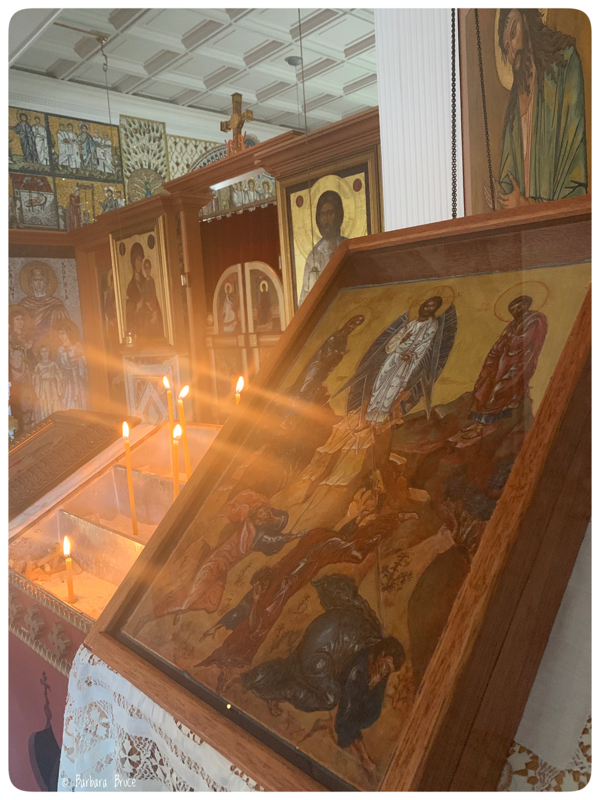
Radiant Candles beside the Transfiguration Feast Day Icon, from August 19/6.
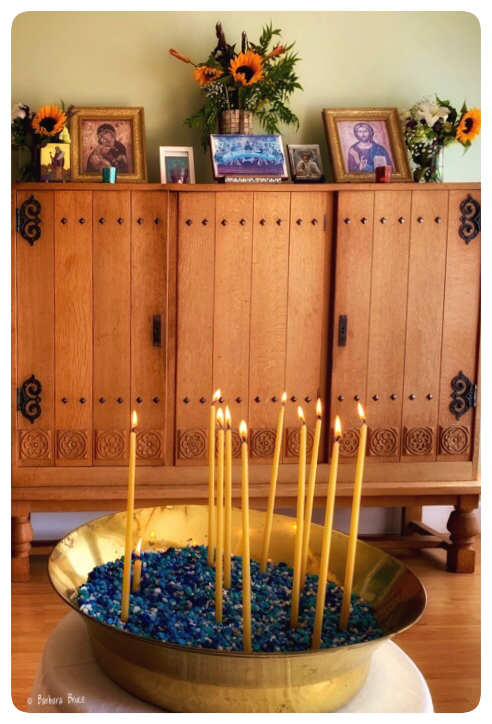
A sweet custom when placing a candle in the sand after Crossing oneself, is to also make the sign of the Cross in the sand with the bottom of your candle, then place the candle in the centre of the Cross you have just traced.
If but ten among us lead a holy life, we shall kindle a fire which shall light up the entire city. ~ St. John Chrysostom
If from one burning lamp someone lights another, then another from that one, and so on in succession, he has light continuously. In the same way, through the Apostles ordaining their successors, and these successors ordaining others, and so on, the grace of the Holy Spirit is handed down through all generations and enlightens all who obey their shepherds and teachers. ~ St. Gregory Palamas
The candles lit before icons of saints reflect their ardent love for God for Whose sake they gave up everything that man prizes in life, including their very lives, as did the holy apostles, martyrs and others. These candles also mean that these saints are lamps burning for us and providing light for us by their own saintly living, their virtues and their ardent intercession for us before God through their constant prayers by day and night. The burning candles also stand for our ardent zeal and the sincere sacrifice we make out of reverence and gratitude to them for their solicitude on our behalf before God. ~ St. John of Kronstadt
When you look at the candles and lamps burning in church, rise in thought from the material fire to the immaterial fire of the Holy Ghost, ‘for our God is a consuming fire.’ When you see and smell the fragrant incense, rise in thought to the spiritual fragrance of the Holy Ghost, ‘for we are unto God a sweet savor of Christ.’ ~ St. John of Kronstadt
The candle you place before the Lord is a metaphor of the fire and light within your soul. Your whole life’s purpose is to intensify its warmth and illumination. ~ Fr. Vladimir Berzonsky
Because our faith is light. Christ said: I am the light of the world (John 8:12). The light of the vigil lamp reminds us of that light by which Christ illumines our souls. Just as the oil and wick burn in the vigil lamp, submissive to our will, so let our souls also burn with the flame of love in all our sufferings, always being submissive to God’s will. In order to teach us that just as the vigil lamp cannot be lit without our hand, so too, our heart, our inward vigil lamp, cannot be lit without the holy fire of God’s grace, even if it were to be filled with all the virtues. All these virtues of ours are, after all, like combustible material, but the fire which ignites them proceeds from God. In order to remind us that before anything else the Creator of the world created light, and after that everything else in order: And God said, let there be light: and there was light (Genesis 1:3). And it must be so also at the beginning of our spiritual life, so that before anything else the light of Christ’s truth would shine within us. From this light of Christ’s truth subsequently every good is created, springs up and grows in us. ~ St. Nikolai Velimirovic
When the soul knows the love of God by the Holy Spirit, then he clearly feels that the Lord is our own Father, the closest, dearest Father, the best. And there is no greater happiness than to love God with all the mind and heart, and our neighbour as ourself. And when this love is in the soul, then all things bring joy to the soul. ~ St. Silouan the Athonite
No matter how much we may study, it is not possible to come to know God unless we live according to His commandments, for God is not known by science, but by the Holy Spirit. Many philosophers and learned men came to the belief that God exists, but they did not know God. It is one thing to believe that God exists and another to know Him. If someone has come to know God by the Holy Spirit, his soul will burn with love for God day and night, and his soul cannot be bound to any earthly thing. ~ St. Silouan the Athonite
Understand two thoughts, and fear them. One says, “You are a saint,” the other, “You won’t be saved.” Both of these thoughts are from the enemy, and there is no truth in them. But think this way: I am a great sinner, but the Lord is merciful. He loves people very much, and He will forgive my sins. ~ St. Silouan the Athonite
A long-distance parishioners’ home’s beautiful Little Church during special prayers
Internal Prayer and the Jesus Prayer – Excerpts from our 2019 Parish Family Camp
In the Name of the Father and of the Son, and of the Holy Spirit. Amen.
Rejoice evermore. Pray without ceasing. In every thing give thanks: for this is the will of God in Christ Jesus concerning you. ~ 1 Thessalonians 5: 16-18
Likewise the Spirit also helpeth our infirmities: for we know not what we should pray for as we ought: but the Spirit itself maketh intercession for us with groaning which cannot be uttered. ~ Romans 8:26
St. Paul said it is necessary to attain a state of permanent prayer, to always pray. – …The Jesus Prayer is a short prayer containing many ideas in it, and by practicing repetition of the Jesus Prayer it is possible to attain a state of permanent prayer. The Lord’s Prayer is very long and contains many ideas. When repeating the Lord’s Prayer the mind focuses on the ideas so that prayer isn’t experienced by the heart. For prayer to be real it must not only be in the mind but also the heart and will (mind, heart, and will, are the three aspects of the soul). Real, permanent prayer does not come easily. It is necessary to make many very long and persistent efforts in order to attain permanent prayer. We must pray to learn to pray. If we attain permanent prayer we will be able to walk, talk, eat, drive, even sleep and still be constantly repeating the prayer. ~ Metropolitan Vitaly
The Jesus Prayer: “Lord Jesus Christ, Son of God, have mercy on me.”– Or “Lord Jesus Christ Son of God, have mercy on me a sinner.” – Or “Lord Jesus Christ, Son of God, have mercy on (Name).”
This simple, ancient prayer is rooted deeply in Church tradition and can be used anytime or anywhere. We recite it to permeate our hearts, to focus our minds, and help us follow God’s Will, instead of our own, usual, self-will. Prayer is the breath of the soul.
Begin by saying the Jesus Prayer sometimes, during the day or night. If the mind wanders, peacefully begin anew, attentively returning the heart again to the prayer. Ask God to calm the mind’s restlessness. Practicing this prayer with humility and patience, draws God’s grace to actively work within us.
Many Orthodox Christians use a prayer rope to help them concentrate as they repeat the Jesus Prayer. Prayer Ropes come in a great variety of forms and sizes. Some are knotted of wool or silk, others are made of wood. When you pray the prayer, hold the prayer rope with your left hand between the thumb and the index finger and move from knot to knot each time you say the prayer. In this way, your right hand is free to Cross yourself as needed while praying. St. Seraphim of Sarov once said the tassels at the end of some prayer ropes are for wiping away our tears. Of course, if we don’t have a prayer rope, we can still pray this prayer.
It’s not the quantity of times the prayer is said, but the quality of our prayer.
The Jesus Prayer is not a mantra to simply quiet the mind. One Jesus Prayer prayed slowly with all our heart and soul, is worth more than a million parroted prayers, repeated without any thought or without focus on what we are actually saying. When praying, we also remember God’s endless Love and Mercy, and thank Him for all our Blessings.
St. Hesychios, an Abbot of Saint Catherine’s Monastery on Mount Sinai who lived in the 7th century said, “Just as it is impossible to fight battles without weapons, or to swim a great sea with clothes on, or to live without breathing, so without humility and the constant prayer to Christ, it is impossible to master the art of inward spiritual warfare or to set about it and pursue it skillfully.”
Abbot Tryphon of the Christ the Saviour Monastery on Vashon Island in Washington says: “There is a common misconception concerning the word “mercy”, used throughout the liturgical services of the Church, as well as our private prayers, and the Jesus Prayer. It is a given that we are all sinners, but the asking for God’s mercy is not limited to asking His forgiveness, or begging God to overlook our sinfulness. When we pray forty Lord have mercies, we are recognizing that EVERYTHING proceeds out of God’s mercy. The air we breathe, the health we enjoy, the food on our table, the water in our tap, the friendships we treasure, our family, and everything good, flows out upon us through God’s mercy. Lord Jesus Christ have mercy.”
Lord Jesus Christ, Son of God, have mercy on me, a sinner – contains our entire Orthodox confession of faith; all dogma is built on it. If you say it attentively, then the Lord will gradually purify your inner world.” ~ Fr. Nikolai Vedernikov
Every prayer must come from the heart, and any other prayer is no prayer at all. Prayer-book prayers, your own prayers, and very short prayers, all must issue forth from the heart to God, seen before you. And still more must this be so with the Jesus Prayer ~ St. Theophan the Recluse
Outdoor Mosaic, St. Sophia Orthodox Church, Canada
But as it is written, Eye hath not seen, nor ear heard, neither have entered into the heart of man, the things which God hath prepared for them that love him. But God hath revealed them unto us by his Spirit: for the Spirit searcheth all things, yea, the deep things of God. For what man knoweth the things of a man, save the spirit of man which is in him? even so the things of God knoweth no man, but the Spirit of God. Now we have received, not the spirit of the world, but the spirit which is of God; that we might know the things that are freely given to us of God. ~ 1 Corinthians 2: 9-12
The soul leaves all surface appearances, not only those that can be grasped by the senses but also those which the mind itself seems to see, and it keeps going deeper until by the operation of the spirit it penetrates the invisible and incomprehensible, and it is there that it sees God. The true vision and the true knowledge of what we seek consists precisely in not seeing, in an awareness that our goal transcends all knowledge… ~ St. Gregory of Nyssa