Within the Limitless

When we are coming to church, what are we looking for? Fish in the desert? No, we are looking for that hidden “inward meditation” of the heart which unites us to Christ… The same thing happens in the church where you are mystically and sacramentally united with Christ. In and through your inner meditation on these things they will become a reality… In order to find Him strive to enter into that hidden, inner meditation and you’ll see that He’ll come of His own accord. You’ll see the heavy stone roll away from your heart and He Himself will rise! ~ Elder Aimilianos (The Way of the Spirit)

…it is also important for us to establish why we go to church. To listen to the sermon? But these days you can get that from a radio presenter (or social media). To pray? But you can pray everywhere and at any time… To put up a candle? But you can put up a candle in front of your icons at home. And so, why do we go to church? …Some people say that if they want to go and pray, they go off to a wood, or to a stream or the seaside, and there in a “Church Erected by God” it is easier for them to be aware of the Creator and to send up glory to Him. Why, they say, do we leave the boundless temple [of creation] to place ourselves under the narrow vaults of a church that is man-made? …That which we offer God, we can offer Him in any place. All that is in the world can thus be laid before Him. But there is that small portion of existence in which God is well pleased to reign, not in Himself but in another. That is my soul. This is that chamber within the limitless edifice of the universe, wherein the Builder thereof will not enter without an invitation. And it depends upon us at whose disposal we lay that freedom of ours, which was given us by God. Will we serve God, or will we serve ourselves…? The only way we can augment the limitless power of the Lord is if we offer Him our own free will… …It is not so important why we seek God. It is more important why He seeks us. …Christ grants us something further which the mind cannot comprehend. “Abide in Me, and I in you…. Receive ye this, this is My Blood, which is shed for you….” Christ entrusts His whole Being to the people; both His Divinity and His manhood. …And so, we come to church, so that we might receive something therein. The church – it’s just walls; but walls built around the Mysterion [Sacrament] of Communion The Mysterion consists in this: that to the people a Hand is extended with the Gifts. Therefore to visit church is not an onerous obligation, but a wondrous privilege. To us there is granted the right to stand as participants in the Mystical Supper. To us there is given the possibility of becoming “partakers of the divine nature.” To us there is granted to possibility of contacting an Energy, such that not one of of the power stations of the world could produce. God sought us. And has found us. We simply need to go to that place, where closer than anywhere else God approaches the people, to that place where in an unprecedented way, through the Gifts themselves, He is distributed to the people. If Christ presents us with the Cup with Communion through the Royal Gates, does it behoove us to turn up our noses and affirm that “I have God in my heart”? ~ Deacon Andrei Kuraev “In Answer to the Question, Why Go to Church If I Have God in My Heart?”(Orthodox Christian Information Center)

Come to me, all who labour and are heavy laden, and I will give you rest. Take my yoke upon you, and learn from me, for I am gentle and lowly in heart, and you will find rest for your souls. For my yoke is easy, and my burden is light. ~ St. Matthew 11: 28-30

The Light of Truth

Photo by Olga Kononenko on Unsplash

Then spake Jesus again unto them, saying, I am the light of the world: he that followeth me shall not walk in darkness, but shall have the light of life. ~ St. John 8:12

In order to remind us that before anything else the Creator of the world created light, and after that everything else in order: “And God said, Let there be light: and there was light” (Genesis 1:3). And it must be so also at the beginning of our  spiritual life, so that before anything else the light of Christ’s truth would shine within us. From this light of Christ’s truth subsequently every good is created, springs up and grows in us. ~ St. Nikolai of Ohrid

Through the Divine Spark of the Holy Spirit, it’s Our Time to Shine.

Let us be as noetic Candles, Aflame with Zeal, and exude the Sweet Aroma of Divine Grace… Christ’s Light of the Virtues.

May your day brim with Light!

Receiving Him Into Our Own Arms

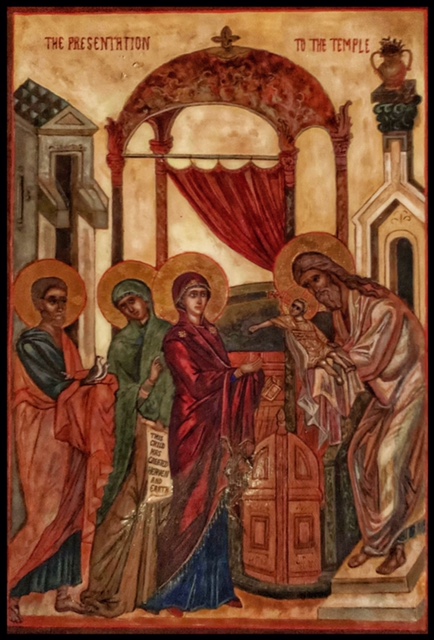
Parish Festal Icon of The Meeting of the Lord in the Temple ~ St. Luke 2:22-40

Greetings on the Feast! (February 15/2)

Today’s bright and beautiful feast day falls 40 days after the Nativity of our Lord Jesus Christ. It is among the most ancient feasts, and since 450 AD, church candles are also blessed on this day as we remember Christ is our salvation, and the Light of the World.

Our lighted candles are a sign of the divine splendour of the One who comes to expel the dark shadows of evil and to make the whole universe radiant with the brilliance of His eternal light. Our candles also show how bright our souls should be when we go to meet Christ... We too should carry a light for all to see and reflect the radiance of the true light as we hasten to meet Him. The Light has come and has shone upon a world enveloped in shadows; the Dayspring from on high has visited us and given light to those who lived in darkness. This, then, is our feast, and we join in procession with lighted candles to reveal the light that has shone upon us and the glory that is yet to come to us through Him. So let us hasten all together to meet our God. The true Light has come, the light that enlightens every man who is born into this world. Let all of us, my brethren, be enlightened and made radiant by this light. Let all of us share in its splendour, and be so filled with it that no one remains in the darkness. Let us be shining ourselves as we go together to meet and to receive with the aged Simeon the Light whose brilliance is eternal... ~ St. Sophronius of Jerusalem (638 AD)

Detail from Meeting of the Lord in the Temple, parish Icon – St. Joseph the Betrothed holds two turtledoves (pigeons), and the Virgin Mary passes the Christ Child to St. Simeon, and aged St. Anna the Prophetess holds a scroll pertaining to the Babe’s Divinity, “This Child has created heaven and Earth.”

On today’s Feast of the Meeting of the Lord, when the heavens meet the earth, God meets man, history meets eternity, when – as our people beautifully say – spring and winter meet, may we also open our hearts for an encounter with the Lord… Open your hearts, listen to the depths of your thoughts, desires, feelings, anticipations, nostalgias, yearnings, the pursuits of your hearts. For our hearts are created in the image of God and they yearn for God; the truth is often buried in passions, desires, appetites, ambitions, prejudices. Let us free ourselves of them and meet the Lord, for He always comes to meet us. He is the One who came, who is with us, Who always comes to be with us. ~ Bishop Atanasije (Homily on the Meeting of our Lord)

In some places, white snowdrop flowers traditionally decorate churches on this special day. Old English Names for Snowdrops are Christ’s Flowers, Purification Flowers, Candlemas Bells, and Fair Maids of February.

Congratulations on the Feast! Today, spring and winter meet, and like blessed spiritual candles, may our hearts and souls shine and wax brightly… as we open our noetic arms to embrace Christ’s Divine Warmth, and Illumination!

Aflame With Zeal

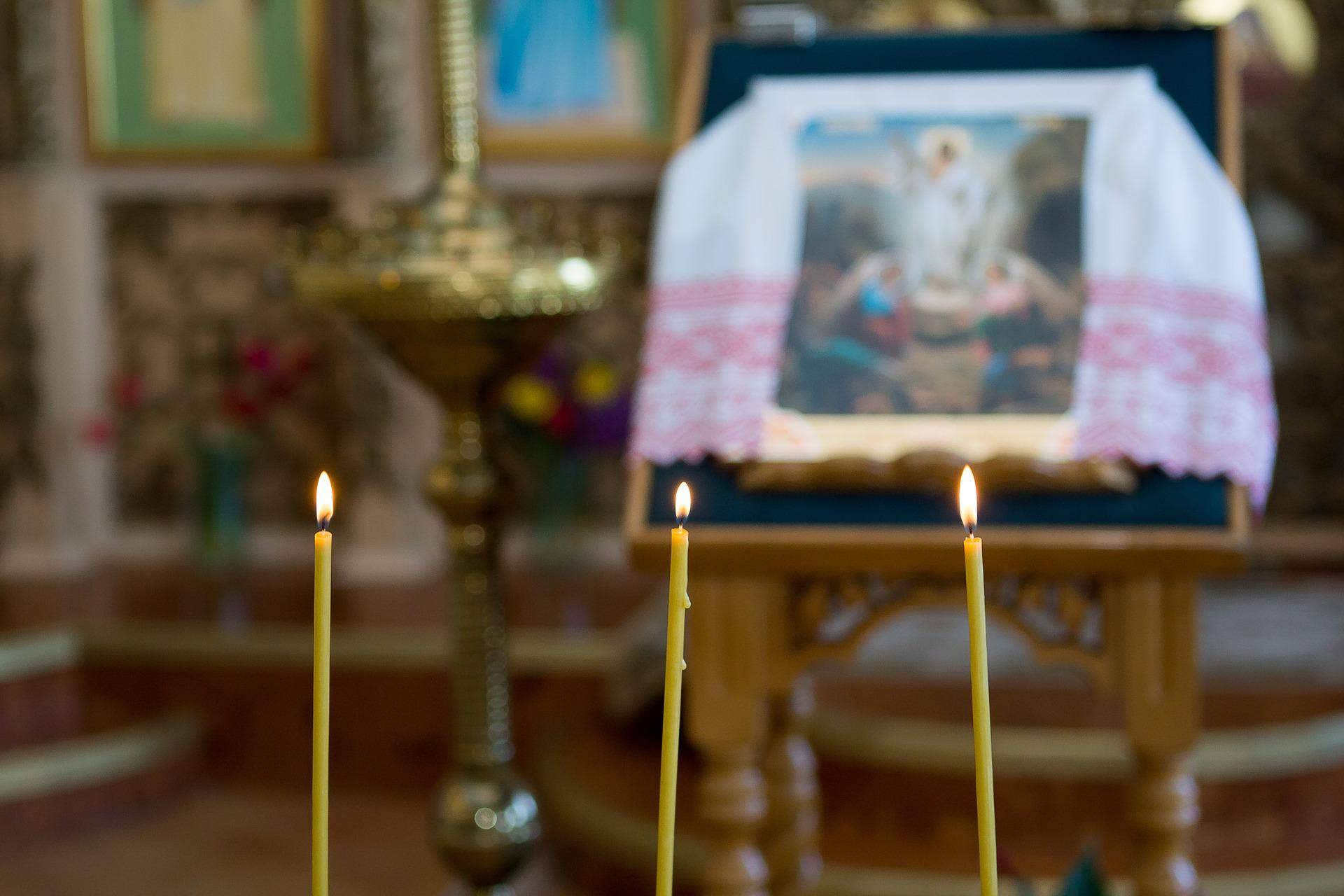
Image by Photo Mix from Pixabay

When you look at the candles and lamps burning in church, rise in thought from the material fire to the immaterial fire of the Holy Spirit, ‘for our God is a consuming fire.’ When you see and smell the fragrant incense, rise in thought to the spiritual fragrance of the Holy Spirit, ‘for we are unto God a sweet savour of Christ.’ ~ St. John of Kronstadt

In order to teach us that just as the vigil lamp cannot be lit without our hand, so too, our heart, our inward vigil lamp, cannot be lit without the holy fire of God’s grace, even if it were to be filled with all the virtues. All these virtues of ours are, after all, like combustable material, but the fire which ignites them proceeds from God. ~ St. Nikolai Velimirovich

In order to remind us that before anything else the Creator of the world created light, and after that everything else in order; And God said, let there be light: and there was light. And it must be so also at the beginning of our spiritual life, so that before anything else the light of Christ’s truth would shine within us. From this light of Christ’s truth subsequently every good is created, springs up and grows within us. ~ St. Nikolai Velimirovich

May the Light of Christ Illumine us all! Keep looking up… there’s always bright Sonshine above those heavy snow clouds!

Light of the Virtues

As the candle gives its own light to illuminate a person in the darkness, so also must the light of the virtues, the light of love and peace, characterize a Christian. The wax that melts, symbolizes the flame of our love for our fellow men. ~ St. Symeon of Thessaloniki

Our souls are as noetic candles of fire and light. May we, with God’s help, exude His Divine Warmth and Illumination upon others in our daily lives.

Sweet Aroma of Divine Grace

Image by Iryna from Pixabay

As the pure candle is derived from the pollen of a flower and has a sweet scent, so also should our souls have the sweet aroma of Divine Grace. ~ St. Symeon of Thessaloniki

When the door of our heart opens and we stand in prayer before Christ the Lord, our souls are as noetic candles of fire and light. With God’s help, may we be worthy to exude His Divine Warmth and Illumination, upon all of whom we interact with daily.

Our Time to Shine

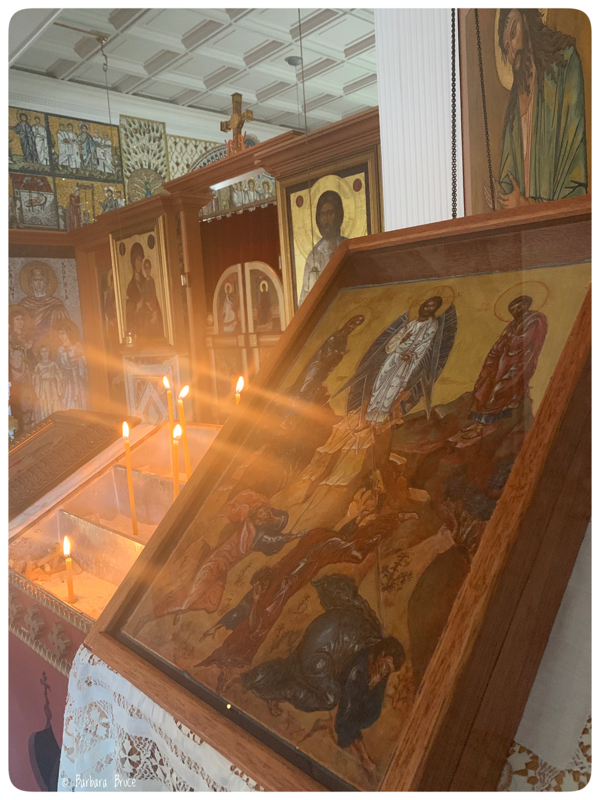
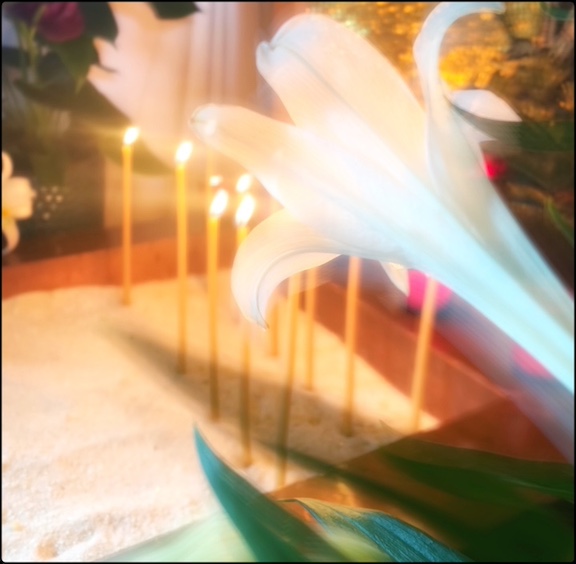
Radiant Candles beside the Transfiguration Feast Day Icon, from August 19/6.

A sweet custom when placing a candle in the sand after Crossing oneself, is to also make the sign of the Cross in the sand with the bottom of your candle, then place the candle in the centre of the Cross you have just traced.

If but ten among us lead a holy life, we shall kindle a fire which shall light up the entire city. ~ St. John Chrysostom

If from one burning lamp someone lights another, then another from that one, and so on in succession, he has light continuously. In the same way, through the Apostles ordaining their successors, and these successors ordaining others, and so on, the grace of the Holy Spirit is handed down through all generations and enlightens all who obey their shepherds and teachers. ~ St. Gregory Palamas

The candles lit before icons of saints reflect their ardent love for God for Whose sake they gave up everything that man prizes in life, including their very lives, as did the holy apostles, martyrs and others. These candles also mean that these saints are lamps burning for us and providing light for us by their own saintly living, their virtues and their ardent intercession for us before God through their constant prayers by day and night. The burning candles also stand for our ardent zeal and the sincere sacrifice we make out of reverence and gratitude to them for their solicitude on our behalf before God. ~ St. John of Kronstadt

When you look at the candles and lamps burning in church, rise in thought from the material fire to the immaterial fire of the Holy Ghost, ‘for our God is a consuming fire.’ When you see and smell the fragrant incense, rise in thought to the spiritual fragrance of the Holy Ghost, ‘for we are unto God a sweet savor of Christ.’ ~ St. John of Kronstadt

The candle you place before the Lord is a metaphor of the fire and light within your soul. Your whole life’s purpose is to intensify its warmth and illumination. ~ Fr. Vladimir Berzonsky

Because our faith is light.  Christ said: I am the light of the world (John 8:12).  The light of the vigil lamp reminds us of that light by which Christ illumines our souls. Just as the oil and wick burn in the vigil lamp, submissive to our will, so let our souls also burn with the flame of love in all our sufferings, always being submissive to God’s will. In order to teach us that just as the vigil lamp cannot be lit without our hand, so too, our heart, our inward vigil lamp, cannot be lit without the holy fire of God’s grace, even if it were to be filled with all the virtues. All these virtues of ours are, after all, like combustible material, but the fire which ignites them proceeds from God. In order to remind us that before anything else the Creator of the world created light, and after that everything else in order: And God said, let there be light: and there was light (Genesis 1:3).  And it must be so also at the beginning of our spiritual life, so that before anything else the light of Christ’s truth would shine within us.  From this light of Christ’s truth subsequently every good is created, springs up and grows in us. ~ St. Nikolai Velimirovic

To the Mother of God

This Icon is a variant of the Hodegetria (Directress) style icon. Here we see the Most Holy Theotokos and her Son, Our Lord God and Saviour Jesus Christ Who stands beside her… His Hand poised, ready to bless us.

Four Beautiful Prayers to the Mother of God

O Theotokos and Virgin, rejoice, O Mary, Full of Grace, the Lord is with thee. Blessed art thou among women, and blessed is the fruit of thy womb, for thou hast born the Saviour of our souls. Amen.

It is truly meet to bless thee, O Theotokos. Ever-Blessed, and Most Pure and the Mother of our God. More honourable than the cherubim, and more glorious beyond compare than the Seraphim, without corruption thou gavest birth to God the Word. True Theotokos, we magnify Thee. Amen.

Beneath thy tender mercy we take refuge, O Theotokos. Reject not our prayer in our distress but deliver us from harm, O Only Pure and Blessed Lady. Amen

Most Glorious Ever-Virgin Mary, Mother of Christ our God, receive our prayer and present it to thy Son and our God, that, for thy sake, He may save our souls. Amen.

How Can I Hold Thee?

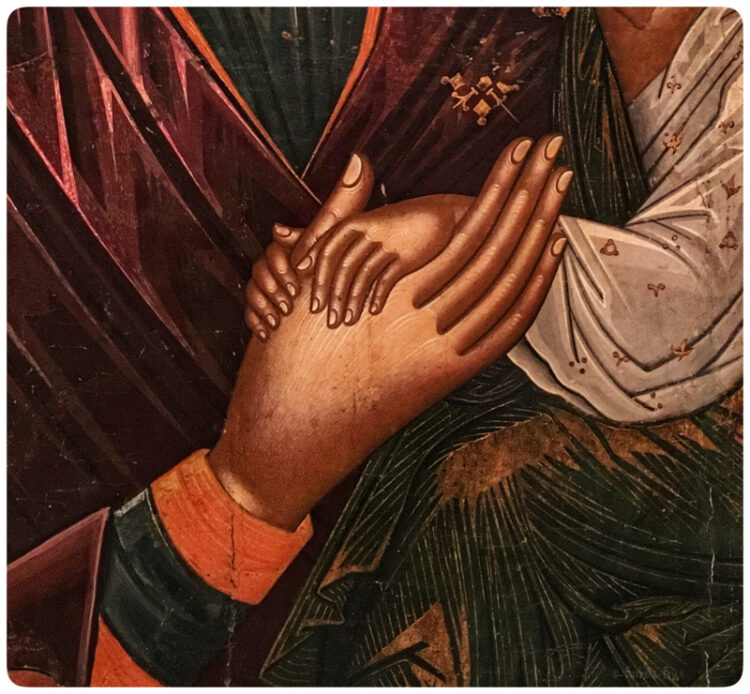
Detail from Icon in the Benaki Museum – Greece 2017

St. Luke 2: 22-40 describes the Feast of the Presentation of the Infant Jesus Into the Temple. (February 15/2)

When Jesus was forty days old, the Virgin Mary and St. Joseph the Betrothed brought Christ to the temple, in order to fulfill the law and dedicate Him to God. 

The Orthodox Christian tradition of Churching a mother on her return to church with her child for a blessing, 40 days after the birth of the baby, comes from the Jewish rite observed in this feast. 

One of the many beautiful hymns written by 9th Century female saint, St. Kassiani:

How can I hold Thee as a Child,
Thou, who holdest everything together?
How do I bring Thee to the temple,
Thou, who art beyond goodness?
How do I deliver Thee into the arms of the elder,
Thou, who sitteth in the bosom of the Father?
How dost Thou endure purification,
Thou, who purifieth the whole corrupt nature?”
So sayeth the Virgin, the temple, who containeth God –
Marvelling at Thy great condescension, O Christ.

Since 450 AD, church candles are also blessed on this day, because of elder St. Simeon’s reference to Christ as a Light of revelation to the Gentiles. (Candlemas)

St. Brigid of Ireland

St. Brigid’s Cross woven with Rushes and photo by Irena

On February 14th/1st we celebrate St. Brigid of Ireland and St. Valentine.

Born in 451, St. Brigid (pronounced Bree-jyah in Gaelic) was the daughter of Dubtach, a pagan king. Brocca, her mother, was a Christian Pictish slave, baptized by St. Patrick himself.

Even as a child, Brigid noticed poverty and destitution. She responded by giving away her own and her family’s considerable possessions to people in need. This generosity did not meet with her father’s approval, who complained to a friend that his daughter was bankrupting the household. His friend answered, “Let her be… She has more virtue before God, than either you or I.”

Brigid followed her desire to be a nun and was tonsured by St. Mael, Bishop of Armagh, who was a nephew of St. Patrick.

She established a monastic community with several other young women, located under a large oak tree. It became known as the Church of the Oak (in Gaelic Cill-Dara)… sometimes she is called Brigid of Kildare.

The community grew in numbers, reputation and achievement. Brigid was the abbess, and continued her care for the poor, selling whatever she had to give them what they needed. People who lived in the area flocked to the monastery to receive medical help, food, and to pray with the nuns. They would often see the abbess out in the fields, tending to the community’s cattle. Brigid and the sisters cared for the local children and established schools for them. Others heard of these efforts, and before long, the abbess travelled Ireland to start schools, to oversee the building of hospitals, and encourage people in their faith… by her own steadfast, cheerful example. 

Under Brigid’s direction, the monastery itself became an art school, where metal work and manuscript illumination (decoration of manuscript pages with coloured figures and designs) were taught. The products of this school included a Gospel book, famously beautiful for its harmony of colors and intricate designs. To some it almost seemed that this Book of Kildare must have been the work of angels… with humans merely copying the figures shown to them by the angels. Unfortunately, this book and many other Christian relics throughout the land were lost during King Henry VIII’s destruction and pillaging of holy sites.

When St. Brigid died in 525 AD, the nuns kept a fire burning in an enclosure at her Kildare convent. This fire burned for centuries, tended by the Sisters and did not burn out until 1220 AD. It was re-lit and burned for another 400 years.

St. Brigid’s association with fire and the closeness of her feast day to the Feast of the Meeting of our Lord in the Temple (also known as Candlemas), a day celebrating Christ as the Light Unto the Nations, links the two Feasts. 

St. Brigid is also affectionately known as Bride, Bridey, or the Mary of the Gael. She is patroness of dairy maids, infants, midwives, blacksmiths, poets, nuns, and students.

Along with Saints Patrick and Columba (Columcille), she is also the patroness of Ireland. St. Brigid is usually depicted in icons as a nun with a Cross woven from rushes and with fire (a candle, lamp, or bowl of fire).

Here is a link to my simple folk song praising St. Brigid of Ireland.

It is said the origin of the St. Brigid’s cross came when she was called to the bedside of a dying pagan chieftain. While sitting with the dying man, St. Brigid picked up some rushes from the floor and began to weave them into a cross. The sick man asked her what she was doing, and St. Brigid told him of Jesus Christ. Before he died, the chieftain become a Christian.

How to make a St. Brigid Cross, woven from rushes.

As Christians, we are called to help provide for the poor and needy (not just during spells of cold weather).

May we acquire the gift to see Christ in every person, as St. Brigid did.

error: Content is protected !!