Courageous and Steadfast

Photo is from the week after Pascha called Bright Week, when the Royal Doors remain fully open. The unblocked view of the altar symbolizes the open door of Christ’s empty tomb as well as the rent veil of the Jewish Temple, which was divinely torn apart at the moment Christ died. The Artos (recalling Christ, the Bread of Life) is blessed, and stands covered, in a place of honour during Bright Week and is later cut up and distributed to the faithful on Thomas Sunday, the Sunday after Pascha.

Today is the Sunday of the Holy Myrrh-Bearers!
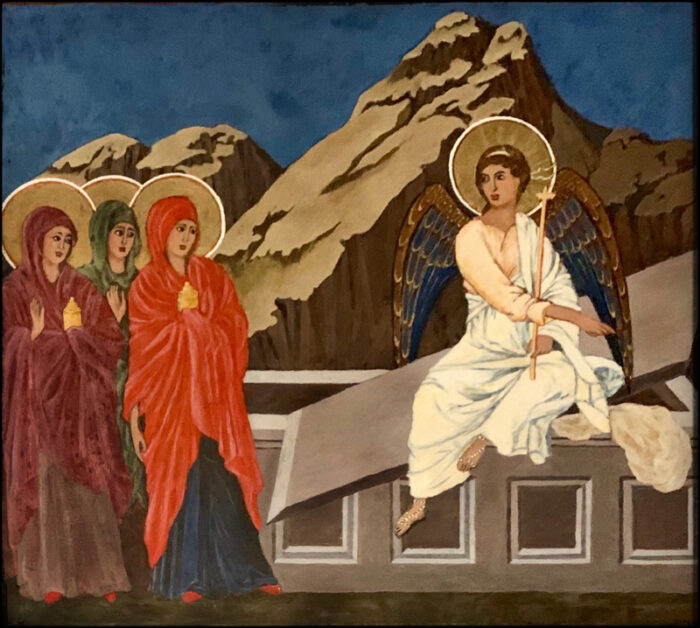
The third Sunday of Holy Pascha is designated as the Sunday of the Holy Myrrhbearers. These courageous and steadfast women disciples of the Lord followed Jesus Christ throughout His ministry… providing and caring for Him and His followers (St. Mark 15:41). They remained faithful to Him during the dangerous times of His arrest, crucifixion, and burial. On account of the preparation for the Sabbath, the initial burial preparations were incomplete and brief. As soon as the Sabbath passed, the women speedily returned, bringing precious myrrh and ointment to anoint His body. It was still dark and very early in the morning, when they arrived at the tomb. Christ’s Resurrection was revealed by an angel, and they were given the honour to announce the glad tidings to the apostles. Because of this, the Myrrhbearing Women, especially St. Mary Magdalene, are sometimes referred to as Equal to the Apostles.

The Holy Myrrhbearers represent all that’s good in our Christian faith. 

They are the spiritual-embodiment of Faith, Hope and Love!

Let God Arise Paschal Stichera (About the Holy-Myrrhbearers) – Circa-the Pandemic. A Parish’s beautiful Virtual Orthodox Choir sings ancient Znamenny Chant, arr. H. Benigsen

Memory Eternal Joanna!
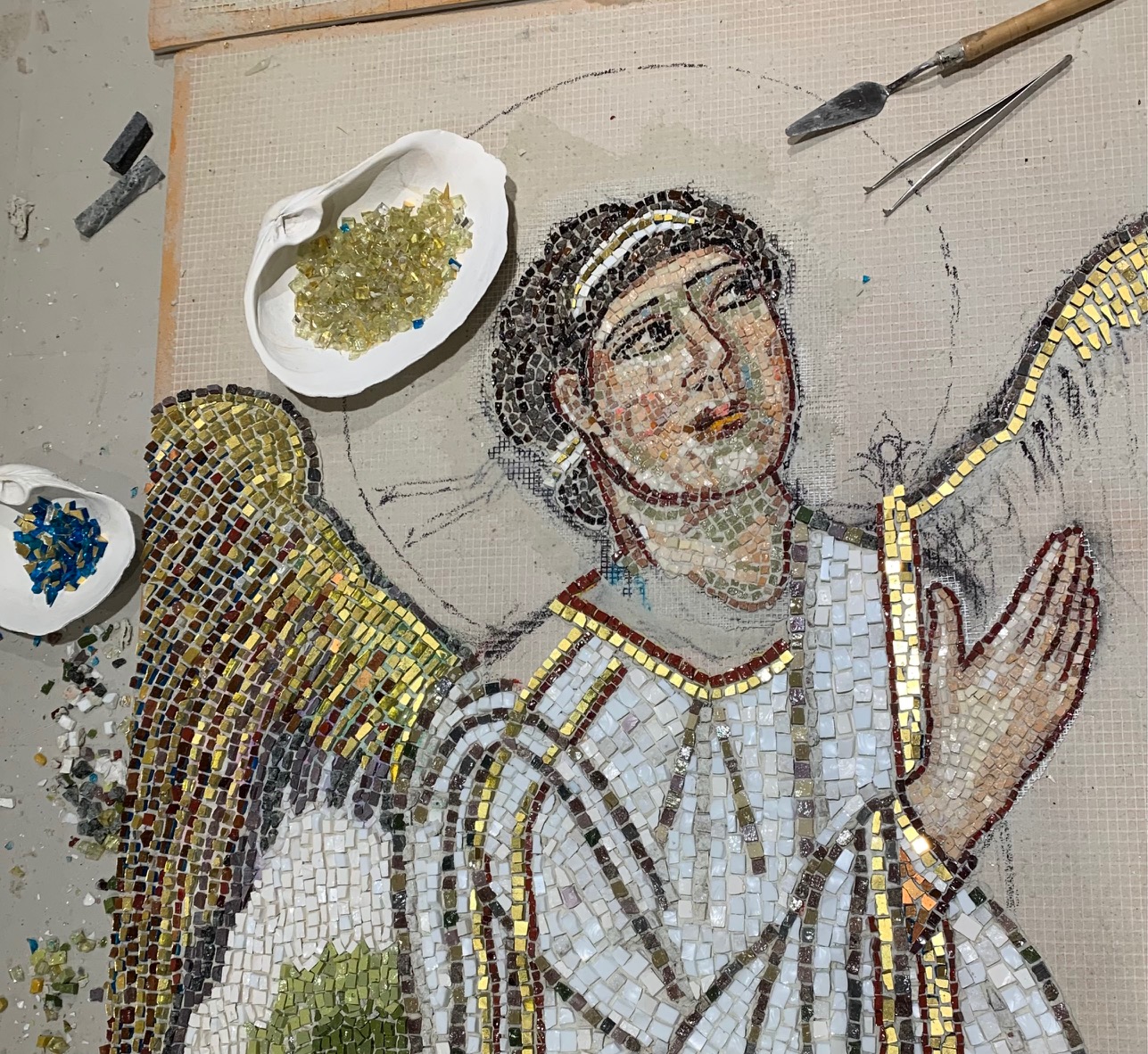
Angelic Efforts

Progress on Altar Angel by Parish Mosaicists based on detail from background angels of a 6th century icon at the ancient St. Catherine’s Monastery of Mt. Sinai.

When we once begin to form good resolutions, God gives us every opportunity of carrying them out. ~ St. John Chrysostom

You can set up an altar to God in your minds by means of prayer. And so it is fitting to pray at your trade, on a journey, standing at a counter or sitting at your handicraft. ~ St. John Chrysostom

Do not be surprised that you fall every day; do not give up, but stand your ground courageously. And assuredly, the angel who guards you will honour your patience. ~ St. John Chrysostom

We all do nearly nothing – some a little more, some a little less. When Christ sees our little effort, He gives us an analogous [matching] token; and so our “nearly nothing” becomes valuable, and we can see a little progress. For this reason we must not despair, but hope in God. ~ Elder Paisios of Mount Athos

Two Thoughts

A view over/above the Royal Doors to the altar’s rear wall, at St. Nicholas Orphanos Church, Thessaloniki – 2017 visit. The ancient interior frescoes are dated from 1310 – 1320 AD.

Greetings on Clean Thursday!

Understand two thoughts, and fear them. One says, “You are a saint,” the other, “You won’t be saved.” Both of these thoughts are from the enemy, and there is no truth in them. But think this way: I am a great sinner, but the Lord is merciful. He loves people very much, and He will forgive my sins. ~ St. Silouan the Athonite

May your Lenten Journey be peaceful and fruitful.

Happy 2nd Day of Christmas

The Nativity Icon

Christ is Born!

Today is the Synaxis of the Theotokos!

The Word became flesh; that is, the Son of God, co-eternal with God the Father and with the Holy Spirit, became human – having become incarnate of the Holy Spirit and the Virgin Mary. O, wondrous, awesome and salvific mystery! The One Who had no beginning took on a beginning according to humanity; the One without flesh assumed flesh. God became man – without ceasing to be God. The Unapproachable One became approachable to all, in the aspect of an humble servant. ~ St. John of Kronstadt (Sermon on the Nativity of Jesus Christ)

Why is it hard to believe that Mary gave birth in a way contrary to the law of natural birth and remained a virgin, when contrary to the law of nature the sea looked at Him and fled, and the waters of the Jordan returned to their source (Ps. 114:3). Is it past belief that a virgin gave birth when we read that a rock issued water (Ex. 17:6), and the waves of the sea were made solid as a wall (Ex. 14:22)? Is it past belief that a Man came from a virgin when a rock bubbled forth a flowing stream (Ex. 17:5-6), iron floated on water (4 Kings 6:6), a Man walked upon the waters (Mt. 14:26)? If the waters bore a Man, could not a virgin give birth to a man? What Man? Him of Whom we read: ‘…the Lord shall be known to the Egyptians, and the Egyptians shall know the Lord in that day; and they shall offer sacrifices, and shall vow vows to the Lord, and pay them’ (Is. 19:20). {In the Old Testament a Hebrew virgin (Miriam) led an army through the sea (Ex. 15:21); in the New Testament a king’s daughter (the Virgin Mary) was chosen to be the heavenly entrance to salvation.} ~ St. Ambrose of Milan (4th century), Synodal Letter 44

He was a baby, He was a child, so that you might grow into a mature, perfected human being; He was wrapped in swaddling clothes, That you might be loosed from the bonds of death; He was laid in a manger, so that you might stand before the altar; He came to dwell on earth, so that you might dwell in the stars. There was no place for Him in the inn, So that you might have many mansions in Heaven. He, being rich, became poor for your sakes, that through His poverty you might become rich. Therefore, His poverty is my inheritance, and the Lord’s weakness is my power. He chose to have nothing Himself, that He might give everything to all. ~St. Ambrose of Milan

Glorify Him!

More Beautiful Than the Stars

Happy Saint’s Day to my goddaughter Cecilia.

Cecilia-strong in faith, rich in faith – Her faith more beautiful than the stars, more precious than gold… ~ St. Nikolai Velimirovich

Greetings on St. Cecilia’s Feast Day! (December 5/November 22)

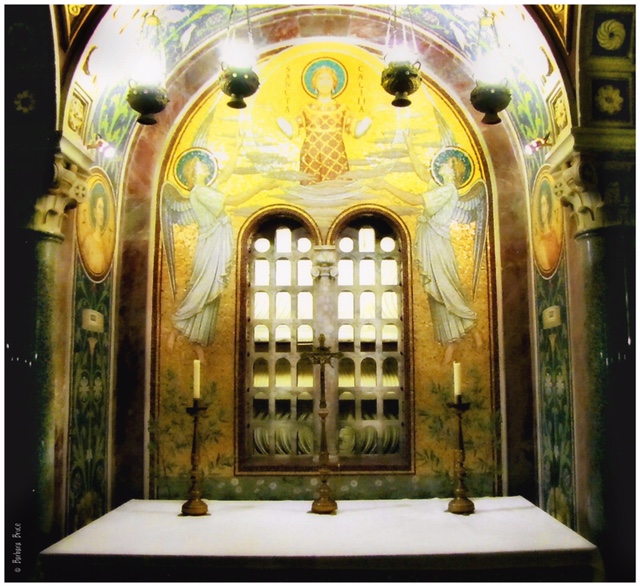
The two featured photos are from a visit to Rome in 2009. Below the main floor is the Church’s Chapel of Relics. The altar with the candlesticks is situated in front of the crypt. Behind the altar’s screened gate is the repository of the second century martyrs, St. Cecilia and her husband St. Valerian.

The Church of St. Cecilia in Trastevere (a Roman neighbourhood), was originally established in the 3rd century, and built on the site of her home after her martyrdom. At the time of her death, St. Cecilia’s body was interred for five centuries in the Catacomb Cemetery of St. Callixtus. However, in the early 800’s, the Pope returned her “home” again, to her own Basilica.

On the upper floor of the main church and in front of the main altar, is the later addition (commissioned in the 16th century), of a glass case enclosing the white marble statue of St. Cecilia. A marble slab on the floor in front of it, quotes the Italian sculptor Stefano Maderno’s sworn statement, recording her miraculously incorrupt body was positioned as seen, and seemingly asleep when the tomb was reopened during the renovations in 1599.

St. Cecilia is considered a patron saint of music in the west. During her undesired earthly wedding; she heard heavenly music, and sang hymns in her heart to Christ. (In the east, St. Romanos the Melodist is a patron saint of music.)

Here is a beautiful, short, 2 minute YouTube video, with detail of St. Cecilia’s Chapel Crypt.

Yet the Lord will command his lovingkindness in the day time, and in the night his song shall be with me, and my prayer unto the God of my life. ~ Psalm 42:8

Kontakion in the 4th Tone

Let us in Godly wise, the hosts of the faithful, / sing hymns to her wedded to Christ of her own will, Cecilia, / whose pure heart with virtues was adorned; / for she wholly put to shame the conceit of Almachius, / and she shone bright as the sun amidst them that pursued her / and then appeared to those upon the earth as a divine staff // that strengthened the holy Faith.

St. Cecilia’s radiant prayers continue to God for us, and are as ever-shining as stars in the heavens.

With One Mind

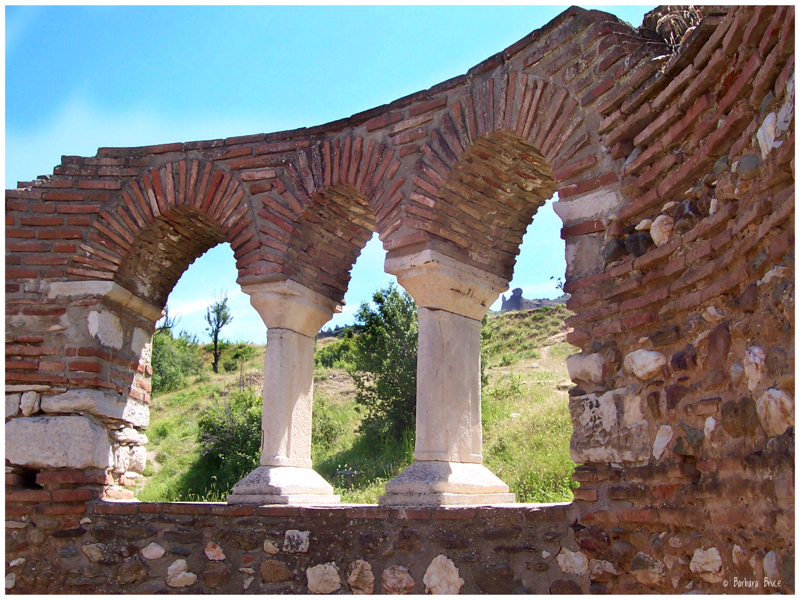
The 3 casements on this ancient church wall in Turkey (2004), inspired construction of the 3 eastern facing windows in our own parish altar.

The Creed belongs only to those who live it. Faith and love, theology and life, are inseparable. In the Byzantine Liturgy, the Creed is introduced with the words, ‘Let us love one another, that with one mind we may confess father, Son, and Holy Spirit, Trinity one in essence and undivided.’ This exactly expresses the Orthodox attitude to Tradition. If we do not love one another, we cannot love God; and if we do not love God, we cannot make a true confession of faith and cannot enter into the inner spirit of Tradition, for there is no other way of knowing God than to love Him. ~ Kallistos Ware (The Orthodox Church)

Multiplier of Wheat

The Multiplier of Wheat Icon of the Mother of God

(Also translated as She Who Ripens the Grain)

We are grateful to have this special icon in our home. My husband is a baker, and we delight in harvesting herbs and vegetables from our kitchen garden.

The Most Holy Theotokos intercedes for harvests, seasonable weather, and lifting of droughts. She is the Benefactress of farmers, gardeners, and others who work the soil for their daily bread.

The Mother of God is a helper for people in their labours for the acquiring of their daily bread… Hail, Full of Grace, the Lord is with You! Grant unto us unworthy ones the dew of Your grace and the showing forth of Your mercy! ~ St. Ambrose of Optina

Salutations to you forever, Virgin Mother of God, our unceasing joy, for to you do I turn again… You are the beginning of our feast; you are its middle and end; the pearl of great price that belongs to the kingdom; … the living altar of the Bread of Life (Jesus)… ~ St. Methodius

The Teacher of children became Himself a Child among children, that He might instruct the unwise. The Bread of heaven came down to earth to feed the hungry. ~ St. Cyril of Jerusalem

Give us this day, our daily bread. ~ St. Matthew 6:11

For we being many are one bread, and one body: for we are all partakers of that one bread. ~ 1 Corinthians 10:17

Our Lord says: I am the living bread which came down from heaven: if any man eat of this bread, he shall live for ever: and the bread that I will give is my flesh, which I will give for the life of the world. ~ John 6:51

Our Lord Jesus Christ said: Verily, verily, I say unto you, Except a corn of wheat fall into the ground and die, it abideth alone: but if it die, it bringeth forth much fruit. ~ St. John 12:24

The Most Holy Mother of God prays for us ceaselessly. She is always visiting us. Whenever we turn to her in our heart, she is there. After the Lord, she is the greatest protection for mankind. ~ Elder Thaddeus of Vitovnica

O Most Holy Theotokos, nourish and pray for us, that we may worthily become God’s wheat!

Happy Ecclesiastical New Year!

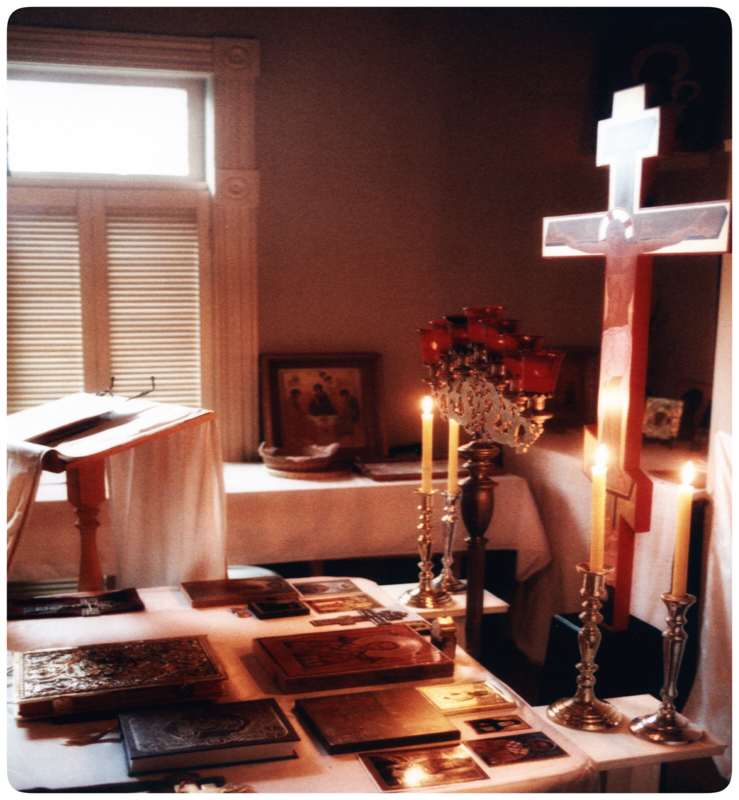
Photo of the Altar, in St. Sophia’s original Mission House Church. Services began there in September of 1991 and continued for 10 years, until the parish could purchase a building and move location of worship. Reminiscent of St. Paul’s dear friends and helpers in Christ, Sts. Priscilla and Aquila who had a church in their house our priest and his matushka’s home was used as a church, and the dining room was set aside as a permanent Altar area, and kept completely separate as such, for a decade.

The entire Liturgical Church Year is a treasury of spiritual wisdom and blessings.

In this busy month of September, there are two Great Feasts, the Nativity of the Theotokos (Sept. 21/8) and the Exaltation of the Holy Cross (Sept. 27/14).

There are also other holy days during this month, such as the Beginning of the Church Liturgical New Year on September 14/1.

The first day of the Church’s Liturgical New Year is called the Beginning of the Indiction. It occurs in September for  both Scriptural and historical reasons.

The Scriptural reason is that God, through Moses, ordained the Old Testament Church to celebrate the New Year at the time of the harvest in the seventh month, that is, September – actually the seventh month according to ancient Hebrew reckoning.

Tradition says the Hebrews entered the Promised Land in September. The Holy Scriptures (Leviticus 23:24-25 and Numbers 29:1-2) confirm the people of Israel celebrating the feast of the Blowing of Trumpets on this day, with the offering of hymns and thanksgiving.

The historical reason is the Roman-Byzantine Emperors and the Eastern Patriarchs of the New Testament Church also decreed the New Year should be in September. According to Holy Tradition, Christ entered the synagogue on September 1/14 to announce His mission to mankind (St. Luke 4:16-22). He was given the book of the Prophet Isaiah to read. He opened it and proclaimed, “The spirit of the Lord is upon me; because He has anointed me to preach the gospel to the poor; He has sent me to proclaim release to captives, and recovering of sight to the blind, to set at liberty those who are oppressed, to proclaim the acceptable year of the Lord…” (Isaiah 61:1-2 )

The Church continues to keep the spiritual significance of the Liturgical New Year, with prayers asking God to grant temperate weather, seasonable rains, and abundance of the fruits of the earth. We are reminded that time is a precious gift.

Let us re-examine our priorities and offer unto the Lord, a New Year… in which we put Him first!

As for Me and My House…

Robin’s Nest in peach tree nestled beside a home ~ Photo by Juliana Tellier

… as for me and my house, we will serve the Lord. ~Joshua 24:15

The summer before entering grade one, I found a beautiful blue robin’s egg on the grass – whole and intact. There were several tall trees nearby, and to my distress, I couldn’t find or return it to its appropriate home. Determined to help, I gently wrapped the egg in Kleenex and brought it home. For days, I carried it bundled in my pockets, and at nights, I slept with it under my pillow. Alas, of course, it never hatched. Burying it in the backyard garden, I realized (with tears) that because the egg had fallen outside its protective nest and grown cold, it couldn’t become what it was meant to be. In my child’s heart, I understood that God already knew all about this poor little baby robin’s egg, and I received an unexpected blessing of comfort… with my own sadness taking flight.

Let us rejoice and be thankful for the opportunity and great blessing of taking our children to church. The House of God is a Loving Nest for us and our little ones. It’s a place of rest, a place of tender care… a place to nestle our souls within the Holy Sacraments. Therefore, let us rise, take wing, and soar to the Holy Communion of our Lord God and Saviour, Jesus Christ.

Even the sparrow has found a home, and the swallow a nest for herself, where she may have her young – a place near your altar, Lord Almighty, my King and my God. ~ Psalm 84:3

Beside them the birds of the heavens dwell; they sing among the branches. ~ Psalm 104:12

…but those who hope in the LORD will renew their strength. They will soar on wings like eagles; they will run and not grow weary, they will walk and not be faint.~ Isaiah 40:31

Behold the fowls of the air: for they do not sow or reap or gather into barns; yet your heavenly Father feeds them. ~ St. Matthew 6:26

Are not two sparrows sold for a penny? Yet not one of them will fall to the ground outside your Father’s care. ~ St. Matthew 10:29

Christ is Born! Glorify Him!

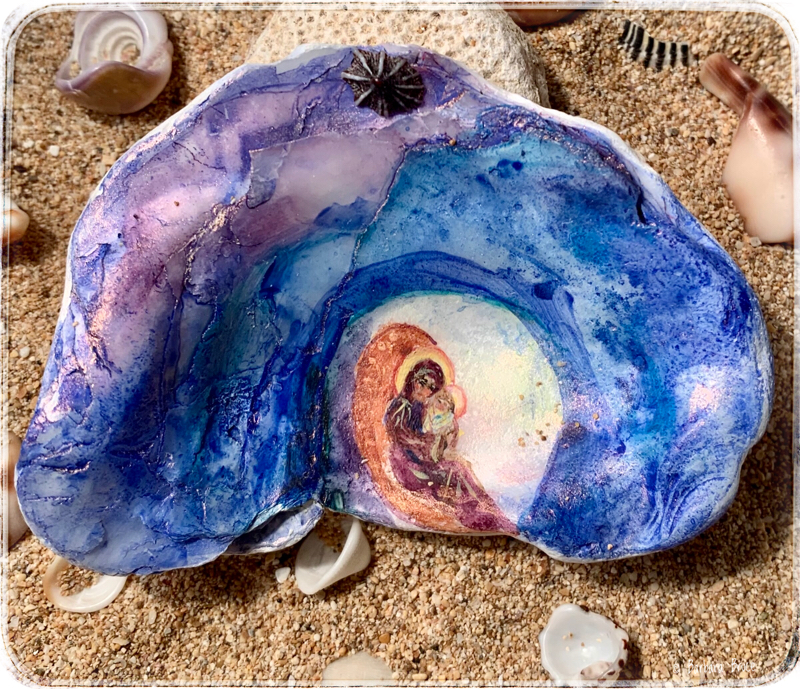
Nativity scene painted on an oyster shell, from a dear friend.

Today the Creator of Time – the Timeless One – the Unoriginate – has a Beginning.

Today – the Word becomes Incarnate.

Christ is Born! Glorify Him!

Greetings on the Joyous Feast of the Holy Nativity of Jesus Christ !

He was a Baby,
He was a Child,
So that you might be a
Perfect person;
He was wrapped
In swaddling clothes,
That you might be
Loosed from the snares of death;
He was in a manger,
That you might be
In the altar;
He was on earth,
That you might be
Among the stars.
He had no place at the inn,
That you might have
Many mansions in the Heavens.
~ St. Ambrose of Milan 339-397 A.D.

This day He who Is, is Born; and He
who Is becomes what He was not.
~ St. John Chrysostom 347-407 A.D.

Christ is born; Glorify Him! Christ comes from heaven; meet ye Him! Christ is on earth; be ye exalted! O all the earth, sing unto the Lord! And sing praises in gladness, O ye people, for He hath been glorified! ~ An ancient hymn composed by St. Gregory the Theologian (329 AD – 390 AD)

Greetings on this first day of Christmastide!

error: Content is protected !!