Our Lady of Perpetual Help

Image by WikiImages from Pixabay

The Theotokos of the Passion Icon – also known as Our Lady of Perpetual Help, is a great spiritual consolation.

Holy Tradition says the original icon was painted by St. Luke the Evangelist… who knew her.

Although the Icon’s Feast Day is celebrated April 30 and on the sixth Sunday after Pascha (Sunday of the Blind Man), one can always reach out any time for Our Lady’s help and compassion – especially during topsy-turvy times of heartache, confusion, and disappointment.

The ancient and beautiful 6th century Akathist Hymn of prayer and praise is attributed to St. Romanos the Melodist to Our Most Holy Theotokos.

The Most Holy Mother of God prays for us ceaselessly. She is always visiting us. Whenever we turn to her in our heart, she is there. After the Lord, she is the greatest protection for mankind. How many churches there are in the world that are dedicated to the Most Holy Mother of God! How many healing springs where people are cured of their ailments have sprung up in places where the Most Holy Theotokos appeared and blessed those springs to heal both the sick and the healthy! She is constantly, by our side, and all too often we forget her. ~ Elder Thaddeus of Vitovnica (From Our Thoughts Determine Our Lives)

Today is also the Synaxis of the Holy Optina Elders, and I congratulate Abbess Amvrosia, and all the nuns of Holy Protection Convent, (including my goddaughter). May your community continue to grow and thrive under the protecting veil of our Most Holy Lady’s Precious Omophorion – and our dear Lord’s salvific love. Happy Feast Day to you all!

Holy Fathers of Optina, pray to God for us!
With One Mind

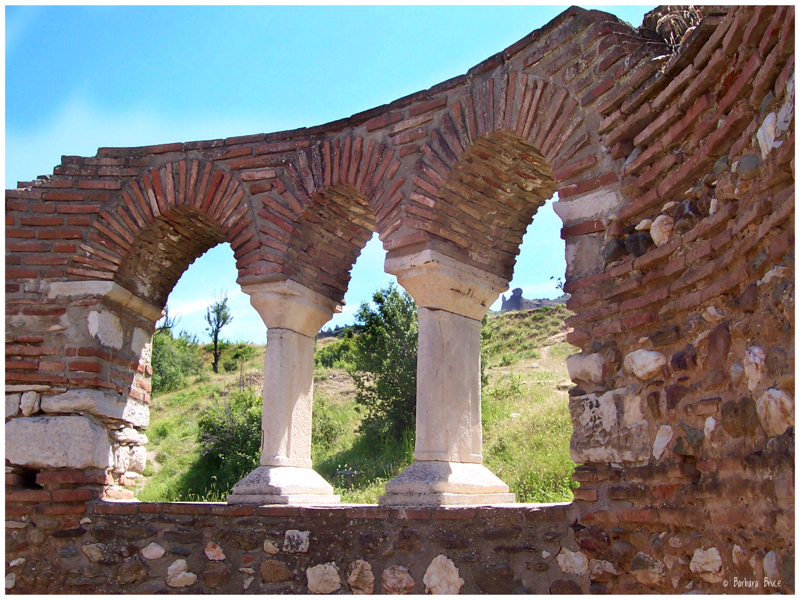
The 3 casements on this ancient church wall in Turkey (2004), inspired construction of the 3 eastern facing windows in our own parish altar.

The Creed belongs only to those who live it. Faith and love, theology and life, are inseparable. In the Byzantine Liturgy, the Creed is introduced with the words, ‘Let us love one another, that with one mind we may confess father, Son, and Holy Spirit, Trinity one in essence and undivided.’ This exactly expresses the Orthodox attitude to Tradition. If we do not love one another, we cannot love God; and if we do not love God, we cannot make a true confession of faith and cannot enter into the inner spirit of Tradition, for there is no other way of knowing God than to love Him. ~ Kallistos Ware (The Orthodox Church)

So Thankful

When I was seven, I received my first King James Bible at Christmas. It had beautiful illustrations, including Christ blessing the children on its front cover. I felt very grown up and would often read for pleasure from this Bible. It was such a joy and wonder seeing our Lord Jesus Christ’s words set in red ink.

And Jesus called a little child unto him, and set him in the midst of them, And said, Verily I say unto you, Except ye be converted, and become as little children, ye shall not enter into the kingdom of heaven. Whosoever therefore shall humble himself as this little child, the same is greatest in the kingdom of heaven. And whoso shall receive one such little child in my name receiveth me. But whoso shall offend one of these little ones which believe in me, it were better for him that a millstone were hanged about his neck, and that he were drowned in the depth of the sea. Take heed that ye despise not one of these little ones; for I say unto you, That in heaven their angels do always behold the face of my Father which is in heaven. ~ St. Matthew 18: 2-6; 10

While growing up, I often wondered what ever happened to that little boy mentioned in the Gospel, whom Jesus called unto Him?

Neither my Baptist Sunday School teachers, nor my pastor, could answer this question.

However, in my early 20’s the Orthodox Church called me “home” and I did find out!

Holy Tradition describes St. Ignatius as the little boy. The saint was also called St. Ignatius the God-Bearer (Theophoros), because he was held in the arms of Christ the Incarnate Son of God, and because he in turn bore God in his heart and prayed unceasingly to Him. Many of St. Ignatius’ writings are available, to this very day!

Take heed often to come together to give thanks to God and show forth His praise. For when you assemble frequently in the same place, the powers of Satan are destroyed, and the destruction at which he aims is prevented by the unity of your faith. Nothing is more precious than peace, by which all war, in heaven and earth, is brought to an end. ~ St. Ignatius of Antioch

I’m so thankful for the Love of God the Father, Son and Holy Spirit… the Holy Trinity One in Essence and Undivided.

I’m thankful for the One Holy Catholic, Apostolic, Orthodox Church.

I’m thankful for the Holy Theotokos and Ever-Virgin Mary, as she hears all our supplications… and with a mother’s boldness, takes them to her Son – praying to God for us.

I’m thankful for the protective intercessions of my saint, Great-Martyr Barbara and my Holy Guardian Angel.

I’m thankful for my many blessings, and for my family and friends.

For if God does not for a moment tire of giving us good things, how can we tire of thanking Him for these good things? ~ St. Nikolai Velimirovic

I’m thankful that you visit Blisswood, which in turn lets me write and share.

Happy Thanksgiving Day!

Happy Ecclesiastical New Year!

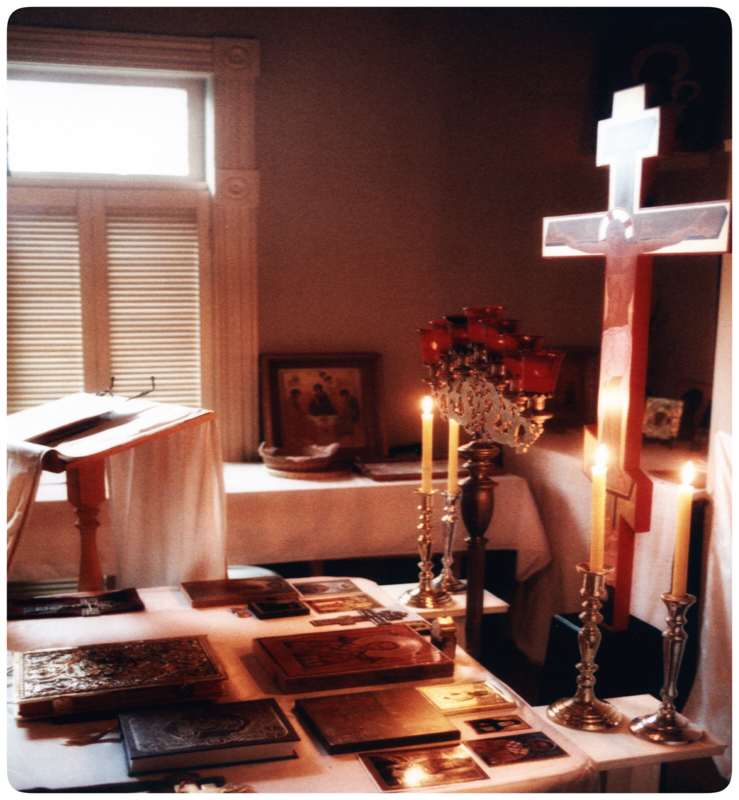
Photo of the Altar, in St. Sophia’s original Mission House Church. Services began there in September of 1991 and continued for 10 years, until the parish could purchase a building and move location of worship. Reminiscent of St. Paul’s dear friends and helpers in Christ, Sts. Priscilla and Aquila who had a church in their house our priest and his matushka’s home was used as a church, and the dining room was set aside as a permanent Altar area, and kept completely separate as such, for a decade.

The entire Liturgical Church Year is a treasury of spiritual wisdom and blessings.

In this busy month of September, there are two Great Feasts, the Nativity of the Theotokos (Sept. 21/8) and the Exaltation of the Holy Cross (Sept. 27/14).

There are also other holy days during this month, such as the Beginning of the Church Liturgical New Year on September 14/1.

The first day of the Church’s Liturgical New Year is called the Beginning of the Indiction. It occurs in September for  both Scriptural and historical reasons.

The Scriptural reason is that God, through Moses, ordained the Old Testament Church to celebrate the New Year at the time of the harvest in the seventh month, that is, September – actually the seventh month according to ancient Hebrew reckoning.

Tradition says the Hebrews entered the Promised Land in September. The Holy Scriptures (Leviticus 23:24-25 and Numbers 29:1-2) confirm the people of Israel celebrating the feast of the Blowing of Trumpets on this day, with the offering of hymns and thanksgiving.

The historical reason is the Roman-Byzantine Emperors and the Eastern Patriarchs of the New Testament Church also decreed the New Year should be in September. According to Holy Tradition, Christ entered the synagogue on September 1/14 to announce His mission to mankind (St. Luke 4:16-22). He was given the book of the Prophet Isaiah to read. He opened it and proclaimed, “The spirit of the Lord is upon me; because He has anointed me to preach the gospel to the poor; He has sent me to proclaim release to captives, and recovering of sight to the blind, to set at liberty those who are oppressed, to proclaim the acceptable year of the Lord…” (Isaiah 61:1-2 )

The Church continues to keep the spiritual significance of the Liturgical New Year, with prayers asking God to grant temperate weather, seasonable rains, and abundance of the fruits of the earth. We are reminded that time is a precious gift.

Let us re-examine our priorities and offer unto the Lord, a New Year… in which we put Him first!

error: Content is protected !!