The Orient From on High

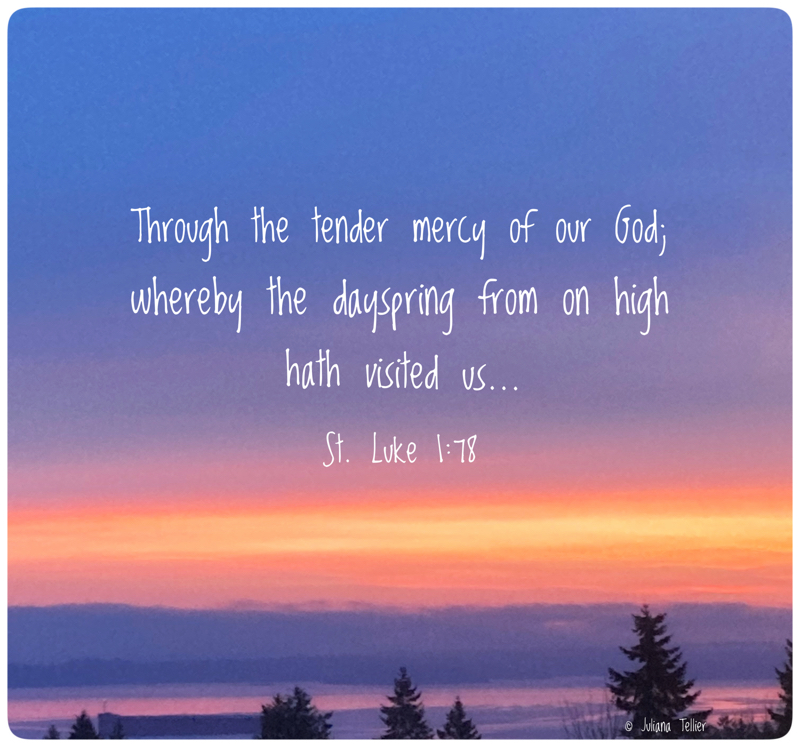
Yesterday’s Dawn by Juliana T.

The Dayspring, the Dawn, the Sun of Righteousness, the Orient from on High, refers to our Lord God and Saviour, Jesus Christ.

God Himself is called the Sun, (Psalm 84:11). As the Source of Light, and Light itself, God gives this same title to His only-begotten Son, who appears on earth as the Dawn of a new day… the Day of the Lord which enlightens those who sit in darkness and in the land of the shadow of death (Isaiah 9:2).

It is not without reason or by chance that we worship towards the East. But seeing that we are composed of a visible and an invisible nature, that is to say, of a nature partly of spirit and partly of sense, we render also a twofold worship to the Creator; just as we sing both with our spirit and our bodily lips, and are baptized with both water and Spirit, and are united with the Lord in a twofold manner, being sharers in the Mysteries and in the grace of the Spirit. Since, therefore, God is spiritual light, and Christ is called in the Scriptures Sun of Righteousness and Dayspring, the East is the direction that must be assigned to His worship. For everything good must be assigned to Him from Whom every good thing arises. Indeed the divine David also says, Sing unto God, ye kingdoms of the earth: O sing praises unto the Lord: to Him that rideth upon the Heavens of heavens towards the East. Moreover the Scripture also says, And God planted a garden eastward in Eden; and there He put the man whom He had formed: and when he had transgressed His command He expelled him and made him to dwell over against the delights of Paradise, which clearly is the West. So, then, we worship God seeking and striving after our old fatherland. Moreover the tent of Moses had its veil and mercy seat towards the East. Also the tribe of Judah as the most precious pitched their camp on the East. Also in the celebrated temple of Solomon, the Gate of the Lord was placed eastward. Moreover Christ, when He hung on the Cross, had His face turned towards the West, and so we worship, striving after Him. And when He was received again into Heaven He was borne towards the East, and thus His apostles worship Him, and thus He will come again in the way in which they beheld Him going towards Heaven; as the Lord Himself said, As the lightning cometh out of the East and shineth even unto the West, so also shall the coming of the Son of Man be. So, then, in expectation of His coming we worship towards the East. But this tradition of the apostles is unwritten. For much that has been handed down to us by tradition is unwritten. ~ St. John of Damascus

Christ, the Sun of righteousness (Malachi 4:2), is without beginning and pre-eternal. He is both immutable and unchangeable, as with Him there is no variableness, nor shadow of turning (James 1:17). He is without end, never-setting, beaming out the true and heavenly light of day without evening, in which the spirits of the righteousness live with the good angels. When this present age reaches its end, the righteous shall also have their bodies with them, as heirs of the light and sons of the true day. That day continues forever without evening, and neither has, nor ever did have, a morning, since it has no beginning. ~ St. Gregory Palamas

Great-Martyr Katherine of Alexandria

Congratulations on your Saint’s Day Katherine, and Catherine! Memory Eternal Ekaterina.

Greetings on Great-Martyr Katherine’s feast day!

St. Katherine was the daughter of Constas, the governor of Alexandria in Egypt. She was a brilliant and avid scholar in philosophy, rhetoric, poetry, music, mathematics, astronomy, and medicine. 

During a visit by the Roman emperor, a huge pagan festival was held in his honour. However, Katherine protested the Christian persecutions and refused to offer sacrifice to the gods, declaring herself a bride of Christ, the One True God. The emperor decided that due to young Katherine’s societal status, intelligence and strong spirit, she should be ridiculed, being made an entertaining, public example, and proven wrong. His plans backfired.

Fifty of the region’s top orators and philosophers were summoned to mockingly debate the superiority of paganism versus Christianity. With her face glowing Divine Grace, and moved through the Power and Wisdom of the Holy Spirit, young Katherine eloquently defended the Christian faith. She victoriously converted hundreds in the audience… including all 50 orators, the emperor’s own wife, the emperor’s imperial advisor, and 200 soldiers. She and the group of new Christians were imprisoned and martyred around the year 305 AD.

St. Katherine’s body was taken by Angels to the highest peak of Mount Sinai, near where God appeared to Moses in the Burning Bush. Her holy relics are enshrined in the world’s oldest and continuously inhabited Christian monastery, which is over seventeen hundred years old.

Our St. Katherine Ring

Pilgrims to St. Katherine’s Monastery on Mt. Sinai are given remembrance rings that have been reverently placed on her holy relics, as a blessing. They are copied from the ring she still has on her hand, from Christ.

St. Katherine is a patron saint of students, scholars, philosophers, teachers, public speakers and librarians.

By the prayers of the most wise martyr Katherine, O Christ, enlighten the darkened eye of my soul, granting me a ray of thy splendour~ Excerpt from Canon to Great-Martyr Katherine

Happy Ecclesiastical New Year!

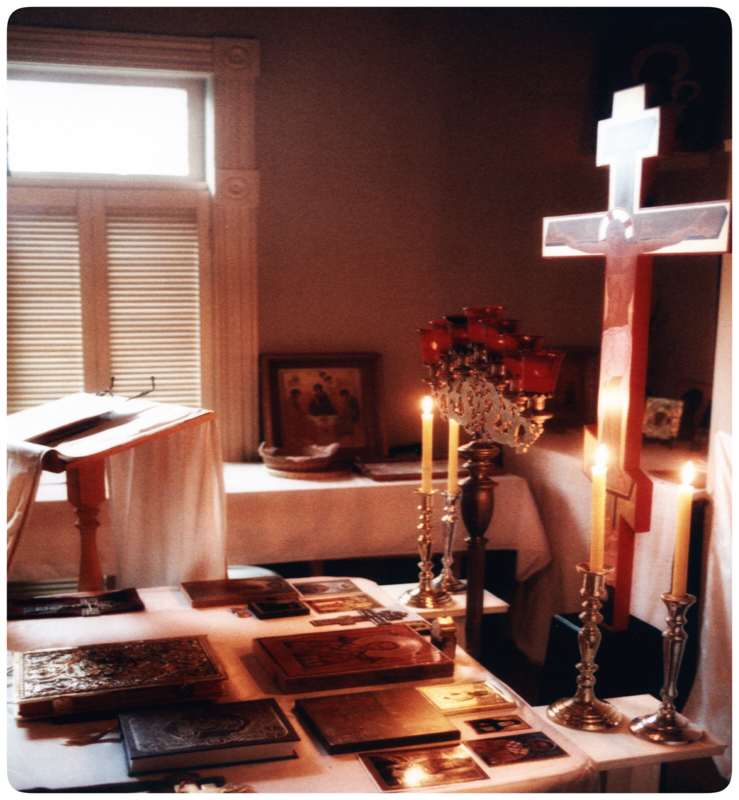
Photo of the Altar, in St. Sophia’s original Mission House Church. Services began there in September of 1991 and continued for 10 years, until the parish could purchase a building and move location of worship. Reminiscent of St. Paul’s dear friends and helpers in Christ, Sts. Priscilla and Aquila who had a church in their house our priest and his matushka’s home was used as a church, and the dining room was set aside as a permanent Altar area, and kept completely separate as such, for a decade.

The entire Liturgical Church Year is a treasury of spiritual wisdom and blessings.

In this busy month of September, there are two Great Feasts, the Nativity of the Theotokos (Sept. 21/8) and the Exaltation of the Holy Cross (Sept. 27/14).

There are also other holy days during this month, such as the Beginning of the Church Liturgical New Year on September 14/1.

The first day of the Church’s Liturgical New Year is called the Beginning of the Indiction. It occurs in September for  both Scriptural and historical reasons.

The Scriptural reason is that God, through Moses, ordained the Old Testament Church to celebrate the New Year at the time of the harvest in the seventh month, that is, September – actually the seventh month according to ancient Hebrew reckoning.

Tradition says the Hebrews entered the Promised Land in September. The Holy Scriptures (Leviticus 23:24-25 and Numbers 29:1-2) confirm the people of Israel celebrating the feast of the Blowing of Trumpets on this day, with the offering of hymns and thanksgiving.

The historical reason is the Roman-Byzantine Emperors and the Eastern Patriarchs of the New Testament Church also decreed the New Year should be in September. According to Holy Tradition, Christ entered the synagogue on September 1/14 to announce His mission to mankind (St. Luke 4:16-22). He was given the book of the Prophet Isaiah to read. He opened it and proclaimed, “The spirit of the Lord is upon me; because He has anointed me to preach the gospel to the poor; He has sent me to proclaim release to captives, and recovering of sight to the blind, to set at liberty those who are oppressed, to proclaim the acceptable year of the Lord…” (Isaiah 61:1-2 )

The Church continues to keep the spiritual significance of the Liturgical New Year, with prayers asking God to grant temperate weather, seasonable rains, and abundance of the fruits of the earth. We are reminded that time is a precious gift.

Let us re-examine our priorities and offer unto the Lord, a New Year… in which we put Him first!

error: Content is protected !!