Now all things have been filled with light, both heaven and earth and those beneath the earth; so let all creation sing Christ’s rising, by which it is established. ~ St. John of Damascus, Paschal Canon
Having beheld the Resurrection of Christ, let us worship the Holy Lord Jesus, the only sinless One. We worship Thy Cross, O Christ, and hymn and glorify Thy holy Resurrection, for Thou art our God, and we know none other beside Thee, we call upon Thy name. O come all ye faithful, let us worship Christ’s holy Resurrection; for behold through the Cross, joy hath come to all the world. Ever blessing the Lord, we hymn His Resurrection. For having endured crucifixion, He hath destroyed death by death. ~ 5th Century Matins Hymn
The wilderness and the dry land shall be glad; the desert shall rejoice and blossom like the crocus; it shall blossom abundantly and rejoice with joy and singing… ~ Isaiah 35:1-2
At winter’s end, the crocus – also known as the penitent flower, appears before thespiritual springofGreat Lent… a season of forgiveness, repentance, efforts, hope, and renewal.
The week preceding Great Lent is called Cheesefare(Maslenitsa), and in 2022, Cheesefare begins Monday, February 28th. Meat is now excluded until Pascha (Easter). Dairy and seafood are (thoroughly) enjoyed this week, and it’s traditional to include blini crepes or pancakes to use up remaining dairy – before the more strict plant-basedfare of Great Lent.
This year Great Lent begins on Monday, March 7th.
May we all cultivate fragrant buds of virtue, and Blossom Forth!
Christ is Risen from the dead, trampling down death by death, and upon those in the tombs bestowing Life! ~Paschal Tropar
What is dying? Just what it is to put off a garment. For the body is about the soul as a garment; and after laying this aside for a short time by means of death, we shall resume it again with more splendour. ~ St. John Chrysostom
Congratulations on entering the Nativity Fast! Although we’re in a different “liturgical season” than the Great Lent which precedes Pascha (Easter)… We are nonetheless, on day #3 into the40 day Nativity Lenten period. Advent helps us properly prepare for the upcoming Great Feast of the Nativity of Christ.
The birth and death of Christ are very connected. Sometimes Nativity (Christmas) is even called the Winter Pascha.
Today is also a friend’s funeral… and the Mystery ofPascha is very much on my mind.
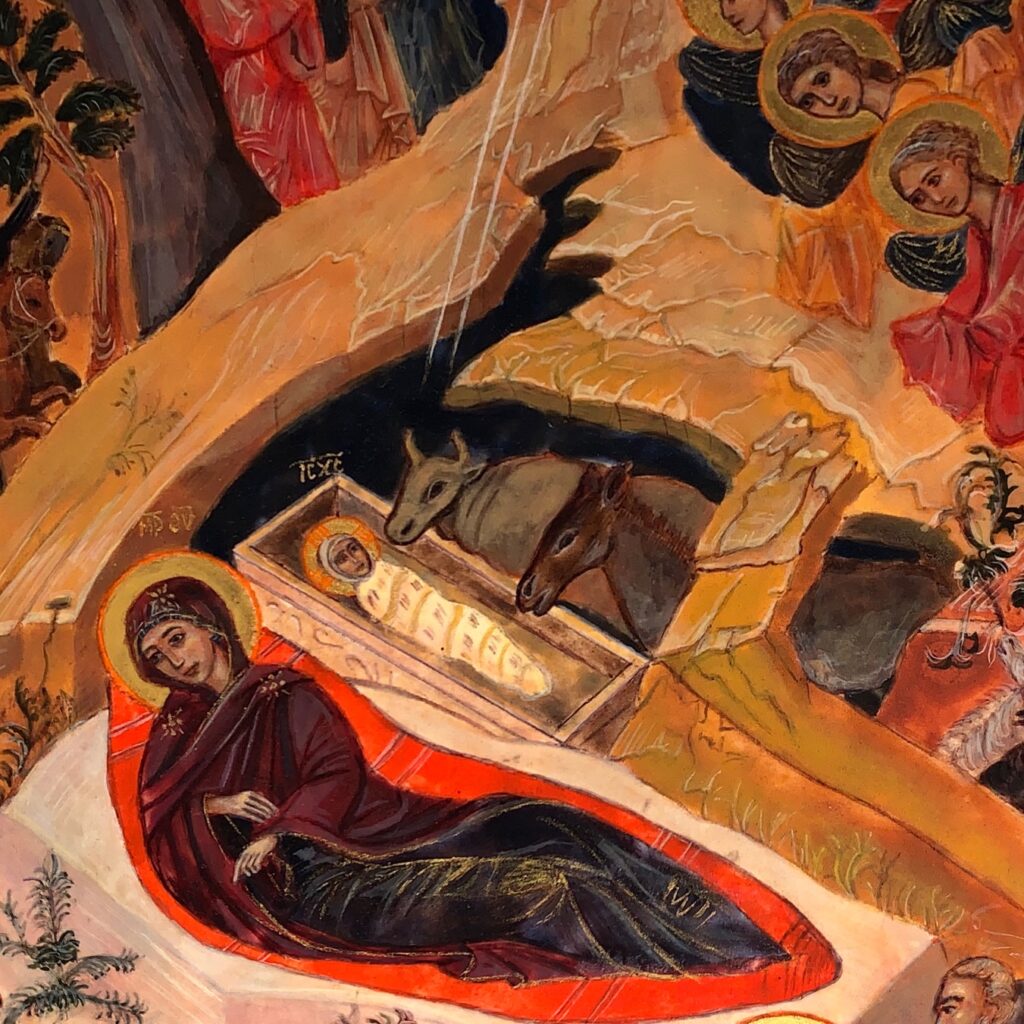
The Nativity Icon deliberately connects events… the manger resembles a stone coffin, the swaddling clothes resemble a burial shroud, and the cave itself prefigures Christ’s tomb. Theox and ass portrayed, are from the prophesy of Isaiah.
Jesus came to us in order to die, and this was known by Him even from the very beginning.He took away death, by conquering death, through His Glorious Resurrection!
Sin entered the world through Adam and Eve, the first created man and woman, and now we all sin. There are big sins and little sins, but everyone sins, and any sin separates us from God.
Because of God’s great love for each one of us, He did something incredibly special. Jesus Christ the Son of God, willingly took all the sins of everyone ever born, that means you, me, the whole world, and put them all upon Himself.When Jesus died and was buried, all our sins died and were buried too. We also remember this at our baptism, and are now forgiven because of what Jesus did for us on the cross!
He is the Son of God – and arose victorious, from the dead!
This is why we no longer fear death.
Death is a new beginning.
Those who have gone on before us, are alive in Christ… For he is not a God of the dead, but of the living: for all live unto him. ~St. Luke 20:38
I’ve been singing and humming the Paschal Tropar a lot today. It helps softens sadness, and bestows hope and joy.
Paschal Tropar – Appalachian melody, English
And God shall wipe away all tears from their eyes; and there shall be no more death, neither sorrow, nor crying, neither shall there be any more pain: for the former things are passed away. ~ Revelation 21:4
With the saints give rest, O Christ our God to the soul of Thy servant, Nicholas. Memory Eternal.
Mosaic from the ancient cathedral Hagia Sophia, (Holy Wisdom) – Constantinople 2006
When we are coming to church what are we looking for? Fish in the desert? No, we are looking for that hidden “inward meditation” of the heart which unites us to Christ… The same thing happens in the church where you are mystically and sacramentally united with Christ. In and through your inner meditation on these things they will become a reality… In order to find Him strive to enter into that hidden, inner meditation and you’ll see that He’ll come of His own accord. You’ll see the heavy stone roll away from your heart and He Himself will rise! ~ Elder Aimilianos; The Way of the Spirit
For the first time, in a very long time, public church services resumed last weekend.
Today is the 25th day after Pascha, and we are midpoint in our journey to the upcoming Great Feast of Pentecost.
The Mid-Pentecost Icon above, illustrates the Gospel account of our Lord, Who at the age of twelve, taught and spoke with the Elders in the Temple of Jerusalem.
At MidFeast, give Thou my thirsty soul to drink of the waters of piety; for Thou, O Saviour, didst cry out to all: Whosoever is thirsty, let him come to Me and drink. Wherefore, O Well-spring of Life, Christ our God, glory to Thee. ~ Troparion of Mid-Pentecost
Our Lord God and Saviour, Jesus Christ, is the Well-spring of our life.
He invites all thirsty souls to come to Him and drink from the waters of immortality; never to thirst again. (St. John 7:37).
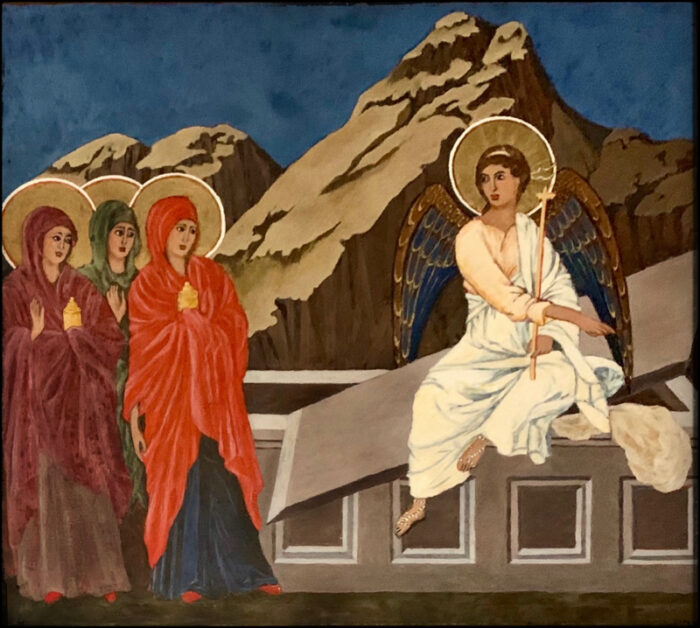
…The myrrh bearing women at the break of dawn, drew near to the tomb of the Giver of Life. There they found an angel seated upon the stone, and he greeted them with these words: “Why do ye seek the Living among the dead? Why mourn ye the Incorrupt amid corruption? Go: proclaim the glad tidings to His disciples.” This is the day which the Lord hath made! Let us rejoice and be glad therein. Pascha of beauty! The Pascha of the Lord! A Pascha worthy of all honour hath dawned for us. Pascha! Pascha, ransom from affliction! For today, as from a bridal chamber, Christ hath shone forth from the tomb, and filled the women with joy, saying “Proclaim the glad tidings to the apostles.” ~ Excerpt from the Aposticha Paschal Stichera; Let God Arise
The third Sunday of Holy Paschais designated as the Sunday of the Holy Myrrhbearers. These courageous and steadfast women disciples of the Lord followed Jesus Christ throughout His ministry… providing and caring for Him and His followers (St. Mark 15:41). They remained faithful to Him during the dangerous times of His arrest, crucifixion, and burial. On account of the preparation for the Sabbath, the initial burial preparations were incomplete and brief. As soon as the Sabbath passed, the women speedily returned, bringing precious myrrh and ointment to anoint His body. It was still dark and very early in the morning, when they arrived at the tomb. Christ’s Resurrection was revealed by anangel, and they were given the honour to announcethe glad tidings to the apostles. Because of this, the Myrrhbearing Women, especially St. Mary Magdalene, are sometimes referred to as Equal to the Apostles.
The Holy Myrrhbearers represent all that is good in our Christian faith. They are the spiritual-embodiment of Faith, Hope and Love.
The Tuesday of St. Thomas week is called Radonitsa, and known as the Day of Rejoicing.
On this day, and with Paschal Joy, we remember all who have reposed in the faith. Orthodox graves are blessed by priests and visited by the faithful.
It is hard for most parishes to gather at the graves on weekdays. So, the graves are blessed instead on St. Thomas Sunday, after the Divine Liturgy. When possible, this is followed by a traditional, joyous, communal picnic at the cemetery.
In any case, is important, to visit the graves of loved ones at any time during the 40 days of Pascha-tide; and to greet them saying or singing Christ is Risen…
For our Orthodox Pascha is not just a festival, but the Festival of all festivals, an event for exceeding all the events of this world. Pascha shakes the whole cosmos: the sun, by our faith, dances and becomes iridescent with every colour of the rainbow, and all of creation rejoices. Some observe a magnificent silence, lacking the strength to express the inexpressible feeling of Paschal joy which fills their souls. Others hasten to share their feeling of the Paschal triumph. All people and all things begin to move, the tedious vanities of this world are cast aside, and all are transfigured. Pascha is, first of all, in us ourselves, in our hearts. God’s gift of the feeling of love penetrates our whole being, and we love each person and all things. This relates not just to the animal kingdom, but to the whole of creation, extending to the smallest blade of grass and the smallest flower. Nothing escapes our loving attention. May the Lord help us all to keep ourselves like this, for as such did the Lord create us… ~Paschal Epistle excerpt of Metropolitan Vitaly – May, 2000; The Two Thousandth Pascha of Christ.
Voices of Faith Hope and Love: St. Sophia Orthodox Church Virtual Youth Choir sing *Son Rise* in 2021. This song is a Paschal Poem, written by an 8 year old youth choir student, many years ago.
This natural dye yields a rich vibrant brick-red colour, and has become a special family tradition to do during Holy Week.
You’ll Need:
– 2 dozen white eggs (save the cartons for later storage) – 1 package of cheesecloth – 24 to 36 (small size) elastic bands (extras may be needed in case of breakage) – 10 to 12 cups of dry yellow onion skins – one bunch of parsley (and if available, pansies or small edible flower heads, and clover leaves, small 2 inch frond-ends of ferns etc.) – 1/2 cup white vinegar
In a very large pot, boil the onion skins in 2 – 4 litres of water, for 30 – 40 minutes. Remove pot from heat. Strain out the skins and discard them. Add the vinegar to the strained dye and stir well.
(While waiting for the skins to boil, take the cheesecloth and cut 24- 6 X 6 inch squares.)
Using the first dozen eggs, place a sprig of something floral, etc. pressing it ‘pretty-side’ flat down upon the egg. Wrap cheesecloth square tightly around egg, keeping the sprig taut against egg.
Pull cheesecloth tighter, leaving a small “pony-tail”. Tie ponytail tightly with elastic band. Set aside on a platter to prevent “rolling-off-the-table-tragedies”! When one dozen eggs are completed thusly, lower them gently into the dye and simmer for 20 minutes over heat, so only a bubble breaks the surface occasionally. This prevents the eggs from becoming tough.
While waiting for the first dozen to boil, work on preparing the next dozen with cheesecloth and flowers. When the first dozen have simmered 20 minutes, remove from dye with slotted spoon and immerse for about 3 minutes in a large bowl of cold water.
Add the second dozen prepared eggs gently into the hot dye, and simmer them for 20 minutes. Remove the first batch of cooled eggs from the water and carefully remove the cheesecloth and sprig of parsley or flower, and admire your creations!
Keep them on a platter so to avoid casualties. Buff them lightly with a “polish” of small amount of olive oil on a paper towel, and place eggs back directly into their cartons for storage and REFRIGERATE!. Repeat procedure with the remaining dozen eggs.
It’s easy to save dry onion skins for the next year each time you cook.