Like Fragrant Incense

Image by Dimitris Vetsikas from Pixabay

An Upstairs Cliros Where Choir Sings Behind Congregation

Music is unique among the liturgical arts in that it’s something we have to do every time we come to church. Iconography, architecture, church furnishings, liturgical books, all these are things an artist can produce once and be done with. But music is never finished. As soon as you sing a note it vanishes forever. As soon as the service is over, whatever beauty you achieved during it has to be produced all over again in the next service. ~Benedict Sheehan

Beautiful church singing comes through prayer, attention to the hymns’ text, and by actively watching the director. Liturgical singing is both a physical and spiritual effort… It’s our living Prayer Before the Ambo.

St. Augustine says, When you sing, you pray twice.

For millennium, while Christian Choristers have basked in the spiritual blessings of psalmody, science has more recently determined the physical health benefits of singing. It’s been documented that choral singing synchronizes the choir’s heart rates – especially during slow chants.

In choral church singing, single voices should never stand out. Individuality ceases when we humbly work on hearing each another. Listening carefully is the only way a choir can blend properly to create true harmony. This could be said in regards to many other things in life.

When one has spare time, it’s wonderful to also sing at home… with or without accompaniment. It literally keeps one out of mischief for awhile (yes!), and uplifts our spirits.

Singing spiritual songs from the heart at any time is a musical metamorphosis. Hymns of consolation, joy and thanksgiving help us grow closer to God… and He blesses all who engage in the beauty of His Church!

We ought to offer up doxologies to God with a humble heart, in order that they may be welcome, like fragrant incense. ~ St. John Chrysostom

Let the word of Christ dwell in you richly, teaching and admonishing one another in all wisdom, singing psalms and hymns and spiritual songs, with thankfulness in your hearts to God. ~ Colossians 3:16 

Sing praises to God, sing praises! Sing praises to our King, sing praises! ~ Psalm 47:6 

Oh sing to the Lord a new song; sing to the Lord, all the earth! ~ Psalm 96:1

Make a joyful noise to the Lord, all the earth; break forth into joyous song and sing praises! ~ Psalm 98:4 

Serve the Lord with gladness! Come into his presence with singing!  ~ Psalm 100:2

I will sing to the Lord as long as I live; I will sing praise to my God while I have being. ~ Psalm 104:33

Sing to him, sing praises to him; tell of all his wondrous works!  ~ Psalm 105:2

Not of This World

Photo Art by Juliana

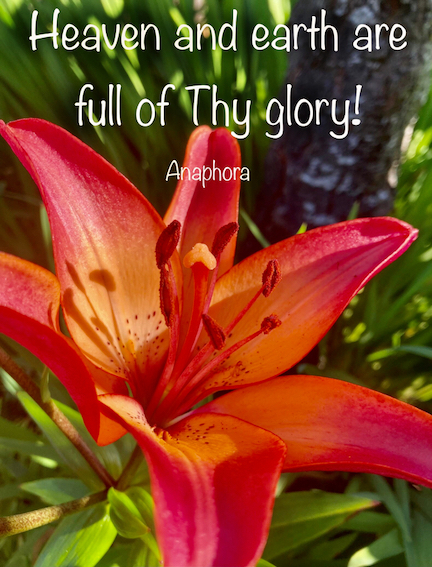
There is an ineffable instant in the Liturgy’s Eucharistic Anaphora where heaven and earth converge in Divine Sanctification- unfettered by time or space.

This is a Great Mystery.

On Earth As It Is In Heaven

Sunrise From Space Image by Arek Socha from Pixabay

We should refer all our problems, whatever they are, to God, just as we say in the Divine Liturgy that ‘we commend our whole life unto Christ our God’. We leave everything to You, Lord. Whatever You will. Let Your will be done on earth as it is in heaven. ~ St. Porphyrios

It is Truly Meet

A Monastery Wall – Image by Dimitris Vetsikas from Pixabay 

Towards the end of evening vigil services, and after the Anaphora at Divine Liturgy, we sing a short, compelling, ancient hymn. Its history is amazing, for it was revealed by the Archangel Gabriel himself, posing as a monk while visiting a monastery on Mt. Athos during the 10th century!

When he began to sing before the Panagia Eleousa (Merciful) Icon of the Virgin Mary, it shone brilliantly. He then was asked by the brethren to write down this unknown beautiful hymn, but there was no paper available. Taking a piece of slate, and inscribing the words on it with his finger, as if the rock was as soft as wax, he vanished. The phrase it it truly meet (meet is old English), meaning it is truly fitting, proper and suitable.

This miracle is celebrated on June 24/11.

Ancient Hymn to the Theotokos
It is truly meet to bless thee, O Theotokos, ever-blessed and most pure, and the Mother of our God. More honourable than the Cherubim, and beyond compare more glorious than the Seraphim, who without corruption gavest birth to God the Word. True Theotokos we magnify thee! ~ Axion Esti

There are many melodies to this hymn, and below are two English tunes from Youtube. The first part has women singing and the second part has men singing another melody of this hymn.

Listen time total – a short 2 minutes, 21 seconds.

Congratulations on your Saint’s Day,
Helena and Eleanor!
May God grant you many years!

Nothing Higher on Earth

Greetings on Forgiveness Sunday!

Great Lent begins Tomorrow.

There is nothing on earth higher, greater or more holy than the Divine Liturgy; nothing more solemn, nothing more life-giving. ~ St. John of Kronstadt

The Church is your hope, the Church is your salvation, the Church is your refuge. ~ St. John Chrysostom

May your Lenten Journey be a peaceful, fruitful preparation for the Great and Holy Feast of Pascha (Easter) – Sunday, April 24th, 2022.

Let Us Go Forth in Peace

Angel Wall Mosaic Before Completion – St. Sophia Orthodox Church in Canada, 2012

“Let us go forth on peace” is the last commandment of the Liturgy. What does it mean? It means, surely, that the conclusion of the Divine Liturgy is not an end but a beginning. Those words, “Let us go forth in peace,” are not merely a comforting epilogue. They are a call to serve and bear witness. In effect, those words, “Let us go forth in peace,” mean the Liturgy is over, the liturgy after the Liturgy is about to begin. This, then, is the aim of the Liturgy: that we should return to the world with the doors of our perceptions cleansed. We should return to the world after the Liturgy, seeing Christ in every human person, especially in those who suffer. In the words of Father Alexander Schememann, the Christian is the one who wherever he or she looks, sees Christ everywhere, and rejoices in him. We are to go out, then, from the Liturgy and see Christ everywhere. ~ Bishop Kallistos (Ware) of Diokleia

error: Content is protected !!