This morning a dear friend sent me pictorial proof of Paradise… right from her very back door! It struck an inspiring chord, reminding me how roses celebrate the deep sacredness and beauty of God’s Creation, and also how in Orthodox traditions the Virgin Mary – our LadyTheotokos is sometimes referred to as the Mystical Lily or Rose. For, like a Mystical Flower with petals folded close beneath her heart, she blossomed forth our Lord Jesus Christ – the Sweet, Salvific Fruit of our Faith. We venerate her unique relationship with God. Even in her icons, the Virgin Mary directs us to glorify Christ. Today is a good day to stop and smell some garden roses, and to celebrate my many blessings! Thank you for visiting Blisswood!
The rose does not speak, but puts forth a strong fragrance. We too, should put forth fragrance, pour forth spiritual fragrance, the fragrance of Christ. The fragrance of our deeds should be heard from far around: good, pure and righteous deeds, full of love. Only thus can the Kingdom of God appear within our hearts, appearing not through words, but with power. ~ St. Luke of Simferopol
I have been amazed that some are utterly in doubt as to whether or not the Holy Virgin is able to be called the Mother of God. For if our Lord Jesus ChristisGod, how should the Holy Virgin who bore him not be the Mother of God?~ St. Cyril of Alexandria (375 -444 AD)
The Most Holy Mother of God prays for us ceaselessly. She is always visiting us. Whenever we turn to her in our heart, she is there. After the Lord, she is the greatest protection of mankind… She is constantly, by our side, and all too often we forget her. ~ Elder Thaddeus of Vitnovica
Troparionin Tone 1: In giving birth thou didst preserve thy virginity, and in thy falling asleep thou hast not forsaken the world, O Theotokos. Thou hast been translated unto life, for thou art the Mother of Life, and by thy supplications, thou dost deliver our souls from death.
Kontakionin Tone 2 : The tomb, nor mortality could not hold the Theotokos, who istireless her prayers and supplications. For, as the Mother of Life, she was translated unto life, by Him Who dwelt within her Ever-Virgin womb.
…and after the third day, they opened the sarcophagus to venerate the precious tabernacle of her who deserves all praise, but found only her grave garments; for she had been taken away by Christ, the God who became flesh from her, to the place of her eternal, living inheritance. And our Lord Jesus Christ Himself, who bestowed glory on his Immaculate Mother Mary Theotokos, will also bestow glory on those who glorify her. Those who call upon her, celebrating her memorial every year, He will save from every danger, and He will fill their households with good things, like the house Onesiphorus (cf. 2 Timothy 1:16;4:19). And they will receive the forgiveness of their sins, both here and in the age to come. For He has shown her to be His cherubic throne on earth, an earthly heaven, the hope and refuge and confidence of our race, so that if we celebrate, with sacred mysteries, the festival of her holy Dormition, we might find mercy and grace in the present age and in the age to come, by the grace and kindliness of our Lord Jesus Christ: to Whom be glory and power, with His unbegotten Father and with the all-holy and life-giving Spirit, now and always and for the ages of ages. Amen. ~ St. John of Thessalonica (8th century) – On the Dormition of Mary Early Patristic Homilies, page 67
The next feast after the Dormition, is the Feast of the Holy Mandylion (The Icon of Christ Not-Made-by-Hands) Aug. 29/16. Sometimes this feast is transferred to the closest Sunday after this date. For the many churches named St. Sophia, (after the Holy Wisdom of God – Our Lord Jesus Christ) today is their Name day, and is also ancient the Feast of Mid-Pentecost.
Troparion in Tone 2: We bow down before Thy pure Image O Good One, asking forgiveness of our transgressions, O Christ, God; for Thou wast well pleased to ascend the Cross in the Flesh, of Thine own will, that Thou mightest save what Thou hadst created from slavery to the enemy. Wherefore, we cry out to Thee in thanksgiving: Thou hast filled all things with joy, O our Saviour, Who hast come to save the world.
Kontakion in Tone 2: O uncircumscribable Word of the Father, knowing the victorious image, uninscribed and divinely wrought, of Thine ineffable and divine dispensation towards man, of Thy true Incarnation, we honour it with veneration.
Below is a beautiful version of the Magnificat Hymn by the Virgin Mary, from St. Luke 1:46-55. The refrain to this hymn: More honourable than the Cherubim, and beyond compare more glorious than the Seraphim, who without corruption gavest birth to God the Word. True Theotokos we magnify thee! ~ Axion Esti was revealed by the Archangel Gabrielhimself, posing as a monk while visiting a monastery on Mt. Athos during the 10th century!
The Magnificat is sung at most vigil services.
…no eye has seen, nor ear heard, nor the heart of man imagined, what God has prepared for those who love him. ~ 1 Corinthians 2:9
The whole creation calls thee blessed, O ever-Virgin born today of Anna: thou spotless branch of the root of Jesse, that brought forth Christ as flower. ~ Irmos at Second Canon of the Festal Matins
Thy nativity, O Virgin Theotokos, hath proclaimed Joy to all the world; for from thee hath shone forth Christ our God, the Sun of Righteousness, Who, having annulled the curse, hath given His blessing, and having abolished death, hath granted us life everlasting. ~Troparion Tone 4
Through the prayers of our Most Holy Lady and Ever-Virgin Mary the Theotokos… May your day be filled the bright and saving heavenly light of the Sun of Righteousness!
The Most Holy Mother of God prays for us ceaselessly. She is always visiting us. Whenever we turn to her in our heart, she is there. After the Lord, she is the greatest protection for mankind… She is constantly, by our side, and all too often we forget her. ~ Elder Thaddeus of Vitovnica
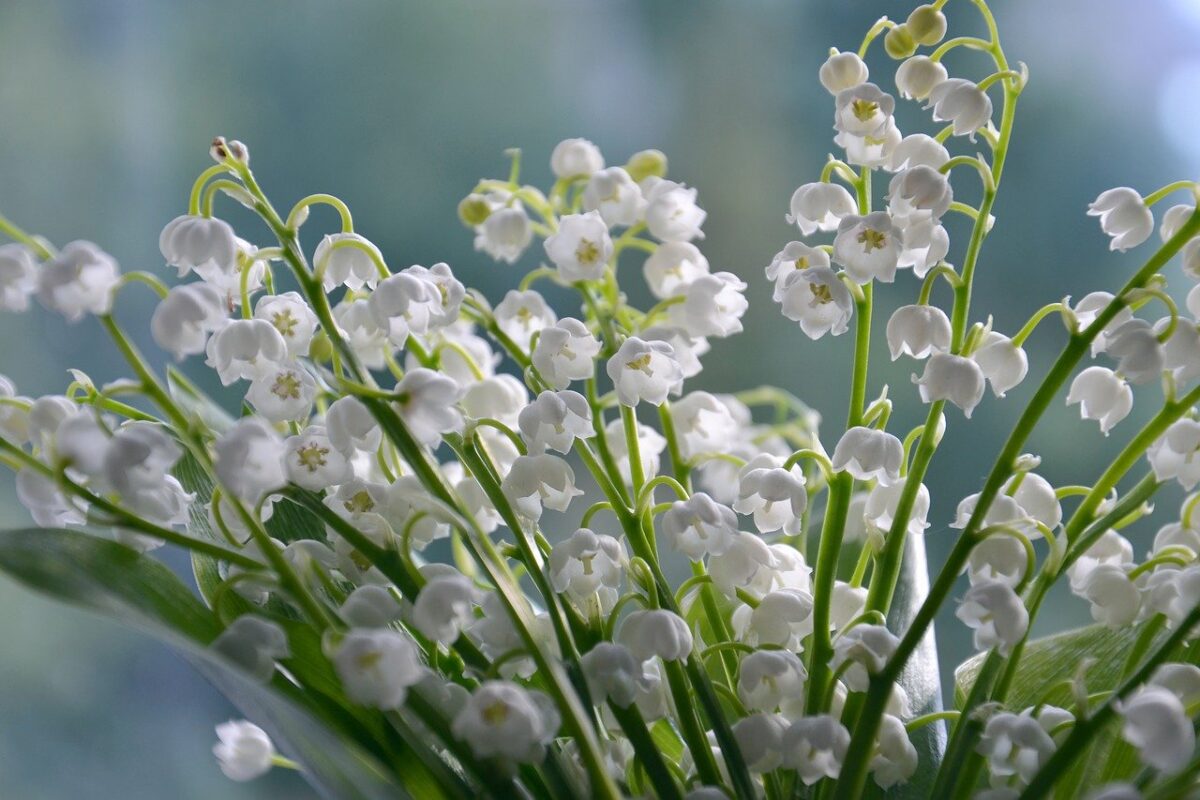
The Venerable Bede (7th century) likened the Virgin Mary to a white lily… symbolizing her purity, innocence and virginity. The floral centre of yellow anthers, are as the golden radiance of her soul.
As long as they (Christ’s Disciples) were in Palestine, holy Mary spent time with them, helping them confirm themselves in the Saviour’s commandments, encouraging them to all goodness and cheering them. But when the disciples departed from Palestine to distant lands alien and unknown, She remained in John’s house. She did not waste Her time with trifles, but used every minute for the benefit of mankind, the very human race that crucified Her innocent Son! She dedicated her labours and care to visiting the sick and the imprisoned; she comforted, taught, and instructed anyone who needed support or counsel. She lived strictly according to Her Son’s commandments and therefore she could assuage people’s sorrows. She was a source of healing, and shade, and all who drew from that source felt freshness and relief and were fortified by heavenly love. The good works to which she entrusted Herself filled her soul with great blessedness and consolation, which were the reward for the woes and calamities she previously bore. For only after Her Son was resurrected did her eyes open to what had happened, and hope arrived. ~ St. Nikolai Velimirovic (Excerpt fromThe Theotokos on Her Deathbed)
An old English name for the Hosta garden plant, is the Assumption Lily, as it blooms close to the Dormition.
The liturgical colour for feasts honouring the Theotokos is blue. The clergy wear blue vestments, and the faithful sometimes wear a bit of blue too, in her honour. In icons, while her veil is red…the colour of divinity, as she is the Theo(God) tokos(Bearer), her clothes under the veil are green or blue, the colours of humanity. Also, upon her veil, are three stars, which represent her eternal virginity: before, during, and forever after the birth of Our Lord God and Saviour Jesus Christ, she remained a pure virgin. At weddings it is still traditional to wear “a little something blue” in honour of the Theotokos.
St. Ambrose Bishop of Milan (330-397), wrote: “Mary’s life, is a rule of life for all.” …It is important that as Orthodox Christians we know and examine the life of the Theotokos who, after Christ Jesus, so influenced every creature, both the bodiless ones and the earthborn, before, during, and after her earthly sojourn. ~ From The Life of The Virgin Mary, The Theotokos, written and compiled by Holy Apostles Convent
Beautiful Walking Tour inside the Church built over the Virgin Mary’s empty tomb (Thank you for sharing Irena!)
Troparion Tone 1: In giving birth thou didst preserve thy virginity, and in thy falling asleep thou hast not forsaken the world, O Theotokos. Thou hast been translated unto life, for thou art the Mother of Life, and by thy supplications, thou dost deliver our souls from death.
Kontakion Tone 2: The tomb, nor mortality could not hold the Theotokos, who istireless her prayers and supplications. For, as the Mother of Life, she was translated unto life, by Him Who dwelt within her Ever-Virgin womb.
Hold on tightly as possible to the Robe of our Great Lady the Theotokos, that she might help you. May the Theotokos, the tender and caring Mother of the entire world, protect you and the entire world. ~ St. Paisios
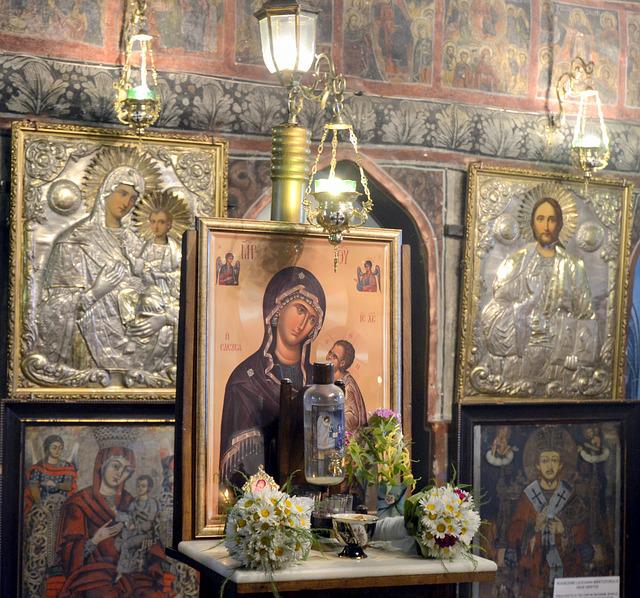
Church Icons of The Most Holy Theotokos – Image by Iulia Radu from Pixabay
Greetings on this wonderful Feast! What a glorious day! Our priest brought a small relic of St. Anna (from Mt. Athos) this morning for the parish to venerate after Divine Liturgy. Blessed joy!
St. Anna (Ann or Anne, from Hebrew Hannah – means favour or grace) is descended from the lineage of King David, and the mother of the Virgin Mary, and grandmother of Jesus Christ.
O Godly-minded Anna, thou didst give birth unto God’s pure Motherwho conceived Him Who is our Life. Wherefore, thou hast now passed with joy to thy heavenly rest, wherein is the abode of them that rejoice in glory; and thou askest forgiveness of sins for them that honour thee with love, O ever-blessed one. ~ Troparia
The Lily symbolizes the unfading flower of virginity and purity of the Mother of God. The six anthers with amber pollen splaying out from the flower’s centre, represent the golden radiance of her soul.
The Father is Light, His Son is Light, and the Spirit, the Comforter, is Light: for, shining forth as from one sun, the Trinity divinely illuminates and preserves our souls… The prophets proclaimed thee in ages past, speaking of thee as the ark of holiness, golden censer, candlestick, and table; and we sing thy praises as the Tabernacle that held God. ~ Second Canon at the Festal Matins
The Theotokos is sometimes referred to as the Golden Candlestick; for within her, she contained the Light that Illumines the whole world.
With joy in spirit, let us go before her today, bearing the bright lamps of faith… into the temple of our hearts!
Festal Troparion, Tone 4 Today is the prelude of God’s good will / and the heralding of the salvation of mankind. / In the temple of God, the Virgin is presented openly, / and she proclaimeth Christ unto all. / To her, then, with a great voice let us cry aloud: / Rejoice, O thou fulfillment // of the Creator’s dispensation.
Festal Kontakion, Tone 4 The most pure temple of the Saviour, / the most precious bridal-chamber and Virgin, / the sacred treasury of the glory of God, / is on this day brought into the house of the Lord, / bringing with her the grace that is in the Divine Spirit. / And the angels of God chant praise unto her: // she is the heavenly tabernacle.
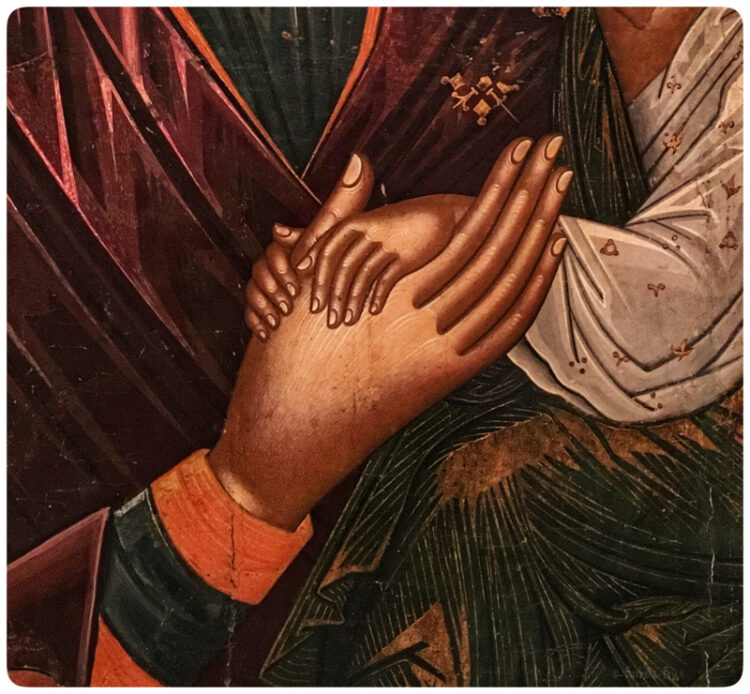
Icon ofSt. Annaholding the Most Holy Theotokos – Benaki Museum, Greece, 2017
Greetings on this beautiful Feast Day! (September 21 /8)
In their barren affliction the holy parents [Sts. Joachim and Anna] of the Mother of God cried aloud unto the Lord; and they… received from heaven a gift worthy of God… Today the inhabited earth rejoiceth with thee, O holy Anna. For thou hast borne as blossom the Mother of its Redeemer, even her who brought forth the Rod of our strength from the root of Jesse, and who bore Christ as flower… Husbandman of our Thoughts and gardener of our souls, Thou hast made the barren earth fertile. Thou hast turned the ground that once was parched into fruitful land, rich in corn and bearing fruit. From Holy Anna Thou hast made to blossom… the Theotokos. ~ Matins Excerpts on the Birth of our Most Holy Lady the Theotokos
The root is the household of the Jews, the rod is Mary, the Flower of Mary is Christ. She is rightly called a rod, for she is of the royal lineage, of the house and family of David. Her Flower is Christ, Who destroyed the stench of worldly pollution and poured out the fragrance of eternal life. As He Himself said, ‘I am a flower of the plain, a lily of the valleys.’ ~ St Ambrose of Milan (4th century)
I have been amazed that some are utterly in doubt as to whether or not the Holy Virgin is able to be called the Mother of God. For if our Lord Jesus Christ is God, how should the Holy Virgin who bore him not be the Mother of God? ~ St. Cyril of Alexandria (375 -444 AD)
Here are some traditionson ways to celebrate today! Besides wearing blue in honour of the Theotokos, many hike and go birdwatching after Liturgy and lunch, to count how many birds and species they can see today. (It is said St. Anna saw a mother bird tending her fledglings in a garden nest, which saddened but inspired St. Anna to pray yet again faithfully for the blessing of a child.) If hiking, and you are allowed to, flowers and wild grasses are picked and placed in the family icon corner.
Some families have recently adapted baking a Birthday Cake or another kind of sweet, and sing theTropar of the Nativity of the Theotokos before enjoying the treat. Others share they make blueberry pancakes after Liturgy or bake a blueberry pie for dessert for after dinner!
Thy nativity, O Virgin Theotokos, hath proclaimed Joy to all the world; for from thee hath shone forth Christ our God, the Sun of Righteousness, Who, having annulled the curse, hath given His blessing, and having abolished death, hath granted us life everlasting. ~ Troparion Tone 4
O Most Holy Theotokos, pray to God for us!
Beautiful Orthodox Hymn to the Virgin Mary by St. Nektarios of Aegina Greece (with English translation)