Thrice Holy

Entrance with Trisagion Prayer in Ancient Greek

Trisagion from Greek, means thrice [tris] and holy [agios]. This Thrice Holy Prayer to the Holy Trinity is used during private prayer, and throughout the Church’s daily worship cycle.

Trisagion in English: Holy God, Holy Mighty, Holy Immortal, have mercy on us.

Trisagion in Greek Pronounced: Agios O Theos, Agios Eeskhiros, Agios Athanatos, eleison imas)

History and Miracle of the Trisagion Hymn

Above, the hosts of angels sing praise; below, men form choirs in the churches and imitate them by singing the same doxology. Above the Seraphim cry out the Trisagion Hymn; below, the human throng sends up the same cry. The inhabitants of heaven and earth are brought together in a common assembly; there is one thanksgiving, one shout of delight, one joyful chorus. ~ St. John Chrysostom

The unceasing and sanctifying doxology by the holy angels in the Trisagion signifies, in general, the equality in the way of life and conduct and the harmony in the divine praising which will take place in the age to come by both heavenly and earthly powers, when the human body now rendered immortal by the resurrection will no longer weigh down the soul by corruption and will not itself be weighed down but will take on, by the change into incorruption, potency and aptitude to receive God’s coming. In particular it signifies, for the faithful, the theological rivalry with the angels in faith; for the active ones, it symbolizes the splendor of life equal to the angels, so far as this is possible for men, and the persistence in the theological hymnology; for those who have knowledge, endless thoughts, hymns, and movements concerning the Godhead which are equal to the angels, so far as humanly possible. ~ St. Maximus the Confessor

And Most of All

Keep thine heart with the utmost care; for out of these are the issues of life. ~ Proverbs 4:23

… A Christian renews within himself the grace-filled springs which were opened to him through Holy Baptism, and which were later so many times obstructed by carelessness and falls, and so many times cleansed by repentance… Let us continue fasting and not give liberty to our feelings, not cease fervent prayers and tears, and not forget works of love; let us seek to hear the word of God and most of all, seek to converse with the Lord, Who is within us. Through this conversation we shall uphold the fear of God and zeal to please Him within ourselves, for in this lies the source of our spiritual life. ~ St. Theophan the Recluse

All Over the World

Altar Mosaic at St. Sophia Church, Canada

The Lord greatly loves the repenting sinner and mercifully presses him to His bosom: “Where were you, My child? I was waiting a long time for you.” The Lord calls all to Himself with the voice of the Gospel, and His voice is heard all over the world. “Come to me My sheep. I created you, and I love you. My love for you brought me to earth, and I suffered all things for the sake of your salvation, and I want you all to know My love, and to say, like the apostles on Mt. Tabor: Lord it is good for us to be with You.” ~ St. Silouan the Athonite

The True Aim

2004 – Dome from the Ancient Chora Church, in Turkey

Sadly, this church was converted to a mosque in 2020.

Prayer, fasting, and vigils, and all other Christian practices, however good they may be in themselves, certainly do not constitute the aim of our Christian life: they are but the indispensable means of acquiring that aim. For the true aim of the Christian life is the acquisition of the Holy Spirit of God. As for fasts, vigils, prayer and almsgiving, and other good works done in the name of Christ, they are only the means of acquiring the Holy Spirit of God. Note well that it is only good works done in the name of Christ that bring us the fruits of the Spirit. ~ St. Seraphim of Sarov

Intentions and Ladybugs

Busy Ladybug on Allium Flower

Why are Ladybugs called Ladybug?

A European tradition from the Middle Ages relates how during one particular year, farmers’ crops everywhere were abnormally attacked by great plagues of small insects. Threatened with potential starvation, the people prayed fervently for the intercession of the Virgin Mary. Prayers were quickly answered with huge clouds of tiny orangy-red insects spotted with black dots, which arrived and ate the offending pestilence. In gratitude, these little bugs were bestowed with the honorary title of Our Lady’s Beetle. Over time, this was shortened to lady beetle, ladybird, and ladybug.

In all our actions, God considers the intention: whether we act for Him or for some other motive. ~ St. Maximus the Confessor

As the field is adorned by a multitude of flowers, so should the field of my own soul be adorned by all the flowers of virtue; as the trees bring forth flowers and afterwards fruit, so must my soul bring forth the fruits of faith and good works. ~ St. John of Kronstadt

Skylark Buns Tradition

Skylark buns are traditionally baked to celebrate the Holy 40 Martyrs of Sebaste.

Sebaste, an ancient Roman town, is now called Ayas in modern-day Turkey. The date of the Holy Forty Martyrs’ “heavenly birthday” falls on March 22/9 (320 AD) and always within Great Lent.

The Holy Forty Martyrs were soldiers in the Roman 12th Legion called Fulminata (the Lightning -Thundering Legion). As Christians, they refused to offer sacrifice to the pagan gods, and were brought to trial before the commander. After enduring many sufferings, they attained the joyous reward reserved for those who give their lives for Christ. The unwavering fortitude of the Holy Forty Martyrs exemplifies great faith, and perseverance to the end.

The Holy Fathers of the Church refer to Great Lent as a fasting spring. During this period, the souls of the faithful are sown with seeds of divine grace, to yield a harvest of good deeds, throughout the year that follows. 

Buns shaped like birds (also known as skylarks) are traditionally baked to celebrate the Forty Martyrs of Sebaste’s feast day.  Skylark buns are also shared after church on the first Sunday closest to their feast day, which also occurs near the first day of spring.

The skylark buns remind us of the Forty Martyrs’ steadfastness… inspiring own our souls to soar heavenward like birds, upon the wings of divine love; looking unto Jesus, the Author and finisher of our lives.  

To Make the Larks    

Take a piece of risen yeasted bread dough, about the size of a medium egg, and roll it out into a long ropey piece, about 5 inches long. 

Tie it loosely into a knot, with approximately equal length protruding from both ends. 

Put on a lightly greased cookie sheet (or use parchment paper). With a pair of scissors, cut a “beak” on one end of the knot, and on the other end of the knot, cut a “tail” into about 3 or 4 feathered strands. 

Push 2 peppercorns firmly into the head, as eyes.  

Do not put birds on cookie sheet too closely together, as they spread a bit as they bake. Cover, let rise again for about half an hour. 

Pop into a preheated 370* oven and bake about 15-20 minutes or until golden brown. 

TIP: For tastier buns, use a bit of honey, a dash of cardamon, and lemon or orange zest in the dough. 

Some people prefer to use currants for the eyes, although these can turn gooey. 

Birds freeze very well if baking ahead of time. You may need to secure their eyes again, if they come loose in bag when thawing.

Gather Love

Such is friendship, that through it we love places and seasons; for as bright bodies emit rays to a distance, and as flowers drop their sweet leaves on the ground around them, so friends impart favour even to places where they dwell. With friends even poverty is pleasant. Words cannot express the joy which a friend imparts; only they can know who have experienced. A friend is dearer than the light of heaven, for it would be better for us that the sun were exhausted than that we should be without friends. ~ St. John Chrysostom

A Lenten Prayer

During the weekdays of Great Lent, we say the prayer of St. Ephraim the Syrian (306-373 AD).

O Lord and Master of my life, a spirit of idleness, despondency, ambition and idle talking, give me not. (Prostration)

But, rather, a spirit of chastity, humble-mindedness, patience and love, bestow on me Thy servant. (Prostration)

Yea, O Lord and King, grant me to see my failings and not condemn my brother, for blessed art Thou unto the ages of ages. Amen. (Prostration)

Then the prayer once more in full, with one prostration at the end.

If unable to physically do a prostration, “bend the knees of your heart” instead.

Scripture brought me to the Gate of Paradise, and the mind stood in wonder as it entered. ~ St. Ephraim the Syrian

Let books be your dining table, and you shall be full of delights. Let them be your mattress, and you shall sleep restful nights. ~ St. Ephraim the Syrian

The Runners

They were runners together in tandem
A perfect relay of mind and heart
Striving together towards a finish
Which each crosses separately
And we were the bystanders
Cheering them on.

They were upholding each other
Carrying each other toward the end
And we were the bystanders
Cheering them on
With bursting hearts.

© Anastasia Sharon Braun

Therefore, since we are surrounded by so great a cloud of witnesses, let us also lay aside every weight, and sin which clings so closely, and let us run with endurance the race that is set before us, looking to Jesus, the founder and perfecter of our faith, who for the joy that was set before him endured the cross, despising the shame, and is seated at the right hand of the throne of God. ~ Hebrews 12: 1-2

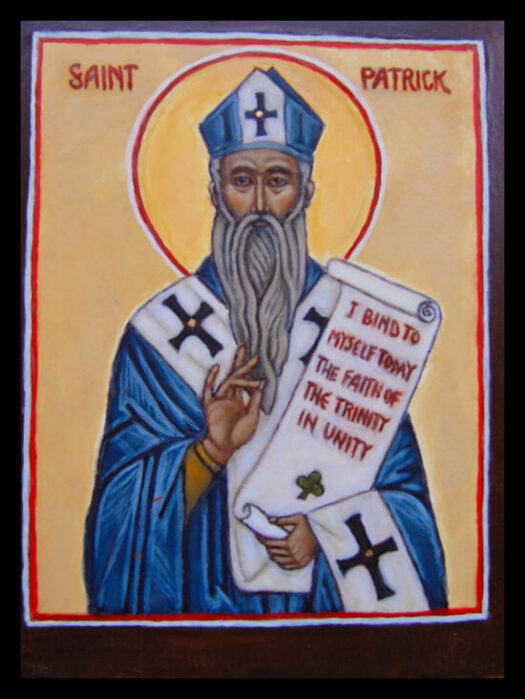
St. Patrick Enlightener of Ireland

Thank you Vera, for sharing the St. Patrick icon!

St. Patrick is so beloved and well-known, that I’m posting this today… for both calendars (March 17/March 30).

St. Patrick led an amazing life. Born in Scotland around the year 385 AD, he was the son of a deacon and the grandson of a priest. Patrick wasn’t particularly religious during his youth, but he lived a quiet life.

That all changed at the age of sixteen, when he was kidnapped by pirates raiding the British coast. Taken to Ireland and sold as a slave, Patrick spent the next six years as a herder on an isolated mountain.

Labouring in solitude, he remembered the faith of his youth, and turned to prayer, finding solace in God. Patrick had a vision revealing he would soon be free and that a ship would be waiting for him. An opportunity arose for his escape, and he fled… traveling many days on foot, until he reached the coast to find the ship from his vision, preparing to sail to Gaul (France).

St. Patrick studied for several years in a monastery under the holy Bishop Germanus. He was ordained a priest and eventually consecrated a bishop. St. Patrick had another vision, that the people in the land of his captors were calling him back to Eire. St. Patrick understood that this was to be his mission… he was to return to Ireland and help establish the Church there. He was one of several missionaries who arrived in Ireland around 432 AD. 

When asked to explain the mystery of the Holy Trinity in a simple manner, St. Patrick used a tiny shamrock (a low growing plant of the clover family) with its three lobed leaves on a single stem, to demonstrate how God the Father- God the Son- and God the Holy Spirit are the Holy Trinity; Three in One, One in Three… Undivided.

Lorica of St. Patrick sung by the GG’s (Abridged Version)

Once, during his travels, he destroyed an idol where human sacrifices would occur. This idol sat on a large rock. When the saint struck the idol with his crozier (bishop staff), the idol crumbled to dust, and the imprint of the crozier remained upon the rock.

As a bishop he faced many struggles and dangers, including hostility from those loyal to the pagan gods. With God’s help, St. Patrick worked through these obstacles while guiding his flock, and baptising new converts. St. Patrick prayed tirelessly, and continued his work of establishing churches and monasteries. It is said he chanted the entire Psalter every day.

His writings include several works of prayers, and letters. One of these prayers is well known as the Lorica (Breastplate) of St. Patrick… A prayer for protection.

During a perilous journey to share the Christian faith in King Loegaire’s territory, the saint discovered they were in mortal danger of an ambush. He prayed the Lorica Prayer, and to those lying in ambush, the saint and his company of monks appeared to them as if they were wild deer, and not humans. Because of this miracle, the Lorica Prayer is also known as The Deer’s Cry.

The early fifth century Enlightenment of Ireland by St. Patrick and his brethren, has been called the most successful single missionary venture in the history of the church.  

This post is collected from various sources over the years… and are but a smidgeon of the countless, wondrous, and miraculous events, regarding the life of St. Patrick, Enlightener of Ireland.

Today we also celebrate the 7th century British St. Owen of Lichfield.

error: Content is protected !!