

To every thing there is a season, and a time to every purpose under the heaven: A time to be born, and a time to die; a time to plant, and a time to pluck up that which is planted; A time to kill, and a time to heal; a time to break down, and a time to build up; A time to weep, and a time to laugh; a time to mourn, and a time to dance; A time to cast away stones, and a time to gather stones together; a time to embrace, and a time to refrain from embracing; A time to get, and a time to lose; a time to keep, and a time to cast away; A time to rend, and a time to sew; a time to keep silence, and a time to speak; A time to love, and a time to hate; a time of war, and a time of peace. He hath made every thing beautiful in his time: also he hath set the world in their heart, so that no man can find out the work that God maketh from the beginning to the end. ~ Ecclesiastes 3: 1-8; 11
Category: Reflections
Beauty for Ashes

To appoint unto them that mourn in Zion, to give unto them beauty for ashes, the oil of joy for mourning, the garment of praise for the spirit of heaviness; that they might be called trees of righteousness, the planting of the Lord, that he might be glorified. ~Isaiah 61:3
God’s love for us is greater than we could ever imagine. By Christ’s Resurrection, He takes the ashes of grief and sin, and transforms them into beauty, hope, and joy.
Trees of Righteousness

To appoint unto them that mourn in Zion, to give unto them beauty for ashes, the oil of joy for mourning, the garment of praise for the spirit of heaviness; that they might be called trees of righteousness, the planting of the Lord, that he might be glorified. ~ Isaiah 61:3
For ye shall go out with joy, and be led forth with peace: the mountains and the hills shall break forth before you into singing, and all the trees of the field shall clap their hands. ~ Isaiah 55:12
Upon the Willows
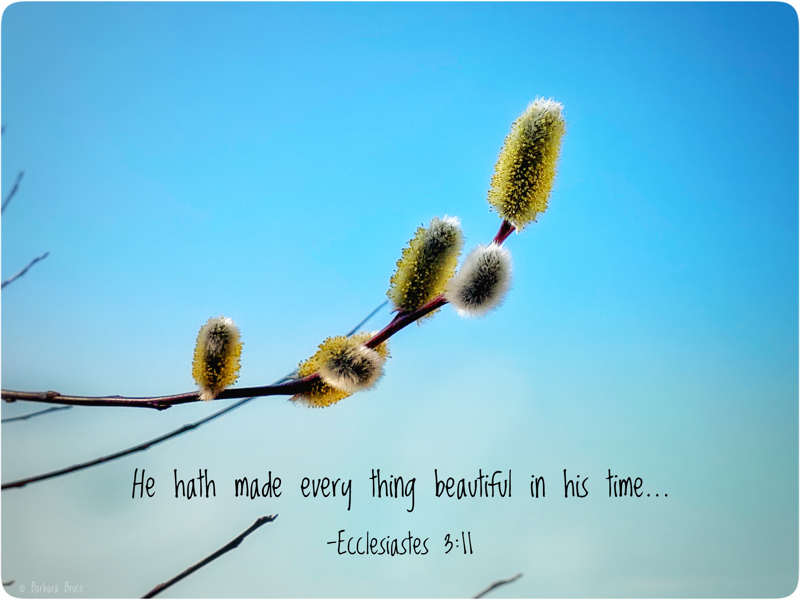
This is a pussy willow branch from a third generation church tree… originally grown from a dried and blessed Palm Sunday bouquet, which sprouted in an icon corner!
These furry little catkins are among the first to blossom forth, in early spring, seemingly to show the trees and bushes it’s time to awake from their cold winter sleep!
Pussy willows make easy everlasting flowers. Pick a bunch, and put them into a dry vase. No water. They will keep for years.
If you think of planting a pussy willow tree near your home, do keep it far away from drains. For, as an exuberant willow, it is determined to seek water.
He has made everything beautiful in its time. Also, he has put eternity into man’s heart, yet so that he cannot find out what God has done from the beginning to the end. ~Ecclesiastes 3:11
Beauty of Holiness

The highest form of prayer is to stand silently in awe before God. ~ St. Isaac the Syrian
The pansy is called the Trinity Flower because of its three-petal shape.
Pansy colours of white, yellow, and purple flowers also remind us of the Virgin Mary’s life… recounting her purity, joy, and mourning, respectively.
Today’s modern Pansy flower originated from its ancient cousin – the wild, European viola, also known as heartsease. In Victorian floriography, the pansy represented thoughts and remembrance, and its name came from the French word pensée.
Pansies and wild violets have medicinal properties and were beloved by herbalists for centuries. They were used for skin complaints, respiratory problems, chest infections, and making dyes.
Besides enjoying their simple beauty in a fragrant bouquet, organic pansies and violas are also edible. They can be candied, used in salads as garnish, decoration for cake tops, and cookies.
Nobody can keep on being angry if she looks into the heart of a pansy for a little while. ~ Lucy Maud Montgomery, Canadian author – Anne of Green Gables
Ineffable Greatness
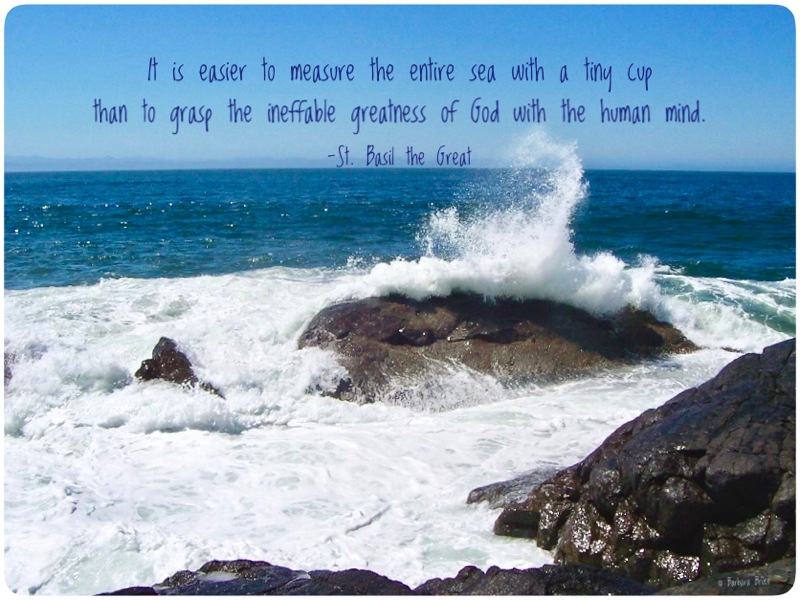
The Lord on high is mightier, Than the noise of many waters, Than the mighty waves of the sea. ~ Psalm 93:4
He stilled the storm to a whisper; the waves of the sea were hushed. ~ Psalm 107:29
And when he was entered into a ship, his disciples followed him. And, behold, there arose a great tempest in the sea, insomuch that the ship was covered with the waves: but he was asleep. And his disciples came to him, and awoke him, saying, Lord, save us: we perish. And he saith unto them, Why are ye fearful, O ye of little faith? Then he arose, and rebuked the winds and the sea; and there was a great calm. But the men marvelled, saying, What manner of man is this, that even the winds and the sea obey him! ~ St. Matthew 8:23-27
IC XC NIKA
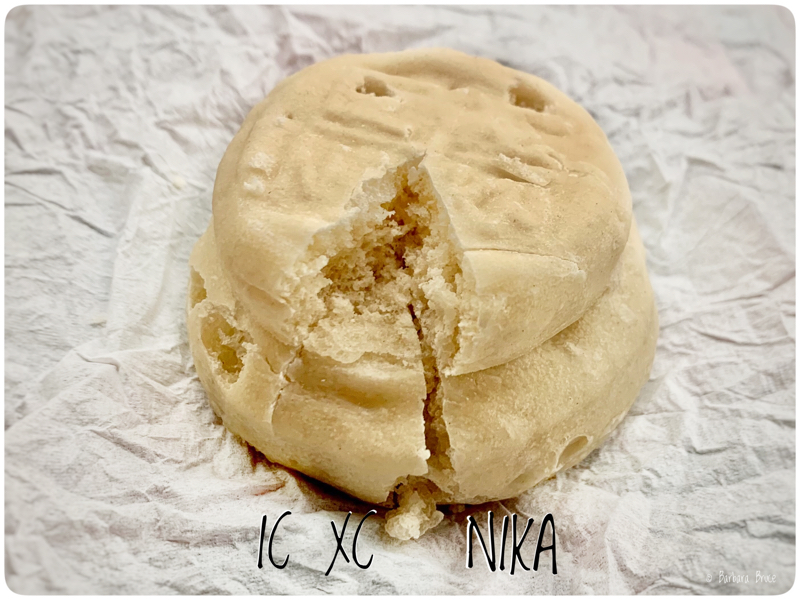
IC XC ~ Jesus Christ (Abbreviated Greek for Jesus Christ. The lines above the letters indicate the words are abbreviated)
NIKA ~ Conquers
IC XC and NIKA (Greek) refer to Jesus Christ’s conquest of Hades and His victory over death and sin by His glorious Resurrection. IC XC and NIKA is stamped on Prosphora.
It’s a pious custom to keep holy bread and holy water in one’s icon corner. These are consumed upon breaking the previous night’s fast, along with morning prayers.
O Lord my God, may Thy holy gift and Thy Holy Water be unto forgiveness of my sins, unto enlightenment of my mind, unto strengthening of my spiritual and bodily powers, unto health of my soul and body, unto vanquishing of my passions and weaknesses, by Thy boundless merciful kindness, through the prayers of Thy Most-pure Mother and all Thy Saints. Amen. ~ Russian Orthodox Cathedral of St John the Baptist
Consider the Lilies

Fawn Lilies flourish in a local woodland.
And why take ye thought for raiment? Consider the lilies of the field, how they grow; they toil not, neither do they spin: And yet I say unto you, That even Solomon in all his glory was not arrayed like one of these. Wherefore, if God so clothe the grass of the field, which to day is, and to morrow is cast into the oven, shall he not much more clothe you, O ye of little faith? ~ St. Matthew 6:28-29
Savouring Great Lent

Pears-pixaBay
Whatever you do, do it gently and unhurriedly, because virtue is not a pear to be eaten in one bite. ~ St. Seraphim of Sarov
Soul Food
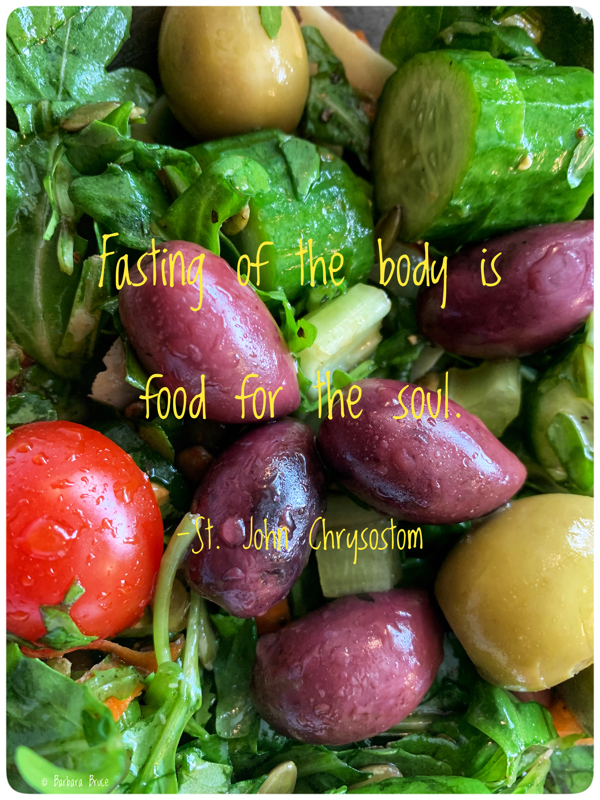
Prayer is food for the soul. Do not starve the soul, it is better to let the body go hungry… ~ St. Joseph of Optina
You don’t have a soul. You are a soul. You have a body. ~C. S. Lewis
Through greed we underwent the first stripping, overcome by the bitter tasting of the fruit, and we became exiles from God. But let us turn back to repentance and, fasting from the food that gives us pleasure, let us cleanse our senses on which the enemy makes war. Let us strengthen our hearts with the hope of grace, and not with foods which brought no benefit to those who trusted in them. Our food shall be the Lamb of God, on the holy and radiant night of His Awakening: the Victim offered for us, given in communion to the disciples on the evening of the Mystery, who disperses the darkness of ignorance by the Light of His Resurrection. ~ Aposticha, Vespers – evening of Sunday of the Last Judgement
Do that which is good, and no evil shall touch you. Prayer is good with fasting and alms and righteousness. A little with righteousness is better than much with unrighteousness. It is better to give alms than to lay up gold: For alms doth deliver from death, and shall purge away all sin. Those that exercise alms and righteousness shall be filled with life: But they that sin are enemies to their own life. ~ Archangel Raphael, Tobit 12:7-10
One should not think about the doings of God when one’s stomach is full; on a full stomach there can be no vision of the Divine mysteries. ~St. Seraphim of Sarov
It is necessary for a Christian to fast, in order to clear his mind, to rouse and develop his feelings, and to stimulate his will to useful activity. These three human capabilities we darken and stifle above all by ‘surfeiting, and drunkenness, and cares of this life’ (Lk. 21:34). ~ St. John of Kronstadt
Many human activities, good in themselves, are not good because of the motive for which they are done. For example, fasting and vigils, prayer and psalmody, acts of charity and hospitality are by nature good, but when performed for the sake of self-esteem they are not good. ~ St. Maximos the Confessor
Devils take great delight in fullness, and drunkenness and bodily comfort. Fasting possesses great power and it works glorious things. To fast is to banquet with angels. ~ St. Athanasius the Great
Let the mouth also fast from disgraceful speeches and railings. For what does it profit if we abstain from fish and fowl and yet bite and devour our brothers and sisters? The evil speaker eats the flesh of his brother and bites the body of his neighbour. ~St. John Chrysostom