Hawaiian Sunrise 2018
Hawaiian Beach Wedding – Hanalei, 2012
During a sunset walk on the beach, we happened upon a couple having wedding photos taken.
We snapped a quick picture, and offered a silent prayer for God to bless them in their life ahead.
The spontaneous kiss and obliviousness to everyone and everything (including the incoming tide splashing up to their knees), completed the romantic scene perfectly.
Of course, marriage is not just romance.
The Crowning at an Orthodox Christian wedding, symbolizes the glory and honour bestowed by God upon the couple during this sacrament… and that Christ establishes them as King and Queen of their home, which they are to rule with Wisdom, justice, and integrity.
The crowns are also referred to as Crowns of Martyrdom.
My godmother related a wedding story with newlyweds asking WHY on earth would there be a need to call these Martyr’s Crowns?
My godmother just said, “You’ll find out.”
Whenever I come across this photo, I can’t help but wonder how the beach couple are doing now.
May God help and bless them, wherever they are… in life’s journey.
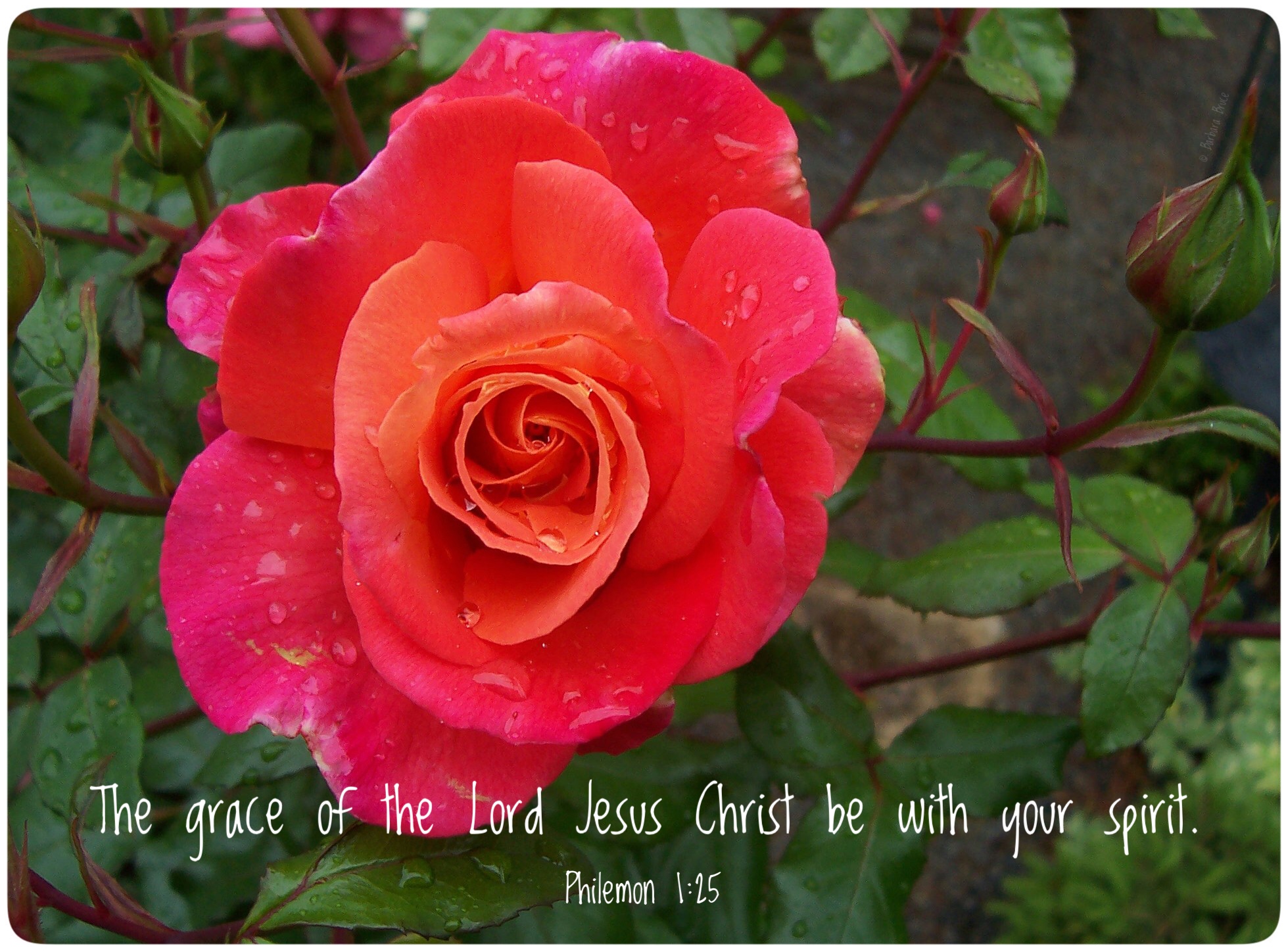
Hawaiian Daybreak, 2012
We should be spectators every day of the wonders of God. ~Mother Gavrilia
All true beauty has the power to draw the soul towards thee, and to make it sing in ecstasy: Alleluia! ~ Kontakion 7, Akathist of Thanksgiving Glory to God for All Things
Blessed be the name of the Lord from henceforth, and forevermore! ~ Psalm 113:2
Happy Sunday!
Our soul is a Divine Breath. Our body is His Creation. In the whole of us we are the icon of God. ~ Gerontissa Gavrielia
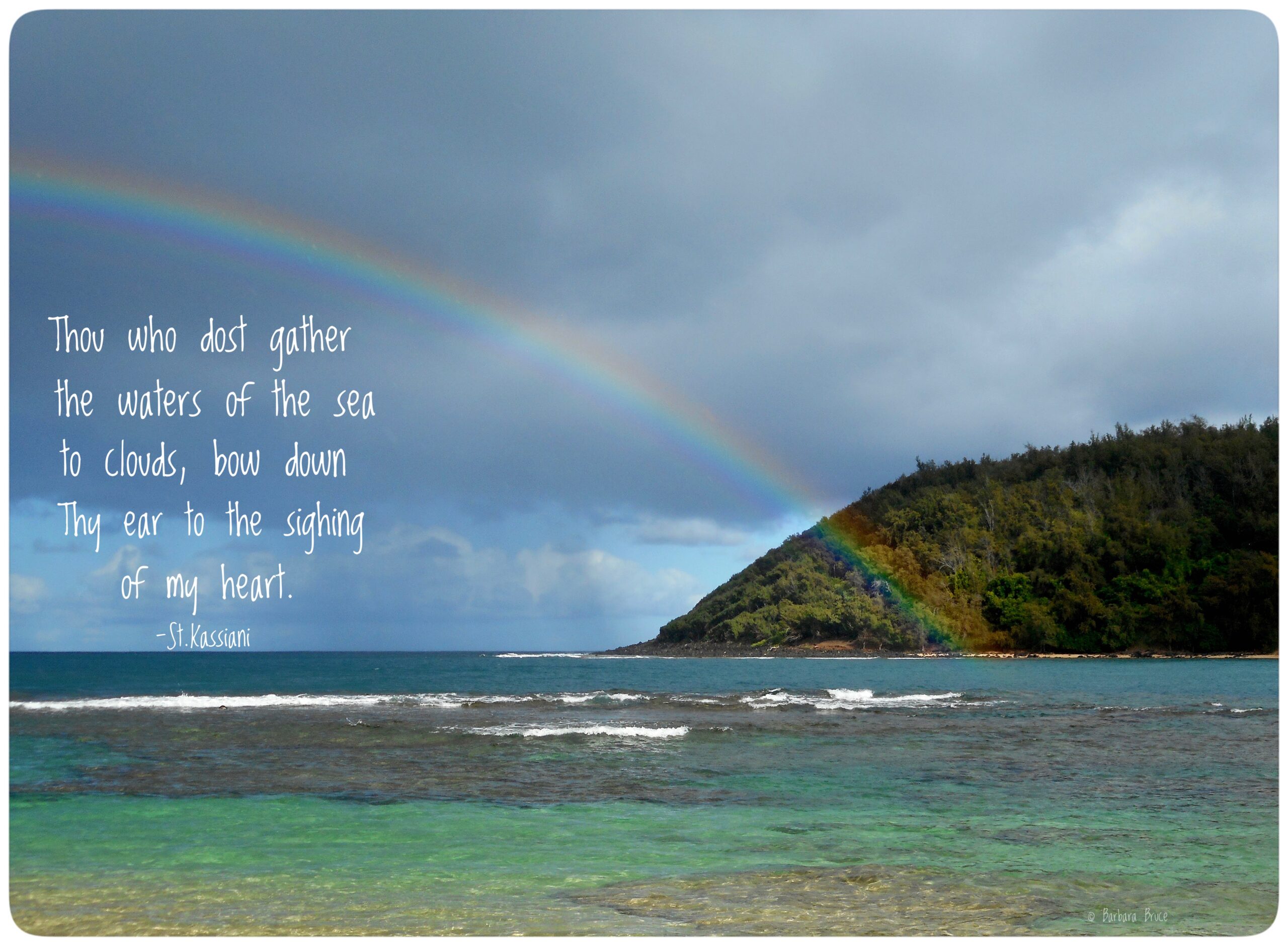
Hawaiian Rainbow 2012
An excerpt from an ethereal hymn by the brilliant female Byzantine hymnographer, Saint Kassiani.
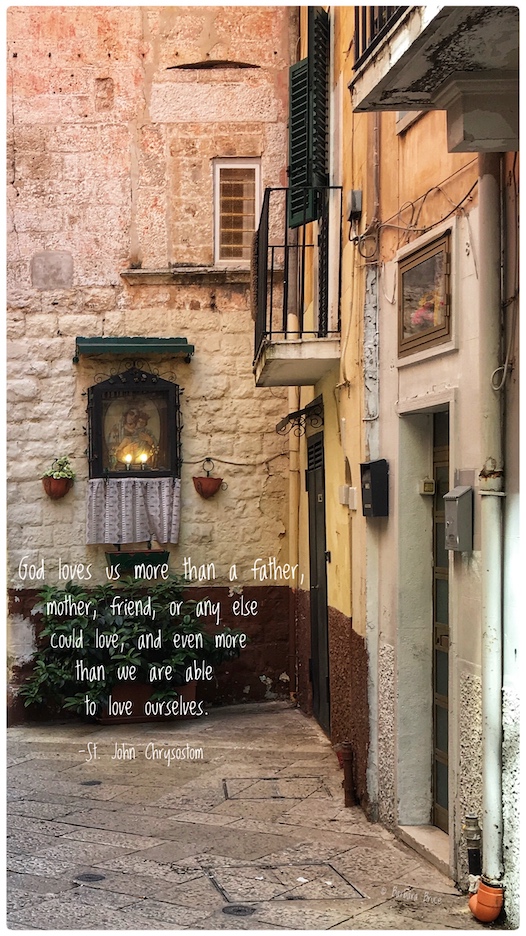
Rear view of family housing in Bari, Italy – 2017. This is near St. Nicholas the Wonderworker Basilica, which houses his myrrh-streaming relics. They were moved in the 11th century from his original shrine in Myra, Turkey, to Bari, Italy- for protection, when Myra came under Saracen rule.
This year, secular Family Day also falls on the ancient and beautiful Feast of the Meeting of the Lord in the Temple.
Happy Feast Day and Family Day to my family, near and far… Related by blood or Spirit. May God grant all your petitions according to your salvation!

Honour your father and your mother, that your days may be long in the land that the Lord your God is giving you. ~ Exodus 20:12
Behold, how good and pleasant it is when brethren dwell in unity! ~Psalm 133:1
My son, keep your father’s commandment, and forsake not your mother’s teaching. ~ Proverbs 6:20
Grandchildren are the crown of the aged, and the glory of children is their fathers. ~ Proverbs 17:6
Train up a child in the way he should go; even when he is old he will not depart from it. ~ Proverbs 22:6
Her children rise up and call her blessed; her husband also, and he praises her… ~ Proverbs 31:28
As one whom his mother comforts, so I will comfort you; you shall be comforted in Jerusalem. ~ Isaiah 66:13
For whoever does the will of my Father in heaven is my brother and sister and mother. ~ St. Matthew 12:50.
For this reason I bow my knees before the Father, from whom every family in heaven and on earth is named… ~Ephesians 3:14-15
Children, obey your parents in everything, for this pleases the Lord. ~ Colossians 3:20
Do not rebuke an older man but encourage him as you would a father, younger men as brothers… ~ 1 Timothy 5:1
But if anyone does not provide for his relatives, and especially for members of his household, he has denied the faith and is worse than an unbeliever. ~ 1 Timothy 5:8
Like newborn infants, long for the pure spiritual milk, that by it you may grow up into salvation… ~ 1 Peter 2:2
Above all, keep loving one another earnestly, since love covers a multitude of sins. ~ 1 Peter 4:8
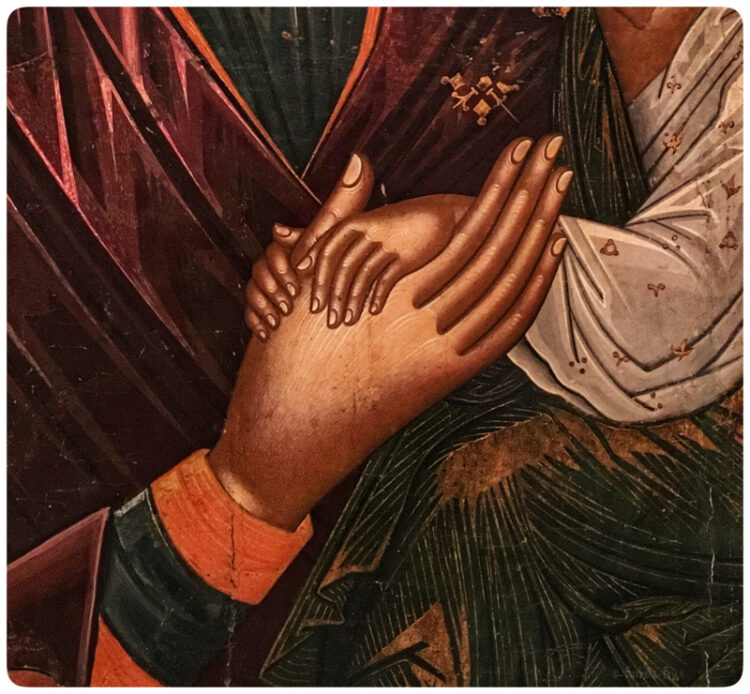
Detail from Icon in the Benaki Museum – Greece 2017
St. Luke 2: 22-40 describes the Feast of the Presentation of the Infant Jesus Into the Temple. (February 15/2)
When Jesus was forty days old, the Virgin Mary and St. Joseph the Betrothed brought Christ to the temple, in order to fulfill the law and dedicate Him to God.
The Orthodox Christian tradition of Churching a mother on her return to church with her child for a blessing, 40 days after the birth of the baby, comes from the Jewish rite observed in this feast.
One of the many beautiful hymns written by 9th Century female saint, St. Kassiani:
“How can I hold Thee as a Child,
Thou, who holdest everything together?
How do I bring Thee to the temple,
Thou, who art beyond goodness?
How do I deliver Thee into the arms of the elder,
Thou, who sitteth in the bosom of the Father?
How dost Thou endure purification,
Thou, who purifieth the whole corrupt nature?”
So sayeth the Virgin, the temple, who containeth God –
Marvelling at Thy great condescension, O Christ.
Since 450 AD, church candles are also blessed on this day, because of elder St. Simeon’s reference to Christ as a Light of revelation to the Gentiles. (Candlemas)
St. Brigid’s Cross woven with Rushes and photo by Irena
On February 14th/1st we celebrate St. Brigid of Ireland and St. Valentine.
Born in 451, St. Brigid (pronounced Bree-jyah in Gaelic) was the daughter of Dubtach, a pagan king. Brocca, her mother, was a Christian Pictish slave, baptized by St. Patrick himself.
Even as a child, Brigid noticed poverty and destitution. She responded by giving away her own and her family’s considerable possessions to people in need. This generosity did not meet with her father’s approval, who complained to a friend that his daughter was bankrupting the household. His friend answered, “Let her be… She has more virtue before God, than either you or I.”
Brigid followed her desire to be a nun and was tonsured by St. Mael, Bishop of Armagh, who was a nephew of St. Patrick.
She established a monastic community with several other young women, located under a large oak tree. It became known as the Church of the Oak (in Gaelic Cill-Dara)… sometimes she is called Brigid of Kildare.

The community grew in numbers, reputation and achievement. Brigid was the abbess, and continued her care for the poor, selling whatever she had to give them what they needed. People who lived in the area flocked to the monastery to receive medical help, food, and to pray with the nuns. They would often see the abbess out in the fields, tending to the community’s cattle. Brigid and the sisters cared for the local children and established schools for them. Others heard of these efforts, and before long, the abbess travelled Ireland to start schools, to oversee the building of hospitals, and encourage people in their faith… by her own steadfast, cheerful example.
When St. Brigid died in 525 AD, the nuns kept a fire burning in an enclosure at her Kildare convent. This fire burned for centuries, tended by the Sisters and did not burn out until 1220 AD. It was re-lit and burned for another 400 years.
Under Brigid’s direction, the monastery itself became an art school, where metal work and manuscript illumination (decoration of manuscript pages with coloured figures and designs) were taught. The products of this school included a Gospel book, famously beautiful for its harmony of colors and intricate designs. To some it almost seemed that this Book of Kildare must have been the work of angels… with humans merely copying the figures shown to them by the angels. Unfortunately, this book and many other Christian relics throughout the land were lost during King Henry VIII’s destruction and pillaging of holy sites.

St. Brigid’s association with fire and the closeness of her feast day to the Feast of the Meeting of our Lord in the Temple (also known as Candlemas), a day celebrating Christ as the Light Unto the Nations, links the two Feasts.
St. Brigid is also affectionately known as Bride, Bridey, or the Mary of the Gael. She is patroness of dairy maids, infants, midwives, blacksmiths, poets, nuns, and students.
Along with Saints Patrick and Columba (Columcille), she is also the patroness of Ireland. St. Brigid is usually depicted in icons as a nun with a Cross woven from rushes and with fire (a candle, lamp, or bowl of fire).
Here is a link to my simple folk song praising St. Brigid of Ireland.
It is said the origin of the St. Brigid’s cross came when she was called to the bedside of a dying pagan chieftain. While sitting with the dying man, St. Brigid picked up some rushes from the floor and began to weave them into a cross. The sick man asked her what she was doing, and St. Brigid told him of Jesus Christ. Before he died, the chieftain become a Christian.
How to make a St. Brigid Cross, woven from rushes.
As Christians, we are called to help provide for the poor and needy (not just during spells of cold weather).
May we acquire the gift to see Christ in every person, as St. Brigid did.
Cat caught napping amid ancient Church Ruins in Thyatira (Western Turkey) – 2004
In the New Testament Book of Acts, we meet Lydia of Thyatira who was a business woman and a seller of purple. She and her household had moved to Philippi and converted to Christianity after meeting the Apostle Paul. Acts 16:13-15;40. Further along in the Acts, we read of Paul and Silas’ miraculous release from a Philippi prison Acts 16:16-40. They returned to stay with Lydia and her family briefly, before continuing along their journey.
Thyatira was an ancient Greek city and important cloth trade centre famous for its dyeing facilities. Thousands of marine snails were collected and boiled for days in gigantic vats, producing vibrant purple pigment for fabric.
Since apostolic times, Thyatira had been home to a significant Christian church, and was mentioned as one of the Seven Churches in the Book of Revelation.
The Christian community continued there until 1922, when the city and surrounding areas were captured by the Turkish army resulting in the deaths and deportations of thousands of Christians. (Most of the deportees also died in harsh conditions.) A church in Thyatira, harbouring about five hundred souls seeking sanctuary, was set on fire. May God rest their souls with the saints!
No operational church or Christian community remains in Thyatira, and the official name for the city changed to Akhisar.
The grass withereth, the flower fadeth: but the word of our God shall stand for ever. ~ Isaiah 40:8
Jesus Christ the Pantocrator
Icon from St. Sophia Orthodox Church, Canada
Pantocrator from the Greek, means Ruler of the Universe. In this icon, Christ’s right Hand is raised in a blessing gesture and His left Hand holds a Gospel.
Gospel came from the Old English word godspel (long “o” sound) literally meaning good news. The first four books of the New Testament are written by the four evangelists (the bearers of good news) Sts. Matthew, Mark, Luke and John. The Gospels narrate our Lord’s teachings, His life, death and Resurrection. They invite us to believe Jesus Christ was born to save the world from sin, and help humanity to truly know God as a Father.
A favourite passage of mine:
And there are also many other things which Jesus did, the which, if they should be written every one, I suppose that even the world itself could not contain the books that should be written. Amen. ~ St. John 21:25