Whiter Than Snow

Behold, you delight in truth in the inward being, and you teach me wisdom in the secret heart. Purge me with hyssop, and I shall be clean; wash me, and I shall be whiter than snow. ~ Psalm 51: 6-7

Praise the Lord from the earth, you great sea creatures and all deeps, fire and hail, snow and mist, stormy wind fulfilling his word! ~ Psalm 148: 7-8

For as the rain and the snow come down from heaven and do not return there but water the earth, making it bring forth and sprout, giving seed to the sower and bread to the eater, so shall my word be that goes out from my mouth; it shall not return to me empty, but it shall accomplish that which I purpose, and shall succeed in the thing for which I sent it. For you shall go out in joy and be led forth in peace; the mountains and the hills before you shall break forth into singing, and all the trees of the field shall clap their hands. ~ Isaiah 55: 10-12

A word fitly spoken is like apples of gold in a setting of silver. Like a gold ring or an ornament of gold is a wise reprover to a listening ear. Like the cold of snow in the time of harvest is a faithful messenger to those who send him; he refreshes the soul of his masters. ~ Proverbs 25: 11-13

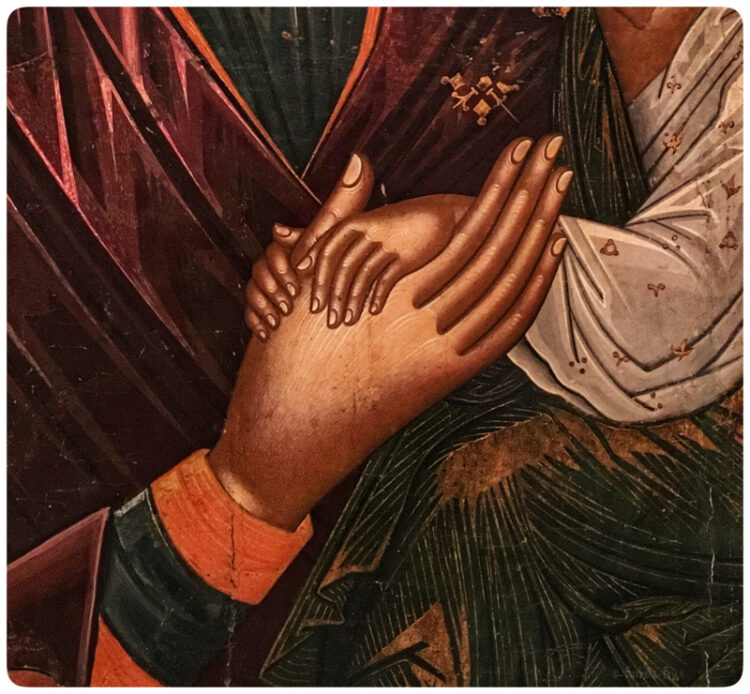
How Can I Hold Thee?

Detail from Icon in the Benaki Museum – Greece 2017

St. Luke 2: 22-40 describes the Feast of the Presentation of the Infant Jesus Into the Temple. (February 15/2)

When Jesus was forty days old, the Virgin Mary and St. Joseph the Betrothed brought Christ to the temple, in order to fulfill the law and dedicate Him to God. 

The Orthodox Christian tradition of Churching a mother on her return to church with her child for a blessing, 40 days after the birth of the baby, comes from the Jewish rite observed in this feast. 

One of the many beautiful hymns written by 9th Century female saint, St. Kassiani:

How can I hold Thee as a Child,
Thou, who holdest everything together?
How do I bring Thee to the temple,
Thou, who art beyond goodness?
How do I deliver Thee into the arms of the elder,
Thou, who sitteth in the bosom of the Father?
How dost Thou endure purification,
Thou, who purifieth the whole corrupt nature?”
So sayeth the Virgin, the temple, who containeth God –
Marvelling at Thy great condescension, O Christ.

Since 450 AD, church candles are also blessed on this day, because of elder St. Simeon’s reference to Christ as a Light of revelation to the Gentiles. (Candlemas)

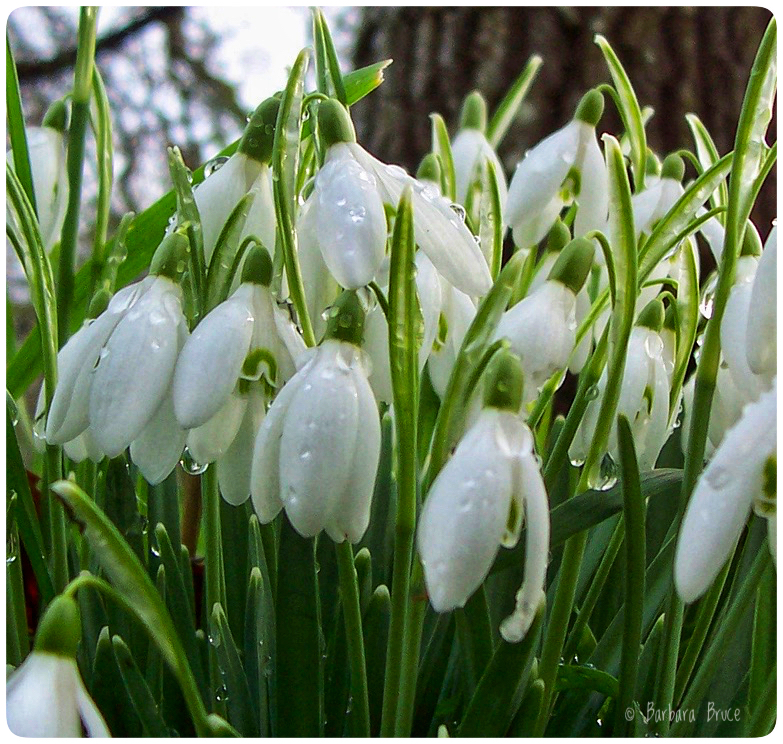
Snowdrops

Old English names for Snowdrop flowers are Christ’s Flowers, Purification Flowers, Candlemas Bells, and Fair Maids of February.

They are named as such, in honour of the great and ancient feast day of The Meeting of the Lord in the Temple! (February 15/2)

Frozen Fun

Perplexed Snowman with Lei

Just when the cherry blossom trees think it’s safe to nudge their sleepy little pink buds awake… it snows. Every February.

Beneath the sulking trees we made a snowman with the GG’s, and a dear friend shared her really cool artistic ice creations and how to make them! (((Thank you Vera)))

I put stuff in a flower pot saucer, add water and let it freeze. The temperature needs to stay at about -5 C for a couple of days at least. When frozen, I pop it out and … ta da!

Fire, and hail; snow, and vapour; stormy wind fulfilling his word. ~ Psalm 148:8

St. Brigid of Ireland

St. Brigid’s Cross woven with Rushes and photo by Irena

On February 14th/1st we celebrate St. Brigid of Ireland and St. Valentine.

Born in 451, St. Brigid (pronounced Bree-jyah in Gaelic) was the daughter of Dubtach, a pagan king. Brocca, her mother, was a Christian Pictish slave, baptized by St. Patrick himself.

Even as a child, Brigid noticed poverty and destitution. She responded by giving away her own and her family’s considerable possessions to people in need. This generosity did not meet with her father’s approval, who complained to a friend that his daughter was bankrupting the household. His friend answered, “Let her be… She has more virtue before God, than either you or I.”

Brigid followed her desire to be a nun and was tonsured by St. Mael, Bishop of Armagh, who was a nephew of St. Patrick.

She established a monastic community with several other young women, located under a large oak tree. It became known as the Church of the Oak (in Gaelic Cill-Dara)… sometimes she is called Brigid of Kildare.

The community grew in numbers, reputation and achievement. Brigid was the abbess, and continued her care for the poor, selling whatever she had to give them what they needed. People who lived in the area flocked to the monastery to receive medical help, food, and to pray with the nuns. They would often see the abbess out in the fields, tending to the community’s cattle. Brigid and the sisters cared for the local children and established schools for them. Others heard of these efforts, and before long, the abbess travelled Ireland to start schools, to oversee the building of hospitals, and encourage people in their faith… by her own steadfast, cheerful example. 

Under Brigid’s direction, the monastery itself became an art school, where metal work and manuscript illumination (decoration of manuscript pages with coloured figures and designs) were taught. The products of this school included a Gospel book, famously beautiful for its harmony of colors and intricate designs. To some it almost seemed that this Book of Kildare must have been the work of angels… with humans merely copying the figures shown to them by the angels. Unfortunately, this book and many other Christian relics throughout the land were lost during King Henry VIII’s destruction and pillaging of holy sites.

When St. Brigid died in 525 AD, the nuns kept a fire burning in an enclosure at her Kildare convent. This fire burned for centuries, tended by the Sisters and did not burn out until 1220 AD. It was re-lit and burned for another 400 years.

St. Brigid’s association with fire and the closeness of her feast day to the Feast of the Meeting of our Lord in the Temple (also known as Candlemas), a day celebrating Christ as the Light Unto the Nations, links the two Feasts. 

St. Brigid is also affectionately known as Bride, Bridey, or the Mary of the Gael. She is patroness of dairy maids, infants, midwives, blacksmiths, poets, nuns, and students.

Along with Saints Patrick and Columba (Columcille), she is also the patroness of Ireland. St. Brigid is usually depicted in icons as a nun with a Cross woven from rushes and with fire (a candle, lamp, or bowl of fire).

Here is a link to my simple folk song praising St. Brigid of Ireland.

It is said the origin of the St. Brigid’s cross came when she was called to the bedside of a dying pagan chieftain. While sitting with the dying man, St. Brigid picked up some rushes from the floor and began to weave them into a cross. The sick man asked her what she was doing, and St. Brigid told him of Jesus Christ. Before he died, the chieftain become a Christian.

How to make a St. Brigid Cross, woven from rushes.

As Christians, we are called to help provide for the poor and needy (not just during spells of cold weather).

May we acquire the gift to see Christ in every person, as St. Brigid did.

Thyatira

Cat caught napping amid ancient Church Ruins in Thyatira (Western Turkey) – 2004

In the New Testament Book of Acts, we meet Lydia of Thyatira who was a business woman and a seller of purple. She and her household had moved to Philippi and converted to Christianity after meeting the Apostle Paul. Acts 16:13-15;40. Further along in the Acts, we read of Paul and Silas’ miraculous release from a Philippi prison Acts 16:16-40. They returned to stay with Lydia and her family briefly, before continuing along their journey.

Thyatira was an ancient Greek city and important cloth trade centre famous for its dyeing facilities. Thousands of marine snails were collected and boiled for days in gigantic vats, producing vibrant purple pigment for fabric.

Since apostolic times, Thyatira had been home to a significant Christian church, and was mentioned as one of the Seven Churches in the Book of Revelation.

The Christian community continued there until 1922, when the city and surrounding areas were captured by the Turkish army resulting in the deaths and deportations of thousands of Christians. (Most of the deportees also died in harsh conditions.) A church in Thyatira, harbouring about five hundred souls seeking sanctuary, was set on fire. May God rest their souls with the saints!

No operational church or Christian community remains in Thyatira, and the official name for the city changed to Akhisar.

The grass withereth, the flower fadeth: but the word of our God shall stand for ever. ~ Isaiah 40:8

Uncontainable

Jesus Christ the Pantocrator

Icon from St. Sophia Orthodox Church, Canada

Pantocrator from the Greek, means Ruler of the Universe. In this icon, Christ’s right Hand is raised in a blessing gesture and His left Hand holds a Gospel.

Gospel came from the Old English word godspel (long “o” sound) literally meaning good news. The first four books of the New Testament are written by the four evangelists (the bearers of good news) Sts. Matthew, Mark, Luke and John. The Gospels narrate our Lord’s teachings, His life, death and Resurrection. They invite us to believe Jesus Christ was born to save the world from sin, and help humanity to truly know God as a Father.

A favourite passage of mine:

And there are also many other things which Jesus did, the which, if they should be written every one, I suppose that even the world itself could not contain the books that should be written. Amen. ~ St. John 21:25

Spiritual Dew

Scientifically speaking, dew is water vapour in air that condenses and collects on cool surfaces such as plants, soil and other ground coverings. (Think of a mirror in a steamy bathroom.) Dew point is the temperature which water vapour in the air becomes saturated and the condensation begins. Many kinds of flora and fauna rely on dew for healthy hydration. In some fields of natural medicine, dew is esteemed with a surprising range of internal and external healing properties.

Dew only forms under a clear sky. It won’t come if there are clouds, wind, or stormy weather. Dew is a silent blessing… a humbler version of rain. It is gentle and nourishing. It sustains. It energizes. It is as refreshing as God’s unconditional love.

I am reminded of a particular trip to a convent visiting my goddaughter. Around day number three, and not feeling well, I was introduced to an unusual idea (new to me, but touted widely), that bare feet can absorb dew’s health benefits directly into the immune system. The abbess suggested whether or not that was indeed the case, I should just try Dew Walking, barefoot on the grass; for its reviving effects alone… plenty enough reason in itself.

Next morning I slipped out from the guesthouse and removed my sandals. Standing on the grassy green and savoring its coolness, the rising sun beamed through the trees, emblazoning the field as with millions of diamonds. A small choir of birds trilled. There was a whiff of fragrant incense. Was it breath from the pores of tiny wildflowers and grasses, ascending in morning praise to God? I slowly passed through the pearl and diamond droplets which clung to clover, wildflowers and grass. I paused. With sun on my face and feet gently planted on the grass – I felt a strong sense of connectedness, of being rooted together with God’s creation. In my heart, I joined my breath with theirs, in a silent prayer of praise, thankful for this peaceful blessing, for this Spiritual Dew.

Many Scripture passages refer to the importance, blessings and miracles of dew. During the Exodus to the Promised Land, God miraculously feeds the Israelites with manna from heaven and dew every morning (Exodus 16:13-14; Numbers 11:9). There are the two miracles (Judges 6:36-40) in which Righteous Gideon asks God regarding a fleece, first that it should be wet with dew in the morning while everything around is dry, and then that it should be dry in the morning while everything around is wet with dew.

Unexpected and tranquil blessings of Spiritual Dew are gifts from the Holy Spirit. There is strength and power in blessed silence.

I heartily encourage you to try barefoot Dew Walking on a summer’s morning!

May we, with God’s help, be refreshed with Spiritual Dew in all things, with each other, and to His glory.

May God give you of the dew of heaven and of the fatness of the earth and plenty of grain and wine. ~ Genesis 27:28

May my teaching drop as the rain, my speech distill as the dew, like gentle rain upon the tender grass, and like showers upon the herb ~ Deuteronomy 32:2

Behold, how good and how pleasant it is for brethren to dwell together in unity! It is like the precious ointment upon the head, that ran down upon the beard,  even Aaron’s beard: that went down to the skirts of his garments; As the dew of Hermon, and as the dew that descended upon the mountains of Zion: for there the LORD commanded the blessing, even life for evermore. ~ Psalm 133: 1-3

Shine

What a beautiful day God has provided for us!

Arise, shine; for thy light is come, and the glory of the Lord is risen upon thee. ~ Isaiah 60:1

Make thy face to shine upon thy servant: save me for thy mercies’ sake. ~ Psalm 31:16

God be merciful unto us, and bless us; and cause his face to shine upon us; Selah. ~ Psalm 67:1

Give ear, O Shepherd of Israel, thou that leadest Joseph like a flock; thou that dwellest between the cherubims, shine forth. ~ Psalm 80:1

Turn us again, O God, and cause thy face to shine; and we shall be saved. ~ Psalm 80:3

Make thy face to shine upon thy servant; and teach me thy statutes. ~ Psalm 119:135

But the path of the just is as the shining light, that shineth more and more unto the perfect day. ~Proverbs 4:18

Every good gift and every perfect gift is from above, and cometh down from the Father of lights, with whom is no variableness, neither shadow of turning. ~ James 1:17

Before the dawn, Mary and the women came and found the stone rolled away from the tomb. They heard the angelic voice: “Why do you seek among the dead as a man the One who is Everlasting Light? Behold the clothes in the grave! Go and proclaim to the world: The Lord is risen!” He has slain death, as He is the Son of God, saving the race of men. ~ Paschal Hypakoe

Shine! Shine! O New Jerusalem! The Glory of the Lord has shone on you! Exalt now and be glad, O Zion! Be radiant, O Pure Theotokos, in the Resurrection of your Son! ~ Paschal Hymn to the Theotokos

Concerning Bubbles

Bubbulsh: A toddler’s pronunciation of Bubbles.

Bubbles: A short-lived, transient phenomenon, as seen in feature photo.

Bubbles during these times: A small group of people with whom one solely has close social or physical contact. Bubbles are now “exclusive” in the sense of once we’re in one, we can’t form new bubbles.

Before COVID, we already existed in family, school, work, worship, or recreational bubbles… of all shapes and sizes, and for various lengths of time. Some bubbles were comfortable, others not so much.

One of my first experiences of a Daily Bubble was the Kitchen Table Bubble… grumpily eating breakfast cereal with another sibling before school. The way the teaspoon would annoyingly clank against their metal dental braces… or the way they would just breathe at me across the table. Not a morning person, I unknowingly made the Kitchen Table Bubble, unpleasant for everyone… including myself.

My first recollection of a Restrictive Bubble was the Blizzard Bubble… when my kid brother and I were snow-bound at our grandma’s. It felt like a month, but was only a couple of weeks. A no-nonsense, pious woman, her unique approach in resolving cabin-fever-fueled sibling scraps was by encouraging us with contests to memorize Psalms. The mercenary winner could receive anything from a penny to a nickel, depending on the accuracy of the recitation. With delusions of wealth and riches, my brother and I ended up with a combined total 27 cents, although we can still recite by heart most of what we learned – and that’s actually priceless!

Unfortunately, in between the Psalms, we also discovered how to use a Bible Concordance, learning how to creatively admonish one another using scriptural quotes, in childlike ways… and out of context.

Him (justifying a slushball to my mouth): “Leviticus 19:17.” (“Thou shalt not hate thy brother in thine heart.”)

Me (refusing to pass the pancake syrup): “Proverbs 25:16.” (Hast thou found honey? eat so much as is sufficient for thee, lest thou be filled therewith, and vomit it.”); Then, graciously passing said syrup: “Proverbs 25:21 -22.” (“If thine enemy be hungry, give him bread to eat; and if he be thirsty, give him water to drink: For thou shalt heap coals of fire upon his head, and the LORD shall reward thee.”)

Him (besting me): “Proverbs 25: 24” (“It is better to dwell in the corner of the housetop, than with a brawling woman and in a wide house.”)

I could go on, but you get the picture.

During this past year, the initial new household restrictions sometimes bestowed joy and blessings. Families who could make it positive, spent extra quality time together… such as playing board games, or doing communal projects and hobbies.

Many acquired new skills! Some examples shared with me are friends and family who have taken up new crafts like knitting, painting, baking, and learning how to sing Somewhere Over the Rainbow in Klingon, on a ukulele.

Sometimes when we’re stuck inside a bubble for quite awhile, it feels like we’re going to pop.

When we forget to look up, we miss the light that make our temporary bubbles beautiful and iridescent… our small spheres become distressingly dull and nitpicky. Loved ones’ Foibles may seem to have duly earned the right to be spelled with a “capital F”.

Husband: “Did you know you always sniff once upon entering any room?”

Wife: “Did you know you always take three bites at a time when eating corn on the cob?”

I could go on, but you get the picture.

A wonderful passage which can be applied to anything, particularly Concerning Bubbles, is Colossians 3:12-16.

Therefore, as the elect of God, holy and beloved, put on tender mercies, kindness, humility, meekness, longsuffering; bearing with one another, and forgiving one another, if anyone has a complaint against another; even as Christ forgave you, so you also must do. But above all these things put on love, which is the bond of perfection. And let the peace of God rule in your hearts, to which also you were called in one body; and be thankful. Let the word of Christ dwell in you richly in all wisdom, teaching and admonishing one another in psalms and hymns and spiritual songs, singing with grace in your hearts to the Lord.

We may miss the opportunity of being with more family. We may miss our friends, and coming together to worship. This is good.

But, if not careful, it can become a downer if we let it. Sometimes we do. Forgiveness and love are the keys to Bubble Tranquility. Bubbles became what we make them… ranging from the ordinary to the extraordinary.

A dear, wise, priest rightly encourages us to remember, “This is just for now.”

error: Content is protected !!