Love

Sunrise on Golden Sand – Hawaii 2008

A new commandment I give unto you, That ye love one another; as I have loved you, that ye also love one another. By this shall all men know that ye are my disciples, if ye have love one to another. ~ John 13:34-35

Now hope does not disappoint, because the love of God has been poured out in our hearts by the Holy Spirit who was given to us. ~ Romans 5:5

God loves us more than a father, mother, friend, or any else could love, and even more than we are able to love ourselves. ~ St. John Chrysostom

What is perfection in love? Love your enemies in such a way that you would desire to make them your brothers … For so did He love, Who hanging on the Cross, said ‘Father, forgive them, for they know not what they do.’ ~ St. Augustine of Hippo

If you find that there is no love in you, but you want to have it, then do deeds of love, even though you do them without love in the beginning. The Lord will see you desire and striving and will put love in your heart. ~ St. Ambrose of Optina

“Love covers a multitude of sins,” (I Pet. 4:8). That is, for love towards one’s neighbour, God forgives the sins of the one who loves. ~St. Theophan the Recluse

Do not ask for love from your neighbor, for if you ask and he does not respond, you will be troubled. Instead show your love for your neighbour and you will be at rest, and so will bring your neighbour to love. ~ St. Dorotheos of Gaza

You don’t become holy by fighting evil. Let evil be. Look towards Christ and that will save you. What makes a person saintly is love. ~ St. Porphyrios

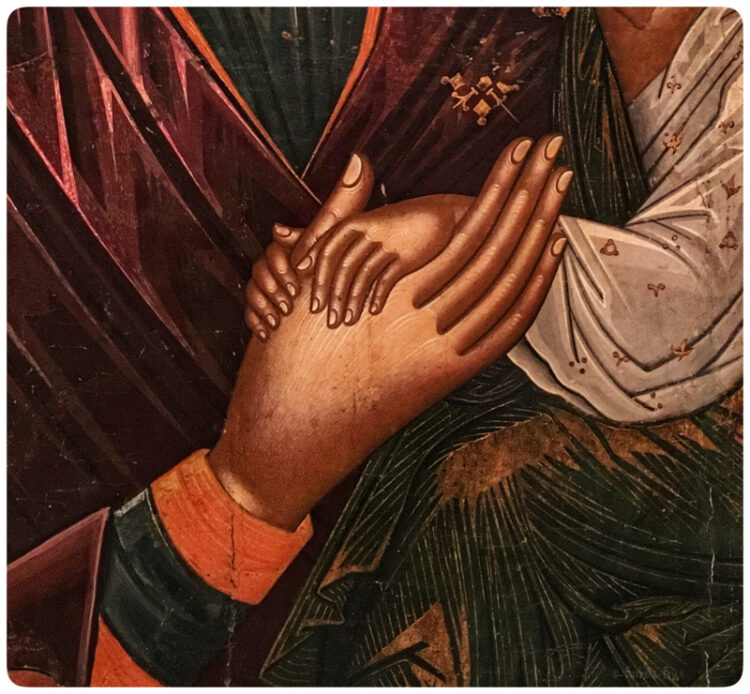
How Can I Hold Thee?

Detail from Icon in the Benaki Museum – Greece 2017

St. Luke 2: 22-40 describes the Feast of the Presentation of the Infant Jesus Into the Temple. (February 15/2)

When Jesus was forty days old, the Virgin Mary and St. Joseph the Betrothed brought Christ to the temple, in order to fulfill the law and dedicate Him to God. 

The Orthodox Christian tradition of Churching a mother on her return to church with her child for a blessing, 40 days after the birth of the baby, comes from the Jewish rite observed in this feast. 

One of the many beautiful hymns written by 9th Century female saint, St. Kassiani:

How can I hold Thee as a Child,
Thou, who holdest everything together?
How do I bring Thee to the temple,
Thou, who art beyond goodness?
How do I deliver Thee into the arms of the elder,
Thou, who sitteth in the bosom of the Father?
How dost Thou endure purification,
Thou, who purifieth the whole corrupt nature?”
So sayeth the Virgin, the temple, who containeth God –
Marvelling at Thy great condescension, O Christ.

Since 450 AD, church candles are also blessed on this day, because of elder St. Simeon’s reference to Christ as a Light of revelation to the Gentiles. (Candlemas)

St. Brigid of Ireland

St. Brigid’s Cross woven with Rushes and photo by Irena

On February 14th/1st we celebrate St. Brigid of Ireland and St. Valentine.

Born in 451, St. Brigid (pronounced Bree-jyah in Gaelic) was the daughter of Dubtach, a pagan king. Brocca, her mother, was a Christian Pictish slave, baptized by St. Patrick himself.

Even as a child, Brigid noticed poverty and destitution. She responded by giving away her own and her family’s considerable possessions to people in need. This generosity did not meet with her father’s approval, who complained to a friend that his daughter was bankrupting the household. His friend answered, “Let her be… She has more virtue before God, than either you or I.”

Brigid followed her desire to be a nun and was tonsured by St. Mael, Bishop of Armagh, who was a nephew of St. Patrick.

She established a monastic community with several other young women, located under a large oak tree. It became known as the Church of the Oak (in Gaelic Cill-Dara)… sometimes she is called Brigid of Kildare.

The community grew in numbers, reputation and achievement. Brigid was the abbess, and continued her care for the poor, selling whatever she had to give them what they needed. People who lived in the area flocked to the monastery to receive medical help, food, and to pray with the nuns. They would often see the abbess out in the fields, tending to the community’s cattle. Brigid and the sisters cared for the local children and established schools for them. Others heard of these efforts, and before long, the abbess travelled Ireland to start schools, to oversee the building of hospitals, and encourage people in their faith… by her own steadfast, cheerful example. 

Under Brigid’s direction, the monastery itself became an art school, where metal work and manuscript illumination (decoration of manuscript pages with coloured figures and designs) were taught. The products of this school included a Gospel book, famously beautiful for its harmony of colors and intricate designs. To some it almost seemed that this Book of Kildare must have been the work of angels… with humans merely copying the figures shown to them by the angels. Unfortunately, this book and many other Christian relics throughout the land were lost during King Henry VIII’s destruction and pillaging of holy sites.

When St. Brigid died in 525 AD, the nuns kept a fire burning in an enclosure at her Kildare convent. This fire burned for centuries, tended by the Sisters and did not burn out until 1220 AD. It was re-lit and burned for another 400 years.

St. Brigid’s association with fire and the closeness of her feast day to the Feast of the Meeting of our Lord in the Temple (also known as Candlemas), a day celebrating Christ as the Light Unto the Nations, links the two Feasts. 

St. Brigid is also affectionately known as Bride, Bridey, or the Mary of the Gael. She is patroness of dairy maids, infants, midwives, blacksmiths, poets, nuns, and students.

Along with Saints Patrick and Columba (Columcille), she is also the patroness of Ireland. St. Brigid is usually depicted in icons as a nun with a Cross woven from rushes and with fire (a candle, lamp, or bowl of fire).

Here is a link to my simple folk song praising St. Brigid of Ireland.

It is said the origin of the St. Brigid’s cross came when she was called to the bedside of a dying pagan chieftain. While sitting with the dying man, St. Brigid picked up some rushes from the floor and began to weave them into a cross. The sick man asked her what she was doing, and St. Brigid told him of Jesus Christ. Before he died, the chieftain become a Christian.

How to make a St. Brigid Cross, woven from rushes.

As Christians, we are called to help provide for the poor and needy (not just during spells of cold weather).

May we acquire the gift to see Christ in every person, as St. Brigid did.

Uncontainable

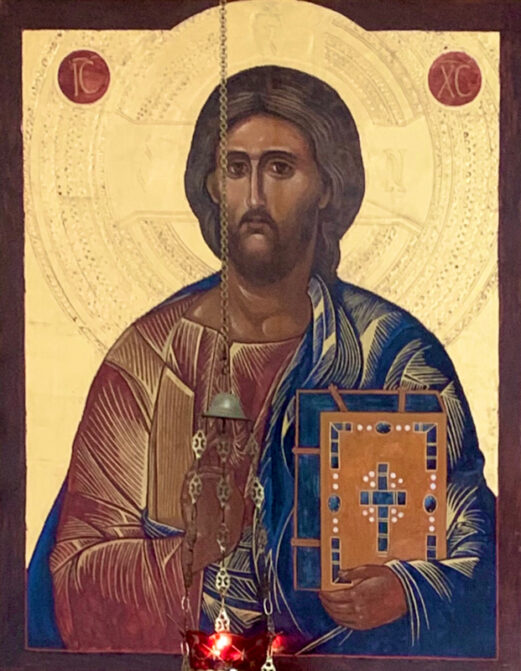
Jesus Christ the Pantocrator

Icon from St. Sophia Orthodox Church, Canada

Pantocrator from the Greek, means Ruler of the Universe. In this icon, Christ’s right Hand is raised in a blessing gesture and His left Hand holds a Gospel.

Gospel came from the Old English word godspel (long “o” sound) literally meaning good news. The first four books of the New Testament are written by the four evangelists (the bearers of good news) Sts. Matthew, Mark, Luke and John. The Gospels narrate our Lord’s teachings, His life, death and Resurrection. They invite us to believe Jesus Christ was born to save the world from sin, and help humanity to truly know God as a Father.

A favourite passage of mine:

And there are also many other things which Jesus did, the which, if they should be written every one, I suppose that even the world itself could not contain the books that should be written. Amen. ~ St. John 21:25

Theophany Greetings!

The Feast of the Theophany of Our Lord Jesus Christ is celebrated January 19/6. After Pascha and Pentecost, this is the next greatest Feast Day of the Orthodox Church.

Theophany means Manifestation of God, as Jesus Christ is God the Word, Incarnate.

When our Lord Jesus Christ is baptized by John in the River Jordan, Christ comes up from the water, the heavens open, and the Spirit of God descends like a dove upon Him. God’s voice from heaven proclaims, “This is My beloved Son, in Whom I am well pleased.” The Holy Trinity is revealed. God the Father, God the Son, and God the Holy Spirit shine forth...

In the Gospel of St. Matthew, chapter 3, verses 1-6, and 11; and verses 13-17, we stand on the banks of the River Jordan and watch this miracle occur.

In the Gospel of St. John, chapter 1: verses 32-34, we see St. John the Baptist bearing witness that Christ is the Son of God.

Theophany reminds us of our own Baptism, for “As many as have been baptized into Christ, have put on Christ, Alleluia!” In the waters of Baptism, we are washed clean from our old life, and we put on the new life in Jesus Christ.

Today is also the Blessing of the Waters.

The feature picture reminds me of a traditional festal family hike around some back lakes, many years ago after Liturgy, on Theophany. Music from the service remained with me… in particular… “The Voice of the Lord is upon the waters, the God of Glory thundered, the Lord is upon many waters. (Psalm 28:3)” Upon rounding a bend in the trail, we encountered the lake shrouded in a blanket of dense mist. A sudden shaft of sunlight pierced through illuminating everything. The swirling fog dissolved as if blown away by a great breath. This exquisite memory remains close to my heart. Each year when hearing said phrase at service, for a moment, I return to that peaceful place.

I believe all bodies of water are particularly blessed with a special beauty upon this feast day! 

Troparion of the Feast (Tone 1)

When Thou, O Lord, wast baptised in the Jordan, the worship of the Trinity was made manifest! For the voice of the Father bare witness unto Thee, calling Thee His beloved Son! And the Spirit, in the form of a dove, confirmed His word as steadfast and sure. O Christ our God, Who hast appeared and enlightened the world, glory to Thee!

Kontakion of the Feast (Tone 4)

Thou hast appeared today to the inhabited earth, and Thy Light, O Lord, hath been signed upon us, who hymn Thee with understanding: Thou hast come, Thou hast appeared, O Light Unapproachable!

Christ is Born! Glorify Him!

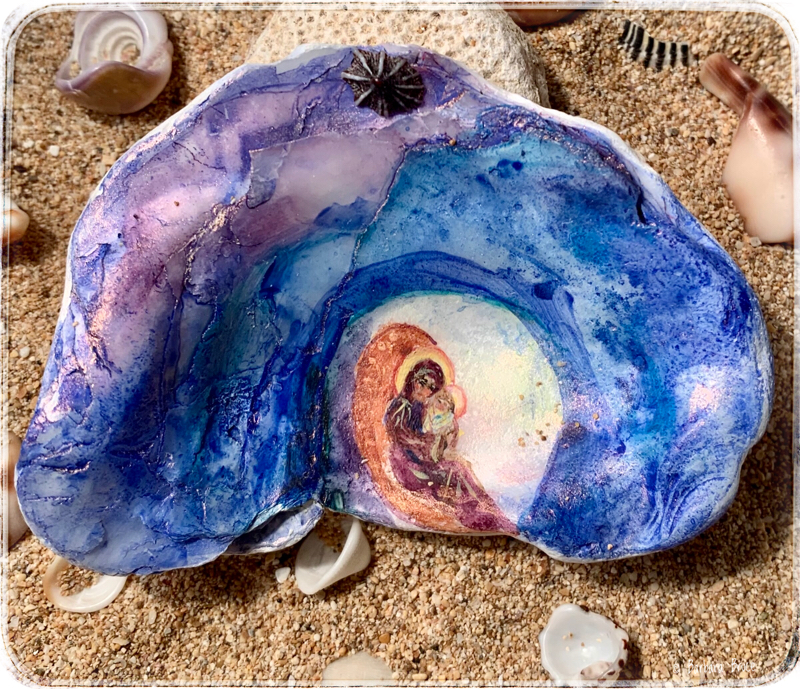
Nativity scene painted on an oyster shell, from a dear friend.

Today the Creator of Time – the Timeless One – the Unoriginate – has a Beginning.

Today – the Word becomes Incarnate.

Christ is Born! Glorify Him!

Greetings on the Joyous Feast of the Holy Nativity of Jesus Christ !

He was a Baby,
He was a Child,
So that you might be a
Perfect person;
He was wrapped
In swaddling clothes,
That you might be
Loosed from the snares of death;
He was in a manger,
That you might be
In the altar;
He was on earth,
That you might be
Among the stars.
He had no place at the inn,
That you might have
Many mansions in the Heavens.
~ St. Ambrose of Milan 339-397 A.D.

This day He who Is, is Born; and He
who Is becomes what He was not.
~ St. John Chrysostom 347-407 A.D.

Christ is born; Glorify Him! Christ comes from heaven; meet ye Him! Christ is on earth; be ye exalted! O all the earth, sing unto the Lord! And sing praises in gladness, O ye people, for He hath been glorified! ~ An ancient hymn composed by St. Gregory the Theologian (329 AD – 390 AD)

Greetings on this first day of Christmastide!

Faith, Strength, Endurance

Rugged Beauty of Church Floor Mosaics in Mystra, Greece – 2017

The Lord lives! Blessed and exalted be my God, the rock of my salvation ~ 2 Samuel 22:47

The Lord himself goes before you and will be with you; he will never leave you or forsake you. Do not be afraid; do not be discouraged. ~ Deuteronomy 31:8

But he that shall endure unto the end, the same shall be saved. ~ St. Matthew 24:13

I can do all things through Christ which strengtheneth me. ~Philippians 4:13

Believing IS Seeing

For with thee is the fountain of life: in thy light shall we see light. ~ Psalm 36:9

In a world where seeing is believing, it is through Faith we understand that believing is seeing.

Faith opens our spiritual eyes and ears. With awe and reverence, Faith is the beginning of wisdom, and it often comes before a miracle.

After the Resurrection of Christ, the (doubting) Apostle Thomas, absent at Christ’s previous visit to the other Apostles said, “Except I see in his hands the prints of the nails… I will not believe.” When Jesus came again, He invites Thomas to “reach hither and touch” and reproaches Thomas, “be not faithless, but believing.” (John 20:27)

My favourite part comes next. It’s powerful. It surpasses time. It’s a direct consolation from Christ to us, right here and right now… in today’s world, where seeing is believing.

Jesus blesses those who believe before they see: “blessed art they that have not seen, and yet have believed.” (John 20:29)

“I believe in Christianity as I believe that the Sun has risen, not only because I see it, but because by it I see everything else.” ~ C. S. Lewis

Sweetest Name

The book of St. Paul to the Philippians is full of spiritual yum yums and this is one of my favourite verses. His epistle describes daily hurdles Christians may experience and the victorious joy in overcoming these difficulties.

When life throws a kitchen sink in our path, duck, cover and carry on… knowing we have God’s help.

Lord Jesus Christ, have mercy on (fill in the blank)!

Here’s a wonderful quote from St. Anthony of Optina: “No matter what misfortune might befall you, no matter what unpleasantness might occur, say ‘I will endure this for Jesus Christ’s sake!’ Just say that, and you will feel better, for the Name of Jesus Christ is powerful… Before It, all difficulties abate, and demons disappear. Your annoyance and faintness of heart will abate when you repeat His most sweet Name…” 

Sharing this powerful prayer from a friend, whose priest gave it to them to use when anxiety over a constant painful situation would rear its ugly head:

“O Lord, Thou lovest (name) more than I do,
And Thou canst help (name) better than I,
And Thou knowest better than I what is profitable for (him)(her).
So do for (name) what is best- only save (him)(her).” 

This prayer is so helpful.

Glory to God for all things!

error: Content is protected !!