Nothing is Hidden

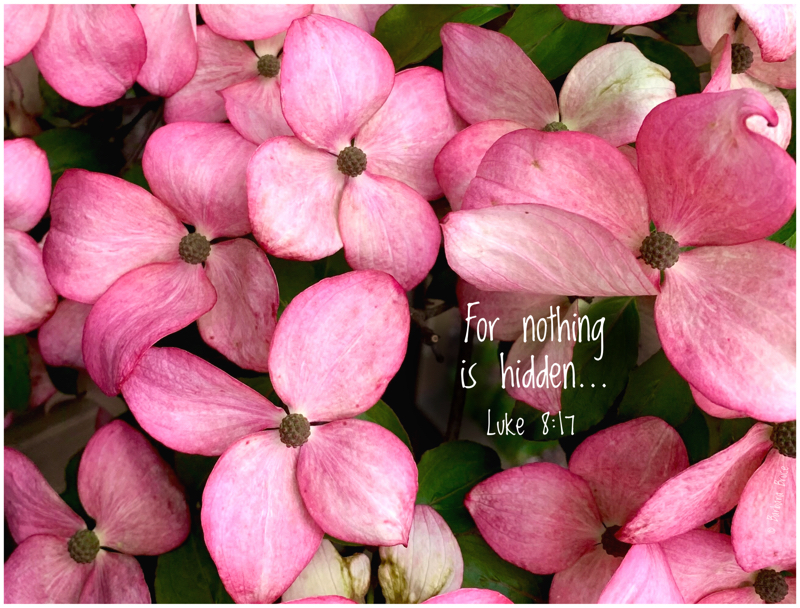
Pink Rosé Dogwood Tree Blossoms

For nothing is hidden that will not be made manifest, nor is anything secret that will not be known and come to light. ~ Luke 8:17

The wind bloweth where it listeth, and thou hearest the sound thereof, but canst not tell whence it cometh, and whither it goeth: so is every one that is born of the Spirit. ~ John 3:8

A few days ago, on the windy Post Feast, we took three (still amazingly fresh) floral Pentecost bouquets out to the cemetery.

The grassy gravesites were dotted with mantles of snow-white daisies and great golden dollops of buttercups. Purply-blue fields of floral confetti tangled with clover… and as quail, ravens and sparrows – scooted, soared and flitted nearby, the last line of the Creed came to mind: I look for the Resurrection of the dead, and the Life of the age to come. 

We stood where past, present and future are tightly entwined, for… He shall come again with glory, to judge the living and the dead; Whose Kingdom shall have no end…

Off to the side, and distracting my reverie, a pink dogwood tree’s blossomed boughs thrashed wildly to and fro in the gusty winds. Narrowing my eyes thoughtfully at it, I noted it was not at all like its more staid and demure counterpart… the white-flowered Pacific dogwood growing beside our church.

Once, during an Archbishop’s past parish visit and upon noticing the young dogwood sapling (official flower of BC, Canada) newly planted beside our church, he recounted how the dogwood tree had a long, Christian-themed history.

While some Biblical scholars assert Christ was crucified on a dogwood tree’s Cross, Orthodox Church tradition conveys that the Cross was made from three different types of wood: cedar, pine and cypress. Regardless, and depending on the country, dogwoods are often found planted on church grounds.

I’d like to share this unknown poet’s sweet poem called:

Legend of the Dogwood Tree

When Christ was on earth, the dogwood grew
To a towering size with a lovely hue.
Its branches were strong and interwoven
And for Christ’s cross its timbers were chosen
Being distressed at the use of the wood
Christ made a promise which still holds good:

“Not ever again shall the dogwood grow
To be large enough for a tree, and so
Slender and twisted it shall always be
With cross-shaped blossoms for all to see.
The petals shall have bloodstains marked brown
And in the blossom’s center a thorny crown.
All who see it will think of Me,
Nailed to a cross from a dogwood tree.
Protected and cherished this tree shall be
A reflection to all of My agony.”

Surprisingly, there are at least 60 species of Dogwood (Cornus) Trees, and they grow quite quickly. In Europe, Dogwood Trees were known as Whipple Trees. The origin of of the name Dogwood comes from the Scandinavian word dag meaning skewer, because the hardwood from this plant was traditionally used to make dags (daggers). Besides being used medicinally, it was used to fashion archery bows, and continues being used in woodworking today.

Dogwood flowers represent durability and ability to withstand various challenges in life. The white dogwood in particular, is symbolic of rebirth, purity and faith… Reminding us of Christ’s Holy Resurrection and the beginning of a new Life in Him.

I look for the Resurrection of the dead, and the Life of the age to come. 

The end part of the Creed reminds us death is not the end.

It’s a road we’ll all travel someday, and as Christians we look forward to beyond death, the resurrection of the dead, and life with God; Whose Kingdom shall have no end.

Which of course, is part of an even greater Mystery!

Much Fruit

Image by Michael Strobel from Pixabay 

Much effort and labour is needed, for a man to be changed and to be the good tree that brings forth fruit. Strive then, for nothing else but to change, renew, and correct yourself. And pray for this… ~ St. Tikhon of Zadonsk

An unfulfilled promise is like a tree without fruit. ~ St. Ambrose of Optina

A tree is known by its fruit; a man by his deeds. A good deed is never lost; he who sows courtesy reaps friendship; and he who sows kindness, gathers love. ~ St. Basil the Great

Verily, verily, I say unto you, Except a corn of wheat fall into the ground and die, it abideth alone: but if it die, it bringeth forth much fruit. ~ St. John 12:24

In Every Test

Cave Monastery in Bulgaria – Image by falco from Pixabay

If we always see God in our minds, and always remember Him, everything will appear tolerable to us. ~ St. John Chrysostom

Do not be anxious about anything, but in every situation, by prayer and petition, with thanksgiving, present your requests to God. ~ Philippians 4:6

In preparing for an upcoming parish fundraiser, some plans had changed. Feeling a bit apprehensive, I sent off revisions with (what I hoped to be) an encouraging response to the flurry of emails, and with a heavy sigh, signed off, “Love in Christ, m Barbara.”

Or – so I thought.

Actually, I’d signed off saying, Live in Christ, m Barbara”.

A note to self. Yes! Live in Christ! Quit sighing!

Guardian Angel had gently reminded- Everything’s in God’s Hands – not mine.

And those pesky, anxious, tummy butterflies?

Vamoosed!

In their hearts humans plan their course, but the Lord establishes their steps. ~ Proverbs 16:9

Live in Christ!

m Barbara

Sew Good

Image by Tamaa66 from Pixabay

Fathers and mothers: Go and lead your child by the hand into the church. ~ St. John Chrysostom

The primary goal in the education of children is to teach, and to give examples of a virtuous life. ~ St. John Chrysostom

The primary lesson for life must be implanted in the soul from the earliest age. The primary lesson for children is to know the eternal God, the One Who gives everlasting life. ~ St. Clement

When your children are still small, you have to help them understand what is good. That is the deepest meaning of life. ~ Elder Paisios

The innocence of young children is an enormous blessing, however… depending upon the child, adults should also be mindful that children’s pure, simplistic understandings and literal perceptions, may on occasion lead to misunderstanding.

I remember being very young – maybe around four, and first hearing the odd expression, You can’t make a silk purse out of a sow’s ear.

Already knowing silk was shiny, pigs were pink, and what a purse was… it came to pass, a few days after learning that a sow is a female pig… I watched in horror and fascination as my grandma began to sew (on her treadle of trauma) a shiny, pink satin, triangular pouch – for my toys.

Once upon a breakfast, she presented me with said pouch. I ungratefully took it (pincer-like), between thumb and forefinger, tore off to my bedroom and flung it into the depths of my closet of no return. Fifteen minutes later found me chomping contemplatively on a piece of toast with a couple side strips of bacon (that obviously grew on trees, like spaghetti), as I sat and pondered the demise of the poor, valiant, pig-girl who inadvertently became my toy-bag, now doomed forever to my closet… and silently vowed to never, ever, to use it or her.

Later, upon learning the real meaning of the 15th century silk purse/sow’s ear proverb, I promptly forgave my grandma and felt like a twit.

Children can and do indeed take things quite literally, and may – by adult standards, think the oddest things.

Two examples on “the literalness of kids” shared with me:

  1. How on one Thanksgiving, a three year watched her grandfather brandish the carving knife and fork, and about to slice into the turkey, cheerfully lilted in his thick Scottish brogue, “Well, now lassie, that’s one BIG BIRD!” She inexplicably burst into tears and wept inconsolably into her mashed potatoes, repeatedly sobbing,“Bee-Bee, Bee-Bee!” Finally, someone twigged that Bee-Bee was her pet name for Big Bird from Sesame Street and they all set her straight.
  2. How in a family of three siblings, when a four year old brother first heard that every third child born in the world is Chinese, was crushed to later learn that he wasn’t Asian, and just “child number three” in his family.

Although I learned to hand-sew well enough, and enjoy embroidery, I never mastered my grandma’s treadle sewing machine… nor the ornery electronic counterpart of it in my grade 8 Home Ec class. But, over the years, I’ve come across some really cool and countless allegorical sewing aphorisms.

Regarding tenacity… there’s an old Chinese proverb I love that says, Perseverance can reduce an iron rod to a sewing needle.

What a wonderful reminder that through steadfast efforts (and unexpected gifts of blessings), we may acquire various swatches, patterns, fabric, and other materials as needed… for tailoring, and repairing our spiritual Garments of Grace... Quite Literally, and – in a Good Way!

Good Deeds are Never Lost

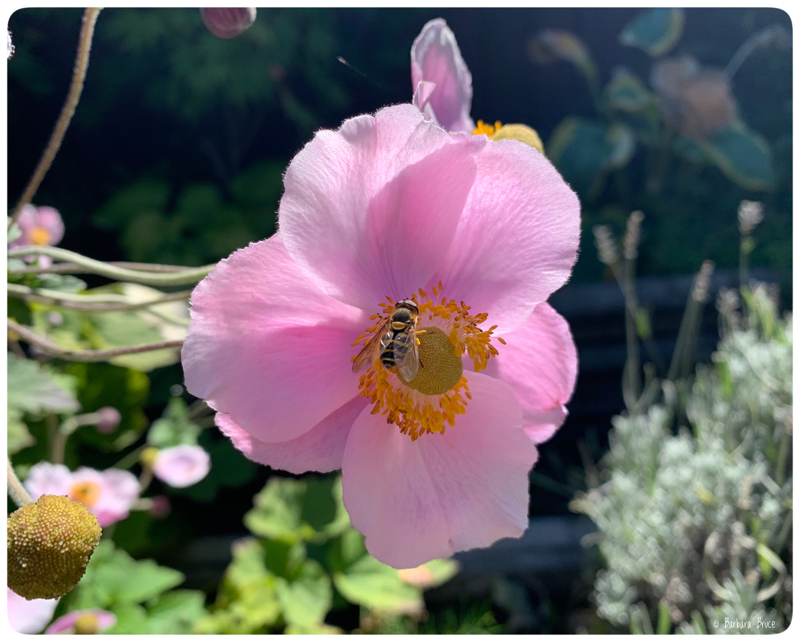
Japanese Anemone flower, a lovely and vigorous perennial that blooms late summer until first frost, providing a welcome splash of garden colour.

Gracious words are like a honeycomb, sweetness to the soul and health to the body. ~ Proverbs 16:24

A tree is known by its fruit; a man by his deeds. A good deed is never lost; he who sows courtesy reaps friendship, and he who plants kindness gathers love. ~ St. Basil the Great

Out and about on errands recently, we pulled into a shopping mall and parked outside a coffee shop. To save time, I nabbed the groceries while my husband picked up wine for dinner. When I returned to the car, my husband related how a street person gently approached him asking for spare change. He actually found several dollars worth of coin, handed it to the street person and asked him to accept it in memory of his deceased brother. The man nodded, took the coin, walked around the corner of the building – and returned several seconds later. A forgotten purse sat on an empty bistro table outside the cafe. He picked up the purse, took it into the coffee shop, handed it over to the barista, then quickly exited and continued on his way. May God help that honest man and reward his good deeds!

Excerpts from Everyman a late-15th-century English morality play. Called by Death, Everyman can persuade none of his friends – Beauty, Kindred, Worldly Goods – to go with him, except Good Deeds

Good Deeds: Everyman, I will bide with thee, I will not forsake thee indeed; Thou shalt find me a good friend at need.

Everyman: I see my time is nigh spent away. Take example, all ye that do hear or see, How they that I loved best do forsake me, Except my Good-Deeds that bideth truly.

Good-Deeds: All earthly things are but vanity: Beauty, Strength, and Discretion, do man forsake, Foolish friends and kinsmen, that fair spake, All fleeth save Good-Deeds, and that am I. 

Everyman: Heaven have mercy upon me, and stand by me!

Good-Deeds: Fear not, I will speak for thee. Short our end, and minish our pain; Let us go and never come again.

It’s not an abundance of words that supplicate God, but a pure soul which manifests good deeds. ~ St John Chrysostom

Almsgiving

Widow with the Two Mites – Mosaic, St. Sophia Orthodox Church, Canada

Jesus looked up and saw the rich putting their gifts into the offering box, and he saw a poor widow putting in two mites *. And he said, “Truly, I tell you, this poor widow has put in more than all of them. For they all contributed out of their abundance, but she out of her poverty put in all she had to live on. ~ St. Luke 21: 1-4. [* Mites, from the Greek lepta, meaning very small copper coins]

Almsgiving above all else requires money, but even this shines with a brighter luster when the alms are given from our poverty. The widow who paid in the two mites was poorer than any human, but she outdid them all. ~ St. John Chrysostom

Feeding the hungry is a greater work than raising the dead. ~ St. John Chrysostom

He who gives alms in imitation of God does not discriminate between the wicked and the virtuous, the just and the unjust, when providing for men’s bodily needs. ~ St. Maximos the Confessor 

Love the poor, and through them you will find mercy... If you give something to one in need, let the cheerfulness of your face precede your gift, and comfort his sorrow with kind words. When you do this, by your gift the gladness of his mind surpasses even the needs of his body. ~ St. Isaac the Syrian

The bread you do not use is the bread of the hungry. The garment hanging in your wardrobe is the garment of the person who is naked. The shoes you do not wear are the shoes of the one who is barefoot. The money you keep locked away is the money of the poor. The acts of charity you do not perform are the injustices you commit. ~ St. Basil the Great

Light

After Theophany, the days grow longer. Chirping robins return. Silver, furry catkins adorn bare branches. Fair Maids of Février poke up through cold earth. Everything is fresh and young again.

Each day, the Author of Life opens a blank new page for us to write on.

Isn’t is marvellous the unwritten pages of our daily deeds are already seen by Him as accomplished? Isn’t it amazing we retain the gift of free will to do as we choose on said pages? Isn’t it miraculous He loves us; regardless!?

Opening our self to God is Life. Allowing God to robe Himself within us suffuses our soul with Love and Light.

The Lord is my light and my salvation – whom then shall I fear? The Lord is the stronghold of my life – of whom shall I be afraid? ~Psalm 27:1

Thy word is a lamp for my feet, a light unto my path. ~ Psalm 119:105

Arise, shine, for your light has come, and the glory of the Lord rises upon you. ~ Isaiah 60:1

You are the light of the world. A town built on a hill cannot be hidden. Neither do people light a lamp and put it under a bowl. Instead they put it on its stand, and it gives light to everyone in the house. In the same way, let your light shine before others, that they may see your good deeds and glorify your Father in heaven. ~ St. Matthew 5:14 – 16

No one lights a lamp and puts it in a place where it will be hidden, or under a bowl. Instead they put it on its stand, so that those who come in may see the light. Your eye is the lamp of your body. When your eyes are healthy, your whole body also is full of light. But when they are unhealthy, your body also is full of darkness. See to it, then, that the light within you is not darkness. Therefore, if your whole body is full of light, and no part of it dark, it will be just as full of light as when a lamp shines its light on you. ~ St. Luke 11:33-36

The light shines in the darkness, and the darkness has not overcome it. ~ St.  John 1:5

When Jesus spoke again to the people, he said, “I am the light of the world. Whoever follows me will never walk in darkness, but will have the light of life.” ~ St. John 8:12

error: Content is protected !!