In the Midst of Them

For where two or three are gathered together in my name, there am I in the midst of them. ~ St. Matthew 18:20

Set our hearts on fire with love for You, O Christ our God, so that in its flame we may love You with all our heart, with all our mind, with all our soul and with all our strength, and our neighbours as ourselves, so that by keeping Your commandments we may glorify You, the giver of all good gifts. ~ A Prayer For Lighting a Candle

Our Time to Shine

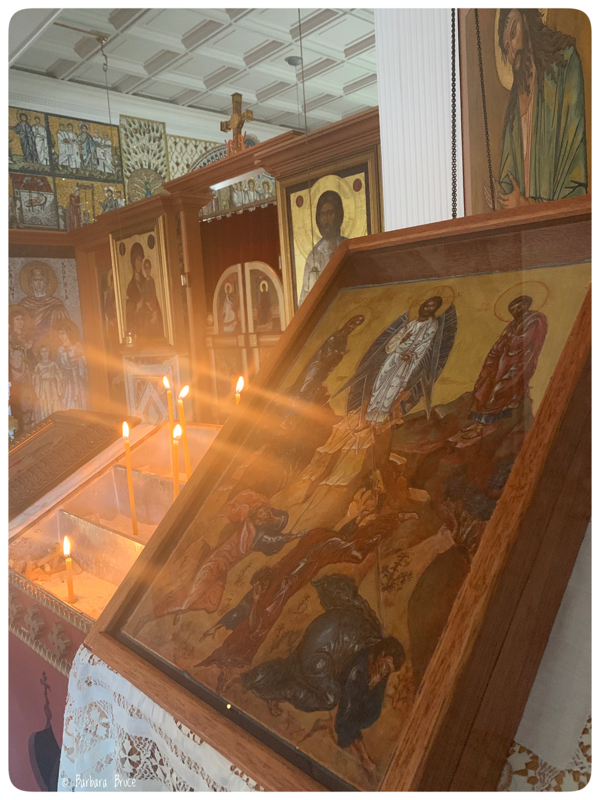
Radiant Candles beside the Transfiguration Feast Day Icon, from August 19/6.

A sweet custom when placing a candle in the sand after Crossing oneself, is to also make the sign of the Cross in the sand with the bottom of your candle, then place the candle in the centre of the Cross you have just traced.

If but ten among us lead a holy life, we shall kindle a fire which shall light up the entire city. ~ St. John Chrysostom

If from one burning lamp someone lights another, then another from that one, and so on in succession, he has light continuously. In the same way, through the Apostles ordaining their successors, and these successors ordaining others, and so on, the grace of the Holy Spirit is handed down through all generations and enlightens all who obey their shepherds and teachers. ~ St. Gregory Palamas

The candles lit before icons of saints reflect their ardent love for God for Whose sake they gave up everything that man prizes in life, including their very lives, as did the holy apostles, martyrs and others. These candles also mean that these saints are lamps burning for us and providing light for us by their own saintly living, their virtues and their ardent intercession for us before God through their constant prayers by day and night. The burning candles also stand for our ardent zeal and the sincere sacrifice we make out of reverence and gratitude to them for their solicitude on our behalf before God. ~ St. John of Kronstadt

When you look at the candles and lamps burning in church, rise in thought from the material fire to the immaterial fire of the Holy Ghost, ‘for our God is a consuming fire.’ When you see and smell the fragrant incense, rise in thought to the spiritual fragrance of the Holy Ghost, ‘for we are unto God a sweet savor of Christ.’ ~ St. John of Kronstadt

The candle you place before the Lord is a metaphor of the fire and light within your soul. Your whole life’s purpose is to intensify its warmth and illumination. ~ Fr. Vladimir Berzonsky

Because our faith is light.  Christ said: I am the light of the world (John 8:12).  The light of the vigil lamp reminds us of that light by which Christ illumines our souls. Just as the oil and wick burn in the vigil lamp, submissive to our will, so let our souls also burn with the flame of love in all our sufferings, always being submissive to God’s will. In order to teach us that just as the vigil lamp cannot be lit without our hand, so too, our heart, our inward vigil lamp, cannot be lit without the holy fire of God’s grace, even if it were to be filled with all the virtues. All these virtues of ours are, after all, like combustible material, but the fire which ignites them proceeds from God. In order to remind us that before anything else the Creator of the world created light, and after that everything else in order: And God said, let there be light: and there was light (Genesis 1:3).  And it must be so also at the beginning of our spiritual life, so that before anything else the light of Christ’s truth would shine within us.  From this light of Christ’s truth subsequently every good is created, springs up and grows in us. ~ St. Nikolai Velimirovic

Wings of Prayer

Faith in God is the wings of prayer. ~ St. Isaac the Syrian

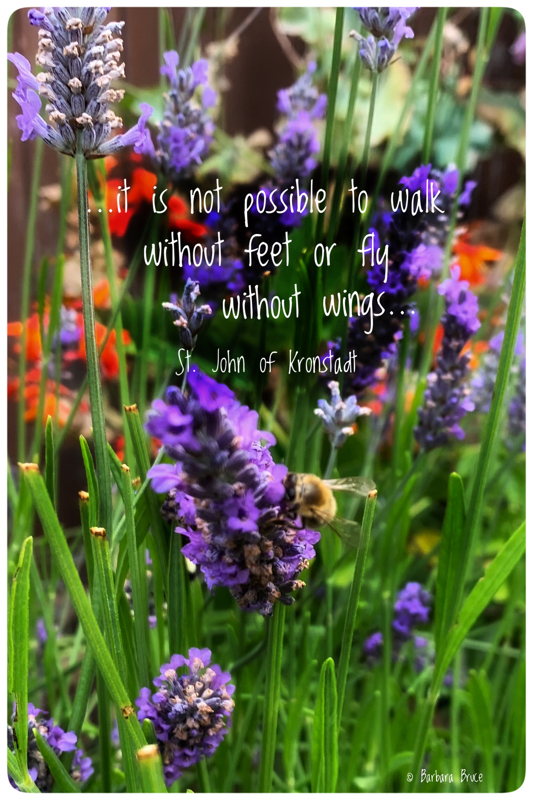
As it is not possible to walk without feet or fly without wings, so it is impossible to attain the Kingdom of Heaven without the fulfillment of the commandments. ~ St. Theophan the Recluse

A Christian needs two wings for flying and walking into heaven: humility and love. ~ St. Paisios

…For the bees do not visit every flower in the same manner, neither does the honeybee attempt to fly off bearing the burden of the entire flower. Rather, once it derives that which is needful from the flower, it leaves the rest behind and takes flight. ~ St. Basil the Great

Gracious words are like an honeycomb, sweetness to the soul and health to the body. ~ Proverbs 16:24

We all receive God’s blessings equally. But some of us, receiving God’s fire, that is, His word, become soft like beeswax, while the others like clay become hard as stone. And if we do not want Him, He does not force any of us, but like the sun He sends His rays and illuminates the whole world, and he who wants to see Him, sees Him, whereas the one who does not want to see, is not forced by Him. And no one is responsible for this privation of light except the one who does not want to have it. God created the sun and the eye. Man is free to receive the sun’s light or not. The same is true here. God sends the light of knowledge like rays to all, but He also gave us faith like an eye. The one who wants to receive knowledge through faith, keeps it by his works, and so God gives him more willingness, knowledge, and power. ~ St. Peter the Damascene, 8th century

Pentecost Greetings

Icon of the Holy Trinity St. Sophia Orthodox Church, Canada

Greetings on Great and Holy Pentecost!

Fifty days after Great and Holy Pascha, we celebrate the wonderful, joyful Great Feast of Pentecost. This important day commemorates the fulfillment of Christ’s promise to his disciples and the descent of the Holy Spirit upon them, and later…. on us. This day is often called the birthday of the Church. The disciples were gathered in prayer at Jerusalem, waiting as Christ had commanded… when a mighty wind was heard, and tongues of fire appeared over their heads. A multilingual crowd heard the disciples preaching about Christ… miraculously speaking to the multitudes in their various native languages.

Preparing for Pentecost, people clean and decorate their homes and icon corners with herbs and green tree branches, that symbolize rebirth of all life through the Holy Spirit.

Today Churches are decorated with flowers, and greenery. Fresh grasses and herbs are strewn on the floors. Everything is vibrant. Small floral bouquets are often held by the faithful at the Liturgy. Sometimes people take the flowers they held at church and afterwards place them in their home’s icon corner, or to the grave of a loved one, or give them to someone who is sick, or elderly.

The Holy Spirit is is the Giver of Life, and clergy wear green vestments in honour of the Holy Spirit. Parishioners also wear green or white in celebration.

It is also said to be traditionally (with a small “t”) windy at Pentecost, to remind us of Holy Spirit.

Today is the first of the Three Days of the Holy Spirit.

May you find and enjoy a delightful, refreshing breeze today!

The Holy Spirit is life and life, the noetic Source of life – the Spirit of wisdom, the Spirit of understanding, good upright, noetic, possessing dominion, cleansing transgressions: God and deifying, Fire and transcending fire, speaking, acting, distributing gifts, by Whom all the prophets and divine apostles and martyrs have been crowned. Strange is the report, strange is the sight – fire distributed in the bestowal of gifts. The Holy Spirit has always been, is now and ever shall be, having neither beginning nor end, but one with the Father and the Son: life and life giving; goodness itself and source of goodness, through Whom the Father is made known and the Son is glorified, and is known by all: one power, one unity, one worship, of the Holy Trinity. ~ Matins at Pentecost Vigil

…The closer we approach God, the closer we approach each other, just as the closer rays of light are to each other, the closer they are to the Sun. In the coming Kingdom of God there will be unity, mutual love and concord. The Holy Trinity remains eternally unchanging, all-perfect, united in essence and indivisible... The One, Indivisible Trinity ever remains the Trinity. The Father always remains the Father, the Son remains the Son, the Holy Spirit remains the Holy Spirit. Besides Their personal Properties, They all share all in common and in Unity. That is why the Holy Trinity is One God. ~ St. John Maximovitch of Shanghai and San Francisco

A Bow From the Heart

Absolutely nothing quenches the passions as much as compassion… If thou wilt endure an offensive word, then thou hast extinguished an ember. But if thou wilt think about it, then, like someone kindling a fire, thou wilt produce smoke, which is confusion. However, one can conveniently extinguish it too by silence, prayer and a bow from the heart. ~ Venerable Dorotheos of Gaza

Fragrance of Humility

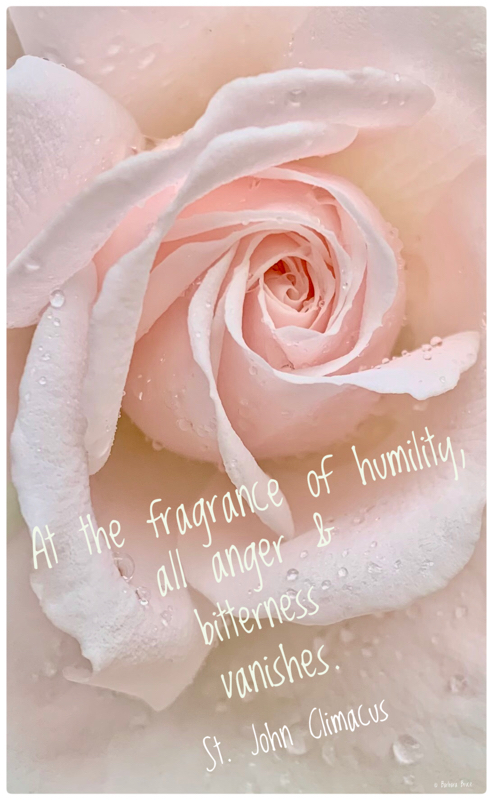
As with the appearance of light, darkness retreats; so, at the fragrance of humility, all anger and bitterness vanishes. ~ St. John Climacus

Humble-mindedness will bring all the virtues. ~ St. Anthimos of Chios 

What salt is for any food, humility is for every virtue… Not every quiet man is humble, but every humble man is quiet. ~ St Isaac the Syrian

God gives us His Grace, when we are humble… If the grace of God comes, everyone and everything changes; however, in order for it to come, we must humble ourselves first. ~ Elder Porphyrios

…reading and spiritual knowledge are good, but only when they lead to greater humility…  ~ St. Peter of Damaskos

God descends to the humble as waters flow down from the hills into the valleys. ~ St. John of Kronstadt

Meekness and humility of heart are virtues without which it is impossible to inherit the Heavenly Kingdom, to be happy on earth, or to experience inner calm. ~ St. Anthony of Optina

Seek God daily. But seek Him in your heart, not outside it. And when you find Him, stand with fear and trembling, like the Cherubim and the Seraphim, for your heart has become a throne of God. But in order to find God, become humble as dust before the Lord, for the Lord abhors the proud, whereas He visits those that are humble in heart, wherefore He says: “To whom will I look, but to him that is meek and humble in heart?~ St. Nektarios of Aegina

The Christian needs two wings in order to soar upward and attain Paradise: humility and love… Humility consists, not in condemning our conscience, but in recognizing God’s grace and compassion. ~ St. Kosmas Aitolos

The natural property of the lemon tree is such that it lifts its branches upwards when it has no fruit, but the more the branches bend down the more fruit they bear. Those who have the mind to understand will grasp the meaning of this. ~ St. John Climacus

Just as water and fire cannot be combined, so do self-justification and humility exclude one another.  ~ St. Mark the Ascetic

Whiter Than Snow

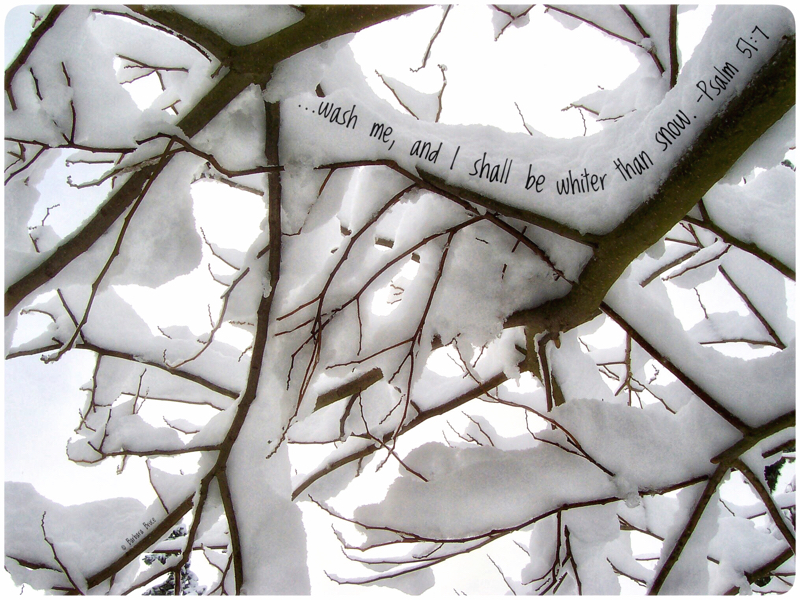
Behold, you delight in truth in the inward being, and you teach me wisdom in the secret heart. Purge me with hyssop, and I shall be clean; wash me, and I shall be whiter than snow. ~ Psalm 51: 6-7

Praise the Lord from the earth, you great sea creatures and all deeps, fire and hail, snow and mist, stormy wind fulfilling his word! ~ Psalm 148: 7-8

For as the rain and the snow come down from heaven and do not return there but water the earth, making it bring forth and sprout, giving seed to the sower and bread to the eater, so shall my word be that goes out from my mouth; it shall not return to me empty, but it shall accomplish that which I purpose, and shall succeed in the thing for which I sent it. For you shall go out in joy and be led forth in peace; the mountains and the hills before you shall break forth into singing, and all the trees of the field shall clap their hands. ~ Isaiah 55: 10-12

A word fitly spoken is like apples of gold in a setting of silver. Like a gold ring or an ornament of gold is a wise reprover to a listening ear. Like the cold of snow in the time of harvest is a faithful messenger to those who send him; he refreshes the soul of his masters. ~ Proverbs 25: 11-13

St. Brigid of Ireland

St. Brigid’s Cross woven with Rushes and photo by Irena

On February 14th/1st we celebrate St. Brigid of Ireland and St. Valentine.

Born in 451, St. Brigid (pronounced Bree-jyah in Gaelic) was the daughter of Dubtach, a pagan king. Brocca, her mother, was a Christian Pictish slave, baptized by St. Patrick himself.

Even as a child, Brigid noticed poverty and destitution. She responded by giving away her own and her family’s considerable possessions to people in need. This generosity did not meet with her father’s approval, who complained to a friend that his daughter was bankrupting the household. His friend answered, “Let her be… She has more virtue before God, than either you or I.”

Brigid followed her desire to be a nun and was tonsured by St. Mael, Bishop of Armagh, who was a nephew of St. Patrick.

She established a monastic community with several other young women, located under a large oak tree. It became known as the Church of the Oak (in Gaelic Cill-Dara)… sometimes she is called Brigid of Kildare.

The community grew in numbers, reputation and achievement. Brigid was the abbess, and continued her care for the poor, selling whatever she had to give them what they needed. People who lived in the area flocked to the monastery to receive medical help, food, and to pray with the nuns. They would often see the abbess out in the fields, tending to the community’s cattle. Brigid and the sisters cared for the local children and established schools for them. Others heard of these efforts, and before long, the abbess travelled Ireland to start schools, to oversee the building of hospitals, and encourage people in their faith… by her own steadfast, cheerful example. 

Under Brigid’s direction, the monastery itself became an art school, where metal work and manuscript illumination (decoration of manuscript pages with coloured figures and designs) were taught. The products of this school included a Gospel book, famously beautiful for its harmony of colors and intricate designs. To some it almost seemed that this Book of Kildare must have been the work of angels… with humans merely copying the figures shown to them by the angels. Unfortunately, this book and many other Christian relics throughout the land were lost during King Henry VIII’s destruction and pillaging of holy sites.

When St. Brigid died in 525 AD, the nuns kept a fire burning in an enclosure at her Kildare convent. This fire burned for centuries, tended by the Sisters and did not burn out until 1220 AD. It was re-lit and burned for another 400 years.

St. Brigid’s association with fire and the closeness of her feast day to the Feast of the Meeting of our Lord in the Temple (also known as Candlemas), a day celebrating Christ as the Light Unto the Nations, links the two Feasts. 

St. Brigid is also affectionately known as Bride, Bridey, or the Mary of the Gael. She is patroness of dairy maids, infants, midwives, blacksmiths, poets, nuns, and students.

Along with Saints Patrick and Columba (Columcille), she is also the patroness of Ireland. St. Brigid is usually depicted in icons as a nun with a Cross woven from rushes and with fire (a candle, lamp, or bowl of fire).

Here is a link to my simple folk song praising St. Brigid of Ireland.

It is said the origin of the St. Brigid’s cross came when she was called to the bedside of a dying pagan chieftain. While sitting with the dying man, St. Brigid picked up some rushes from the floor and began to weave them into a cross. The sick man asked her what she was doing, and St. Brigid told him of Jesus Christ. Before he died, the chieftain become a Christian.

How to make a St. Brigid Cross, woven from rushes.

As Christians, we are called to help provide for the poor and needy (not just during spells of cold weather).

May we acquire the gift to see Christ in every person, as St. Brigid did.

error: Content is protected !!