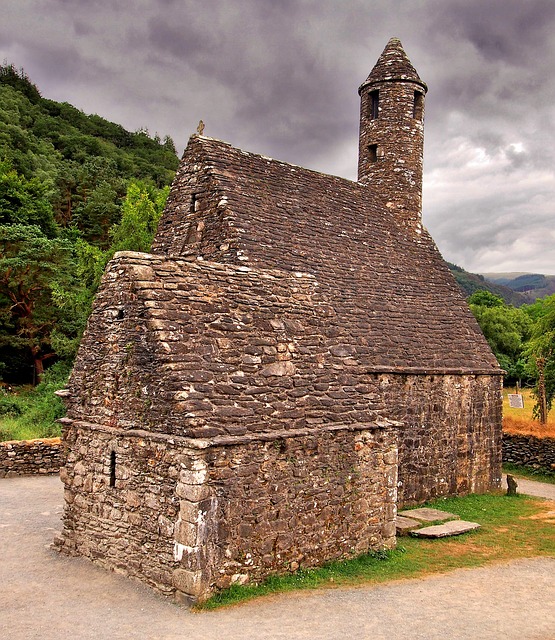
Gabhaim Molta Bríghde 

An Ancient Irish Chapel – Image by Josef Kotarba Pixabay

Gabhaim Molta Bríghde  (pronounced gaw-im molta breejya) means I Give Praise to St. Brigid.

Greetings on St. Brigid of Ireland’s Feast Day!

Along with St. Patrick, Holy St. Brigid is the Patroness and Protector of Ireland.

Here is a link to my simple folk song praising St. Brigid of Ireland.

The YouTube video below is a Gaelic Folk Song about St. Brigid, with an English Translation in the description section. The lineage of Gabhaim Molta Bríghde’s ancient, traditional melody and lyrics are from “unknown sources” however this arrangement of Sheet Music is sometimes attributed to Tomás Ó Flannghaile (Thomas Flannery), 1846-1916.

Gaelic with English Translation

Here is a fascinating article with excellent photos by Clare Monardo, describing An Exploration of the Holy Wells of St. Brigid. (What a wonderful pilgrimage this would make!)

A Gift of Hospitality – St. Brigid Abbess of Kildare.

On St. Brigid’s Day, it can be traditional to enjoy the Irish fare of oat bannocks, colcannon, barm brack, and perhaps a wee draught of beer.

How to make a St. Brigid Cross, woven from rushes. (Thank you for sharing your newly woven St. Brigid’s Rush Cross, Irena and Juliana!)

St. Brigid’s association with the miracles of fire and the closeness of her day to tomorrow’s Feast of the Meeting of our Lord in the Temple (also known as Candlemas), are closely linked.

On St. Brigid’s day, we celebrate Christ, the Light unto all Nations – the Eternal Spring Who draws nigh to all.

Troparion of Venerable Mother Brigid, Enlightener of Ireland (Tone 4): Instructed by the discourses of the holy Patrick, thou didst arrive at the utmost west, heralding the Orient which hath visited us from on high. Wherefore, we bless thee, O venerable mother Brigid, and cry out to thee: Pray thou in behalf of souls.

Kontakion of Venerable Mother Brigid, Enlightener of Ireland (Tone 6): Rejecting thy noble rank, and loving the godly monastic life, from the wood of the oak didst thou raise up a convent, the first in thy land; and having there united a multitude of nuns to God, thou didst teach the surrounding lands to cry to the Lord: Have mercy on us!

St. Brigid continues to bestow blessings upon those who come to her with faith, interceding with Christ our God, that He may have mercy on our souls.

Great-Martyr Katherine of Alexandria

Congratulations on your Saint’s Day Katherine, and Catherine! Memory Eternal Ekaterina.

Greetings on Great-Martyr Katherine’s feast day!

St. Katherine was the daughter of Constas, the governor of Alexandria in Egypt. She was a brilliant and avid scholar in philosophy, rhetoric, poetry, music, mathematics, astronomy, and medicine. 

During a visit by the Roman emperor, a huge pagan festival was held in his honour. However, Katherine protested the Christian persecutions and refused to offer sacrifice to the gods, declaring herself a bride of Christ, the One True God. The emperor decided that due to young Katherine’s societal status, intelligence and strong spirit, she should be ridiculed, being made an entertaining, public example, and proven wrong. His plans backfired.

Fifty of the region’s top orators and philosophers were summoned to mockingly debate the superiority of paganism versus Christianity. With her face glowing Divine Grace, and moved through the Power and Wisdom of the Holy Spirit, young Katherine eloquently defended the Christian faith. She victoriously converted hundreds in the audience… including all 50 orators, the emperor’s own wife, the emperor’s imperial advisor, and 200 soldiers. She and the group of new Christians were imprisoned and martyred around the year 305 AD.

St. Katherine’s body was taken by Angels to the highest peak of Mount Sinai, near where God appeared to Moses in the Burning Bush. Her holy relics are enshrined in the world’s oldest and continuously inhabited Christian monastery, which is over seventeen hundred years old.

Our St. Katherine Ring

Pilgrims to St. Katherine’s Monastery on Mt. Sinai are given remembrance rings that have been reverently placed on her holy relics, as a blessing. They are copied from the ring she still has on her hand, from Christ.

St. Katherine is a patron saint of students, scholars, philosophers, teachers, public speakers and librarians.

By the prayers of the most wise martyr Katherine, O Christ, enlighten the darkened eye of my soul, granting me a ray of thy splendour~ Excerpt from Canon to Great-Martyr Katherine

Morning Prayer of the Optina Elders

Christ is Risen!

O Lord, grant that I may meet all that this coming day brings to me with spiritual tranquility. Grant that I may fully surrender myself to Thy holy Will. At every hour of this day, direct and support me in all things. Whatsoever news may reach me in the course of the day, teach me to accept it with a calm soul and the firm conviction that all is subject to Thy Holy Will. Direct my thoughts and feelings in all my words and actions. In all unexpected occurrences, do not let me forget that all is sent down from Thee. Grant that I may deal straightforwardly and wisely with every member of my family, neither embarrassing nor saddening anyone. O Lord, grant me the strength to endure the fatigue of the coming day and all the events that take place during it. Direct my will and teach me to pray, to believe, to hope, to be patient, to forgive, and to love. Amen.

The Optina Elders are the Righteous Fathers of the Optina Monastery in Russia, who struggled valiantly in the monastic life of prayer, humility, obedience, and love. God granted them the gifts of discernment, prophecy, clairvoyance, and the grace to guide souls along the path of salvation.

They are Leo (who reposed in 1841), Macarius (1860), Moses (1862), Anthony (1865), Hilarion (1873), Ambrose (1891), Anatolius (1894), Isaacius (1894), Joseph (1911), Barsanuphius (1913), Anatolius (1922), Nectarius (1928), Nicon (1931), and Isaacius (1936).

Their beautiful prayer encompasses everyone’s potential daily encounters and experiences.

Truly He is Risen!

St. Brigid of Ireland

St. Brigid’s Cross woven with Rushes and photo by Irena

On February 14th/1st we celebrate St. Brigid of Ireland and St. Valentine.

Born in 451, St. Brigid (pronounced Bree-jyah in Gaelic) was the daughter of Dubtach, a pagan king. Brocca, her mother, was a Christian Pictish slave, baptized by St. Patrick himself.

Even as a child, Brigid noticed poverty and destitution. She responded by giving away her own and her family’s considerable possessions to people in need. This generosity did not meet with her father’s approval, who complained to a friend that his daughter was bankrupting the household. His friend answered, “Let her be… She has more virtue before God, than either you or I.”

Brigid followed her desire to be a nun and was tonsured by St. Mael, Bishop of Armagh, who was a nephew of St. Patrick.

She established a monastic community with several other young women, located under a large oak tree. It became known as the Church of the Oak (in Gaelic Cill-Dara)… sometimes she is called Brigid of Kildare.

The community grew in numbers, reputation and achievement. Brigid was the abbess, and continued her care for the poor, selling whatever she had to give them what they needed. People who lived in the area flocked to the monastery to receive medical help, food, and to pray with the nuns. They would often see the abbess out in the fields, tending to the community’s cattle. Brigid and the sisters cared for the local children and established schools for them. Others heard of these efforts, and before long, the abbess travelled Ireland to start schools, to oversee the building of hospitals, and encourage people in their faith… by her own steadfast, cheerful example. 

When St. Brigid died in 525 AD, the nuns kept a fire burning in an enclosure at her Kildare convent. This fire burned for centuries, tended by the Sisters and did not burn out until 1220 AD. It was re-lit and burned for another 400 years.

Under Brigid’s direction, the monastery itself became an art school, where metal work and manuscript illumination (decoration of manuscript pages with coloured figures and designs) were taught. The products of this school included a Gospel book, famously beautiful for its harmony of colors and intricate designs. To some it almost seemed that this Book of Kildare must have been the work of angels… with humans merely copying the figures shown to them by the angels. Unfortunately, this book and many other Christian relics throughout the land were lost during King Henry VIII’s destruction and pillaging of holy sites.

St. Brigid’s association with fire and the closeness of her feast day to the Feast of the Meeting of our Lord in the Temple (also known as Candlemas), a day celebrating Christ as the Light Unto the Nations, links the two Feasts. 

St. Brigid is also affectionately known as Bride, Bridey, or the Mary of the Gael. She is patroness of dairy maids, infants, midwives, blacksmiths, poets, nuns, and students.

Along with Saints Patrick and Columba (Columcille), she is also the patroness of Ireland. St. Brigid is usually depicted in icons as a nun with a Cross woven from rushes and with fire (a candle, lamp, or bowl of fire).

Here is a link to my simple folk song praising St. Brigid of Ireland.

It is said the origin of the St. Brigid’s cross came when she was called to the bedside of a dying pagan chieftain. While sitting with the dying man, St. Brigid picked up some rushes from the floor and began to weave them into a cross. The sick man asked her what she was doing, and St. Brigid told him of Jesus Christ. Before he died, the chieftain become a Christian.

How to make a St. Brigid Cross, woven from rushes.

As Christians, we are called to help provide for the poor and needy (not just during spells of cold weather).

May we acquire the gift to see Christ in every person, as St. Brigid did.

error: Content is protected !!