How Beautiful is the “Mystery“, the “Sacrament” of Tomorrow! ~ Gerontissa Gavrielia
If God does not leave a blade of grass, a flower, or a small leaf of a tree without His good providence, will He leave us? ~ St. John of Kronstadt, My Life in Christ
How Beautiful is the “Mystery“, the “Sacrament” of Tomorrow! ~ Gerontissa Gavrielia
If God does not leave a blade of grass, a flower, or a small leaf of a tree without His good providence, will He leave us? ~ St. John of Kronstadt, My Life in Christ
They spring up like flowers and wither away; like fleeting shadows, they do not endure. ~ Job 14:2
The grass withers and the flowers fall, but the word of our God endures forever. ~ Isaiah 40:8
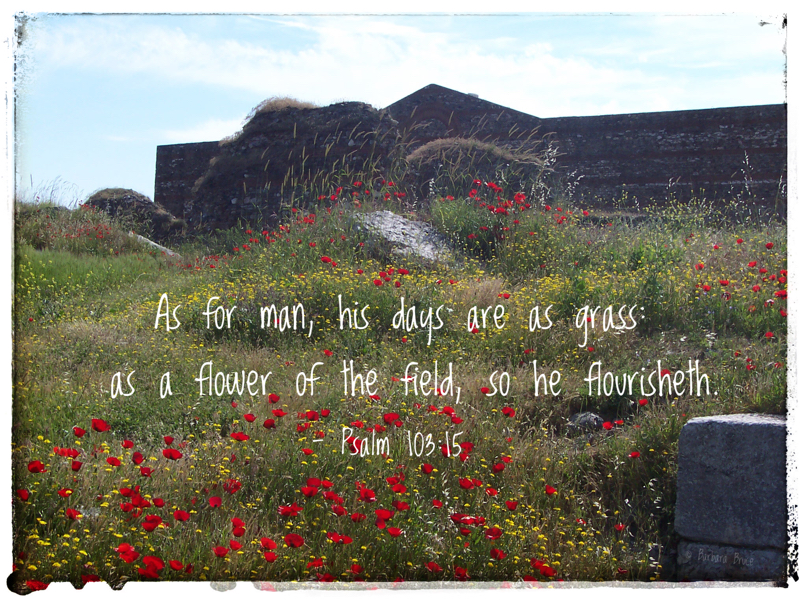
As for man, his days are like grass; he flourishes like a flower of the field; for the wind passes over it, and it is gone, and its place knows it no more. But the steadfast love of the Lord is from everlasting to everlasting on those who fear him, and his righteousness to children’s children, to those who keep his covenant and remember to do his commandments. The Lord has established his throne in the heavens, and his kingdom rules over all. ~ Psalm 103:15-19
In the beginning was the Word, and the Word was with God, and the Word was God. He was in the beginning with God. All things came into being through Him, and apart from Him not even one thing came into being that has come into being. In Him was life, and the life was the Light of mankind. ~ St. John 1:1-4
Fawn Lilies flourish in a local woodland.
And why take ye thought for raiment? Consider the lilies of the field, how they grow; they toil not, neither do they spin: And yet I say unto you, That even Solomon in all his glory was not arrayed like one of these. Wherefore, if God so clothe the grass of the field, which to day is, and to morrow is cast into the oven, shall he not much more clothe you, O ye of little faith? ~ St. Matthew 6:28-29
St. Brigid’s Cross woven with Rushes and photo by Irena
On February 14th/1st we celebrate St. Brigid of Ireland and St. Valentine.
Born in 451, St. Brigid (pronounced Bree-jyah in Gaelic) was the daughter of Dubtach, a pagan king. Brocca, her mother, was a Christian Pictish slave, baptized by St. Patrick himself.
Even as a child, Brigid noticed poverty and destitution. She responded by giving away her own and her family’s considerable possessions to people in need. This generosity did not meet with her father’s approval, who complained to a friend that his daughter was bankrupting the household. His friend answered, “Let her be… She has more virtue before God, than either you or I.”
Brigid followed her desire to be a nun and was tonsured by St. Mael, Bishop of Armagh, who was a nephew of St. Patrick.
She established a monastic community with several other young women, located under a large oak tree. It became known as the Church of the Oak (in Gaelic Cill-Dara)… sometimes she is called Brigid of Kildare.

The community grew in numbers, reputation and achievement. Brigid was the abbess, and continued her care for the poor, selling whatever she had to give them what they needed. People who lived in the area flocked to the monastery to receive medical help, food, and to pray with the nuns. They would often see the abbess out in the fields, tending to the community’s cattle. Brigid and the sisters cared for the local children and established schools for them. Others heard of these efforts, and before long, the abbess travelled Ireland to start schools, to oversee the building of hospitals, and encourage people in their faith… by her own steadfast, cheerful example.
When St. Brigid died in 525 AD, the nuns kept a fire burning in an enclosure at her Kildare convent. This fire burned for centuries, tended by the Sisters and did not burn out until 1220 AD. It was re-lit and burned for another 400 years.
Under Brigid’s direction, the monastery itself became an art school, where metal work and manuscript illumination (decoration of manuscript pages with coloured figures and designs) were taught. The products of this school included a Gospel book, famously beautiful for its harmony of colors and intricate designs. To some it almost seemed that this Book of Kildare must have been the work of angels… with humans merely copying the figures shown to them by the angels. Unfortunately, this book and many other Christian relics throughout the land were lost during King Henry VIII’s destruction and pillaging of holy sites.

St. Brigid’s association with fire and the closeness of her feast day to the Feast of the Meeting of our Lord in the Temple (also known as Candlemas), a day celebrating Christ as the Light Unto the Nations, links the two Feasts.
St. Brigid is also affectionately known as Bride, Bridey, or the Mary of the Gael. She is patroness of dairy maids, infants, midwives, blacksmiths, poets, nuns, and students.
Along with Saints Patrick and Columba (Columcille), she is also the patroness of Ireland. St. Brigid is usually depicted in icons as a nun with a Cross woven from rushes and with fire (a candle, lamp, or bowl of fire).
Here is a link to my simple folk song praising St. Brigid of Ireland.
It is said the origin of the St. Brigid’s cross came when she was called to the bedside of a dying pagan chieftain. While sitting with the dying man, St. Brigid picked up some rushes from the floor and began to weave them into a cross. The sick man asked her what she was doing, and St. Brigid told him of Jesus Christ. Before he died, the chieftain become a Christian.
How to make a St. Brigid Cross, woven from rushes.
As Christians, we are called to help provide for the poor and needy (not just during spells of cold weather).
May we acquire the gift to see Christ in every person, as St. Brigid did.
Cat caught napping amid ancient Church Ruins in Thyatira (Western Turkey) – 2004
In the New Testament Book of Acts, we meet Lydia of Thyatira who was a business woman and a seller of purple. She and her household had moved to Philippi and converted to Christianity after meeting the Apostle Paul. Acts 16:13-15;40. Further along in the Acts, we read of Paul and Silas’ miraculous release from a Philippi prison Acts 16:16-40. They returned to stay with Lydia and her family briefly, before continuing along their journey.
Thyatira was an ancient Greek city and important cloth trade centre famous for its dyeing facilities. Thousands of marine snails were collected and boiled for days in gigantic vats, producing vibrant purple pigment for fabric.
Since apostolic times, Thyatira had been home to a significant Christian church, and was mentioned as one of the Seven Churches in the Book of Revelation.
The Christian community continued there until 1922, when the city and surrounding areas were captured by the Turkish army resulting in the deaths and deportations of thousands of Christians. (Most of the deportees also died in harsh conditions.) A church in Thyatira, harbouring about five hundred souls seeking sanctuary, was set on fire. May God rest their souls with the saints!
No operational church or Christian community remains in Thyatira, and the official name for the city changed to Akhisar.
The grass withereth, the flower fadeth: but the word of our God shall stand for ever. ~ Isaiah 40:8
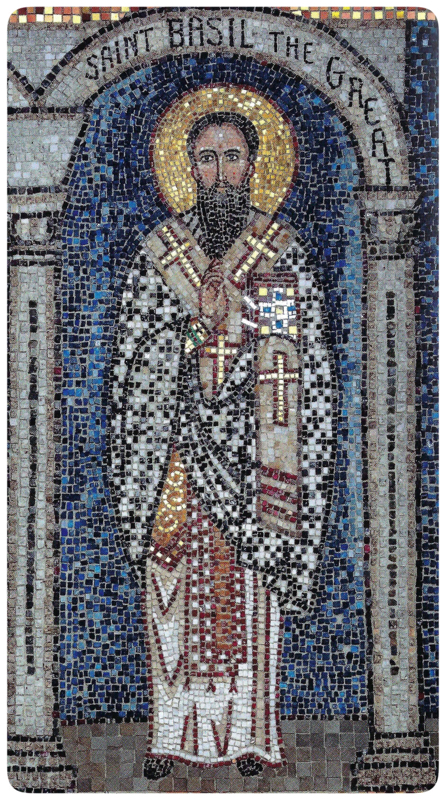
St. Basil the Great wall mosaic – St. Sophia Orthodox Church
Greetings on this second feast day which falls during Christmastide, celebrating the wonderful saint… St. Basil the Great!
Many bake the traditional cake in his honour!
Preserve gratitude like a precious deposit within your soul, and from it you will receive a double portion of delight. Remember the apostolic word, “Give thanks in all circumstances.” ~ St. Basil the Great
For if we all took only what was necessary to satisfy our own needs, giving the rest to those who lack, no one would be rich, no one would be poor, and no one would be in need. ~ St. Basil the Great
A tree is known by its fruit; a man by his deeds. A good deed is never lost; he who sows courtesy reaps friendship, and he who plants kindness gathers love. ~ St. Basil the Great
A good deed is never lost; he who sows courtesy reaps friendship, and he who plants kindness gathers love. ~ St. Basil the Great
When you sit down to eat, pray. When you eat bread, do so thanking Him for being so generous to you. If you drink wine, be mindful of Him who has given it to you for your pleasure and as a relief in sickness. When you dress, thank Him for His kindness in providing you with clothes. When you look at the sky and the beauty of the stars, throw yourself at God’s feet and adore Him who in His wisdom has arranged things in this way. Similarly, when the sun goes down and when it rises, when you are asleep or awake, give thanks to God, who created and arranged all things for your benefit, to have you know, love and praise their Creator. ~ St. Basil the Great
Human life is but of brief duration. ‘All flesh is grass, and all the goodliness thereof is as the flower of the field. The grass withers, the flower fades; but the word of our God shall stand forever’ (Isa. 40:6). Let us hold fast to the commandment that abides, and despise the unreality that passes away. ~ St. Basil the Great
Ruins of a synagogue in Western Turkey 2006