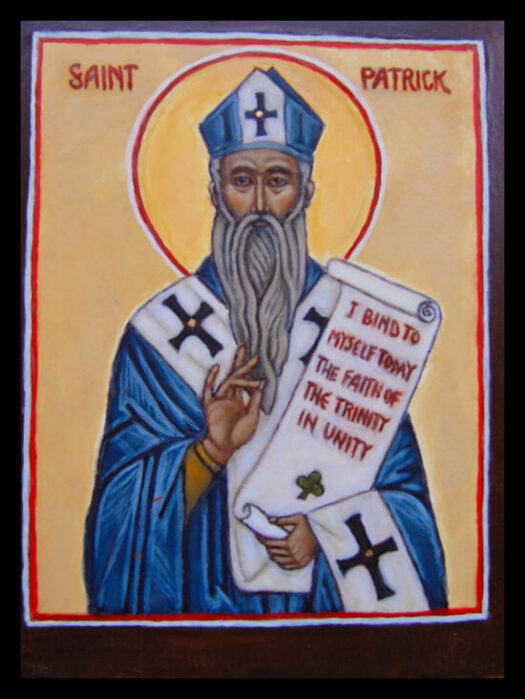
St. Patrick Enlightener of Ireland

Thank you Vera, for sharing the St. Patrick icon!

St. Patrick is so beloved and well-known, that I’m posting this today… for both calendars (March 17/March 30).

St. Patrick led an amazing life. Born in Scotland around the year 385 AD, he was the son of a deacon and the grandson of a priest. Patrick wasn’t particularly religious during his youth, but he lived a quiet life.

That all changed at the age of sixteen, when he was kidnapped by pirates raiding the British coast. Taken to Ireland and sold as a slave, Patrick spent the next six years as a herder on an isolated mountain.

Labouring in solitude, he remembered the faith of his youth, and turned to prayer, finding solace in God. Patrick had a vision revealing he would soon be free and that a ship would be waiting for him. An opportunity arose for his escape, and he fled… traveling many days on foot, until he reached the coast to find the ship from his vision, preparing to sail to Gaul (France).

St. Patrick studied for several years in a monastery under the holy Bishop Germanus. He was ordained a priest and eventually consecrated a bishop. St. Patrick had another vision, that the people in the land of his captors were calling him back to Eire. St. Patrick understood that this was to be his mission… he was to return to Ireland and help establish the Church there. He was one of several missionaries who arrived in Ireland around 432 AD. 

When asked to explain the mystery of the Holy Trinity in a simple manner, St. Patrick used a tiny shamrock (a low growing plant of the clover family) with its three lobed leaves on a single stem, to demonstrate how God the Father- God the Son- and God the Holy Spirit are the Holy Trinity; Three in One, One in Three… Undivided.

Lorica of St. Patrick sung by the GG’s (Abridged Version)

Once, during his travels, he destroyed an idol where human sacrifices would occur. This idol sat on a large rock. When the saint struck the idol with his crozier (bishop staff), the idol crumbled to dust, and the imprint of the crozier remained upon the rock.

As a bishop he faced many struggles and dangers, including hostility from those loyal to the pagan gods. With God’s help, St. Patrick worked through these obstacles while guiding his flock, and baptising new converts. St. Patrick prayed tirelessly, and continued his work of establishing churches and monasteries. It is said he chanted the entire Psalter every day.

His writings include several works of prayers, and letters. One of these prayers is well known as the Lorica (Breastplate) of St. Patrick… A prayer for protection.

During a perilous journey to share the Christian faith in King Loegaire’s territory, the saint discovered they were in mortal danger of an ambush. He prayed the Lorica Prayer, and to those lying in ambush, the saint and his company of monks appeared to them as if they were wild deer, and not humans. Because of this miracle, the Lorica Prayer is also known as The Deer’s Cry.

The early fifth century Enlightenment of Ireland by St. Patrick and his brethren, has been called the most successful single missionary venture in the history of the church.  

This post is collected from various sources over the years… and are but a smidgeon of the countless, wondrous, and miraculous events, regarding the life of St. Patrick, Enlightener of Ireland.

Today we also celebrate the 7th century British St. Owen of Lichfield.

St. Brigid of Ireland

St. Brigid’s Cross woven with Rushes and photo by Irena

On February 14th/1st we celebrate St. Brigid of Ireland and St. Valentine.

Born in 451, St. Brigid (pronounced Bree-jyah in Gaelic) was the daughter of Dubtach, a pagan king. Brocca, her mother, was a Christian Pictish slave, baptized by St. Patrick himself.

Even as a child, Brigid noticed poverty and destitution. She responded by giving away her own and her family’s considerable possessions to people in need. This generosity did not meet with her father’s approval, who complained to a friend that his daughter was bankrupting the household. His friend answered, “Let her be… She has more virtue before God, than either you or I.”

Brigid followed her desire to be a nun and was tonsured by St. Mael, Bishop of Armagh, who was a nephew of St. Patrick.

She established a monastic community with several other young women, located under a large oak tree. It became known as the Church of the Oak (in Gaelic Cill-Dara)… sometimes she is called Brigid of Kildare.

The community grew in numbers, reputation and achievement. Brigid was the abbess, and continued her care for the poor, selling whatever she had to give them what they needed. People who lived in the area flocked to the monastery to receive medical help, food, and to pray with the nuns. They would often see the abbess out in the fields, tending to the community’s cattle. Brigid and the sisters cared for the local children and established schools for them. Others heard of these efforts, and before long, the abbess travelled Ireland to start schools, to oversee the building of hospitals, and encourage people in their faith… by her own steadfast, cheerful example. 

Under Brigid’s direction, the monastery itself became an art school, where metal work and manuscript illumination (decoration of manuscript pages with coloured figures and designs) were taught. The products of this school included a Gospel book, famously beautiful for its harmony of colors and intricate designs. To some it almost seemed that this Book of Kildare must have been the work of angels… with humans merely copying the figures shown to them by the angels. Unfortunately, this book and many other Christian relics throughout the land were lost during King Henry VIII’s destruction and pillaging of holy sites.

When St. Brigid died in 525 AD, the nuns kept a fire burning in an enclosure at her Kildare convent. This fire burned for centuries, tended by the Sisters and did not burn out until 1220 AD. It was re-lit and burned for another 400 years.

St. Brigid’s association with fire and the closeness of her feast day to the Feast of the Meeting of our Lord in the Temple (also known as Candlemas), a day celebrating Christ as the Light Unto the Nations, links the two Feasts. 

St. Brigid is also affectionately known as Bride, Bridey, or the Mary of the Gael. She is patroness of dairy maids, infants, midwives, blacksmiths, poets, nuns, and students.

Along with Saints Patrick and Columba (Columcille), she is also the patroness of Ireland. St. Brigid is usually depicted in icons as a nun with a Cross woven from rushes and with fire (a candle, lamp, or bowl of fire).

Here is a link to my simple folk song praising St. Brigid of Ireland.

It is said the origin of the St. Brigid’s cross came when she was called to the bedside of a dying pagan chieftain. While sitting with the dying man, St. Brigid picked up some rushes from the floor and began to weave them into a cross. The sick man asked her what she was doing, and St. Brigid told him of Jesus Christ. Before he died, the chieftain become a Christian.

How to make a St. Brigid Cross, woven from rushes.

As Christians, we are called to help provide for the poor and needy (not just during spells of cold weather).

May we acquire the gift to see Christ in every person, as St. Brigid did.

A Shamrock Day

Regardless of it being March 30th on the civil calendar today, it’s also March 17th on the ancient Julian calendar – thus, St. Patrick Day again for some. 🙂

Icons of St. Patrick often show him holding a three-leafed shamrock growing on a single stem, he used this to illustrate the Holy Trinity – our One God in Three Persons.

St. Patrick wrote many hymns. Here is an excerpt from a beautiful, longer hymn, the Lorica (Breastplate) of St. Patrick. “I bind unto myself today, the Strong Name of the Trinity! By Invocation of the same, the Three in One, and One in Three!”   ~ St. Patrick

St. Patrick’s Lorica Hymn, sung by the GG’s (Abridged Version)

error: Content is protected !!